

 Preview
 Send
Send Share
Share
 Details
 Guide
Guide

 Download
 Similars
 X-Ray
X-Ray Diaporama
 Q&A
Q&A Stats
StatsThe Baptism

- 122.0 x 150.0 cm


 Read More
The artwork displayed on this page is protected by copyright law, which means we cannot legally create or sell an identical reproduction. This protection is enforced under international agreements such as the Berne Convention and by national laws, including those outlined by the U.S. Copyright Law - Title 17.
This method fully complies with copyright regulations because it does not involve copying or duplicating the protected artwork. Instead, it is a creative reinterpretation - a new painting that is influenced by the original but not identical to it.
Giclée / Art Print
Museum-quality giclée or canvas print with fast production and flexible finish options. ( Buy Hand Made Painting Switch to Digital Image)




P118B $10

P118H $10

P118W $10

P438Z $10

P508JH $12

P508YH $12

P805H $10

P805Z $10

P919BZ $10

P919G $10

P919XJ $10

P959ZH $10

P968JZ $12

W106C $8

W218G $10

W218JH $8

W218Y $10

W307PJ $10

W316G $10

W316PJ $8

W316Y $10

W398PJ $8

W4111J $10

W500HY $15

W500JH $15

W692G $12

W849H $8

W940BG $15

W953PJ $8




Pick from our preset sizes that match the artwork's original proportions.

Type the width and the height you need, to fit your frame or your wall. A print can only be cut, never made bigger than the picture, so a size with a different shape loses a part of the image. We send you a digital mockup to approve before we print anything. The picture shown on this page does not show the real cut — only the mockup does.
Worldwide Delivery () in 2 weeks instead of standard 4/5 weeks. (3 November)

Free Worldwide Express Shipping

High-Quality Linen Canvas

Full Shipping Insurance

Customs Tax Refund Guarantee

True Color Matching Guarantee

100-Day Return Policy (Defects Only)

100% Money-Back Guarantee

Bulk Discount Offer
 Glass option is only available in size under 110 CM

The Baptism
Giclée / Art Print
Reproduction Size
-


Total Price
$ 63
A Moment Frozen in Time
In The Baptism, Antonio Donghi achieves something truly extraordinary: he captures a fragment of middle-class life and suspends it in a state of eternal, quietude. The painting presents a family scene featuring three central figures, where a man in a suit and tie and a woman cradling a baby are set within a space that feels simultaneously real and profoundly abstract. There is a haunting quality to the composition; the individuals appear almost as immobile wax statues on a podium, their expressions neutral and strangely detached from the joyous occasion they are celebrating. This sense of emotional distance creates a tension between the sacred nature of the ritual and the stoic, almost frozen presence of the participants, as if they are waiting for a ritual photograph that will never quite capture their true essence.
< p>The atmosphere is charged with an unreal lack of familiarity, driven by an adamant painting style and a fixed, absorbed light that illuminates the scene with surgical precision. Donghi’s mastery lies in his ability to use light not just to reveal form, but to create a sense of mystery. The figures are set in a minimal environment that strips away the distractions of the modern world, leaving only the essential elements of the event. This deliberate reduction of detail allows the viewer to focus on the subtle interplay of texture and shadow, making the painting feel less like a mere depiction of an event and more like a dreamlike meditation on existence itself.The Artistry of Neoclassical Precision
Technically, The Baptism is a triumph of the Neoclassical movement, showcasing Donghi’s refined ability to marry meticulous detail with a powerful, structured composition. His attention to the clothing of the subjects—a skill perhaps inherited from his father, a fabric dealer—serves a deeper purpose than mere ornamentation; it functions as a way to socially characterize the roles of those portrayed. Every fold in the fabric and every sharp line in the attire contributes to the painting's sense of social order and permanence. The spatial clarity is remarkable, with each element occupying its place with absolute certainty, reminiscent of the architectural stability found in the works of Renaissance masters like Piero della Francesca.
For the discerning collector or interior designer, this work offers a unique aesthetic value. It possesses a Magical Realism that avoids the chaotic energy of much modern art, offering instead a sense of profound, meditative calm. The painting’s ability to evoke both the mundane and the monumental makes it a captivating centerpiece for any sophisticated space. Whether one is drawn to its smooth, polished surfaces or its enigmatic, quiet dignity, The Baptism stands as a testament to the power of stillness. It invites the observer to pause, to look closely, and to find beauty in the silent resonance of a single, captured moment.
Questions & Answers
From which era does "The Baptism" date?
"The Baptism" belongs to the Modern era.
How does "The Baptism" balance light and dark?
"The Baptism" by Antonio Donghi is recorded as shadow, with a dark luminance.
What level of contrast does "The Baptism" by Antonio Donghi show?
The contrast level of "The Baptism" by Antonio Donghi is balanced.
Related Artworks


Artist Biography
The Silent Resonance of Antonio Donghi
In the quietude of an Italian afternoon, where light rests heavily upon a simple vase or a solitary figure, one finds the soul of Antonio Donghi. Born in Rome in 1897, Donghi emerged as a master of the unseen, a painter capable of transforming the most mundane scenes of popular life into moments of profound, almost sacred, stillness. His journey began within the disciplined walls of the Instituto di Belle Arti, where he cultivated a technical precision that would become his lifelong signature. However, it was the turbulence of World War I that served as a crucible for his artistic identity; emerging from military service, Donghi sought refuge not in the chaotic abstractions of the burgeoning avant-garde, but in the enduring clarity of classical tradition and the serene landscapes of the Italian spirit.
As he wandered through the intellectual corridors of Florence and Venice, Donghi absorbed the gravity of the Renaissance masters. He found a spiritual kinship with the monumental simplicity of Piero della Francesca, whose influence is visible in the architectural stability and rhythmic poise of Donghi’s figures. This was not merely an imitation of the past, but a deliberate reconstruction of reality. His work became a cornerstone of the Neoclassical movement and the Valori Plastici circle, where he championed a return to "plastic values"—a focus on form, volume, and a certain archaic stiffness that lent his subjects a timeless, almost statuesque quality. To look upon a Donghi painting is to witness a world stripped of modern frenzy, replaced by a deliberate, meditative calm.
A Mastery of Light and Stillness
The brilliance of Donghi’s technique lies in his ability to marry the meticulous with the emotive. Critics of his era often drew comparisons to Georges Seurat and Henri Rousseau, noting how he could imbue contemporary scenes with a subtle, dreamlike humor and a sense of detachment. His compositions are characterized by an extraordinary spatial clarity; every element, from a stray petal in a still life to the distant contour of a Tuscan hill, occupies its place with absolute certainty. There is no ambiguity in his brushwork, only a refined execution that captures the soft glow of light as it interacts with texture and shadow.
His subject matter often revolved around the beauty of the everyday:
- Still Lifes: Simple arrangements of flowers or fruit, rendered with a disarming symmetry reminiscent of naive art.
- Genre Scenes: Depictions of laundresses, jugglers, and cafe patrons, where figures possess a quiet dignity and a certain cool, enigmatic distance.
- Landscapes: Precise, detailed views of the Italian countryside, particularly in northern Lazio, Umbria, and Tuscany, captured with an almost photographic devotion to detail.
Legacy and the Rediscovery of a Master
Despite his meteoric rise in the 1920s—marked by international acclaim and successful exhibitions in New York—Donghi’s career faced the inevitable ebb of shifting artistic tides. As the art world moved toward more aggressive and experimental modes of expression, his commitment to figurative clarity was occasionally dismissed as old-fashioned or out of touch with the post-war zeitgeist. For several decades, his name receded from the primary critical discourse, a period of relative obscurity that lasted until a profound reassessment by art historians in the 1980s.
Today, Antonio Donghi is celebrated not as a relic of the past, but as a visionary who found strength in stability. His ability to evoke Magical Realism through the lens of Italian Neoclassicism has secured his place in the pantheon of 20th-century masters. His works now reside in the most prestigious collections, including the National Gallery of Modern Art in Rome and the Palazzo Pitti in Florence, serving as a permanent testament to his ability to find the eternal within the ephemeral. He remains the quiet master, reminding us that there is immense power in the pause, and profound beauty in the simple act of looking.

Antonio Donghi
1897 - 1963 , Italy
Quick Facts
- Full Name: Antonio Donghi
- Nationality: Italian
- Date Of Birth: 1897
- Date Of Death: 1963
- Place Of Birth: Rome, Italy
- Notable Artworks:
- The Baptism
- Woman in a Cafe
- Artistic Movement Or Style: Neoclassical
- Artists Who Influenced This Artist:
- Henri Rousseau
- Georges Seurat
- Artists Or Movements Influenced By This Artist: ['Naive Art']
Related Articles

The Enduring Legacy of Family Portraiture: A Historical & Artistic Exploration
Explore the rich history of family portraiture with ArtsDot. Discover artistic styles, symbolism & collecting insights. Commission a custom oil painting or appraise your existing artwork today!

Mastering Harmony: The Top 25 Greatest Artworks by Raphael
Explore 25 iconic High Renaissance masterpieces by Raphael. Discover timeless beauty and museum-quality art on ArtsDot.com.
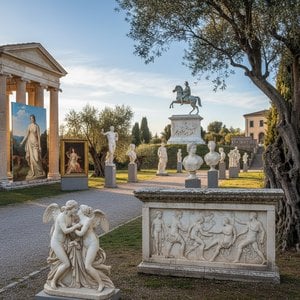
Neoclassical Art: 10 Masterpieces That Shaped History |
Explore 10 defining Neoclassical masterpieces by David, Ingres & Canova. Discover the history, symbolism & artistry behind these iconic paintings and sculptures. Find museum-quality art reproductions at – elevate your home with timeless beauty.

Capturing Light: The 25 Most Iconic Masterpieces by Claude Monet
Explore 25 iconic Claude Monet masterpieces and the magic of Impressionism. Discover the full collection online at ArtsDot.com.

Evolving Portraits: Personalized Art as a Chronicle of Family Life Across Generations
Create a timeless family legacy with custom portraits! ArtsDot connects you with skilled artists for heirloom-quality paintings & prints. Explore styles, commission your unique artwork today.
