

- 115.0 x 88.0 cm


The picture follows your choices: , .
Collectible Description
This stunning portrait by Andrea Appiani depicts General Louis Charles Antoine Desaix, a pivotal figure in Napoleon’s Italian campaign. Executed around 1800, it showcases Appiani's skill in capturing likeness and conveying dignity within a richly detailed neoclassical setting.
 Read More
Artist Biography
Andrea Appiani (1754-1817) was a leading Italian Neoclassical painter renowned for his elegant portraits, mythological frescoes & commissions from Napoleon. Explore masterpieces like 'Napoleon at Lodi' and the Rotonda of Monza!
Hand Made Oil Reproduction
Hand-painted oil on canvas in your size and frame, made to order by our artists. ( Switch to Print Switch to Digital Image)
More about this painting
 Preview
 Send
Send Share
Share
 Details
 Guide
Guide

 Download
 Similars
 X-Ray
X-Ray Diaporama
 Q&A
Q&A Stats
StatsOrder your painting in four simple steps
Take your time. You can change any answer; the price in your order card follows each choice.
1 Step one of four
Which size would you like?
These sizes keep the proportions of the original painting. The drawing shows your choice on a wall, above a two-metre sofa.
Or give your own measurements
Pick from our preset sizes that match the artwork's original proportions.

Type the width and the height you need, to fit your frame or your wall. This is hand-painted, so for a size with a different shape the artist can paint a bit more around the picture, or cut a bit — you choose. We send you a digital mockup to approve before the painting starts. The picture shown on this page does not show the real result — only the mockup does.
2 Step two of four
How should it be prepared: rolled, stretched or framed?
The prices below are for the size you chose in step one.
Choose the edges of the stretched canvas
Choose your frame

White $1

Blurside $1

Extended $1

P118B $10

P118H $10

P118W $10

P438Z $10

P508JH $12

P508YH $12

P805H $10

P805Z $10

P919BZ $10

P919G $10

P919XJ $10

P959ZH $10

P968JZ $12

W106C $8

W218G $10

W218JH $8

W218Y $10

W307PJ $10

W316G $10

W316PJ $8

W316Y $10

W398PJ $8

W4111J $10

W500HY $15

W500JH $15

W692G $12

W849H $8

W940BG $15

W953PJ $8

H24-GOLD $30

H24-SILVER $30

H36-GOLD $45

H36-SILVER $45
Framed
Moulding: . Overall size with the frame: .
3 Step three of four
Would you like anything changed in the painting?
Most people answer no. Because each painting is made by hand, our artist can also adapt it for you.
After order, ArtsDot.com team will email client for instructions and provide a mockup preview
4 Step four of four
A few finishing options
All of them are optional. The answers already selected cost nothing extra.
Who paints it?
Worldwide Delivery () in 3/4 weeks instead of standard 5 weeks. (3 November). No compromise on quality.
A nameplate, as in a museum?
Engraved Bronze Plaque Details
This elegant plaque features the artist's name and the title of the artwork, finely engraved for a timeless presentation.
It is made from bronze with a refined, elegant finish. The text is precisely laser-engraved for a sharp and permanent result. Measuring 9x2 cm, the plaque is compact yet easy to read. It's built to be durable and scratch-resistant, offering a professional, museum-quality look. Mounting is simple thanks to the included adhesive backing.
Transparent Acrylic Plaque Details
The plaque includes essential engraved details such as the artist's name, the title of the artwork, the date it was created, the type of media used-like oil on canvas or watercolor-a brief description of the piece, and a QR code that links to the complete artwork information.
It is crafted from clear acrylic, offering a sleek, modern appearance. The text is UV-engraved in black to ensure strong visual contrast. With a size of 10x15 cm, it ensures optimal readability. It comes equipped with two metal hooks for secure wall mounting. The plaque is designed to be weather-resistant, making it suitable for various environments, and it includes interactive features that work seamlessly with smartphone scanning.
Black Acrylic Plaque Details
This elegant plaque includes engraved information such as the artist's name, the title of the artwork, the date it was created, the type of media used (like oil on canvas or watercolor), a short description of the artwork, and a QR code for quick access to more information.
The plaque itself is made from refined black acrylic with a premium finish. The text is laser-engraved in white for high contrast and readability. Its size is 10x15 cm, designed to be easy to read. It comes with two metal hooks for professional mounting. The design is sleek and fits any interior style. It is also weather-resistant and durable, with built-in digital integration for mobile compatibility.
A protective varnish?
When do you need it?
✓ Check and order
Your painting, as you ordered it

General Desaix
Reproduction Medium
Reproduction Size
-

Elite Senior Artist
More detail, finesse, and extra production time
-

Reproduction Frame
-
-
For artworks or reproductions larger than 105 cm (approximately 41 inches) on any side, the frame will be shipped as a kit, disassembled. This method ensures safe delivery and prevents damage during transport.
Professional assembly required - this is not a DIY product.
The kit must be assembled and the canvas stretched by an experienced professional framer, using wood glue (not supplied), a canvas stretching plier and clamps to hold the bars square while the glue dries. Incorrect assembly or uneven canvas tension can permanently damage the artwork and is not covered by our warranty.
 For artworks or reproductions larger than 105 cm (approximately 41 inches) on any side, the frame will be shipped as a kit, disassembled. This method ensures safe delivery and prevents damage during transport.
All solid wood bars are included, precisely cut to size.
Assembled with the screws provided, plus wood glue for the corner joints, which is not supplied and must be sourced by your framer.
Professional tools are required and not included: a canvas stretching plier (tensioner) and clamps to hold the bars square while the glue dries.
Important:
The corner joints require wood glue, the bars must be held with clamps until the glue is fully dry, and tightening the canvas on the assembled frame requires a canvas stretching plier. None of these are included in the kit. Please arrange an experienced professional framer before ordering this size.

Nameplate
-
-

Protective Varnish
Glossy Varnish (enhances colors, protects against light/moisture)
-

Customize My Artwork
Examples of what can be changed: Replace face with customer photo; Add pet (e.g., replace cat with dog); Include hidden message in background; Change background landscape or elements.
-

Urgent
Worldwide Delivery () in 3/4 weeks instead of standard 5 weeks. (3 November). No compromise on quality.
-
Express Shipping
Worldwide Delivery () in 5 weeks. (10 November).
Included
Total Price
$ 263
Glass option is only available in size under 110 CM
Included with every order
- Free Worldwide Express Shipping
- High-Quality Linen Canvas
- Full Shipping Insurance
- Customs Tax Refund Guarantee
- True Color Matching Guarantee
- 100-Day Return Policy (Defects Only)
- 100% Money-Back Guarantee
- Bulk Discount Offer


Andrea Appiani’s “General Desaix”: A Portrait of Napoleonic Dignity
The painting "General Desaix" by Andrea Appiani stands as a testament to the Neoclassical style's preoccupation with idealized form and restrained emotion—a stylistic hallmark that perfectly encapsulates the spirit of Milan during Napoleon Bonaparte’s reign. Executed around 1800, this portrait transcends mere likeness; it aspires to convey not just physical appearance but also moral character and heroic stature, reflecting the values championed by the French Emperor.- Subject Matter: The artwork depicts General Louis Charles Antoine Desaix, a celebrated military commander who played an instrumental role in Napoleon’s decisive victory at Marengo in 1800—a pivotal moment securing Bonaparte's dominance over Italy.
- Style & Technique: Appiani employed meticulous oil painting techniques, prioritizing clarity and precision to achieve a polished surface finish. The artist skillfully utilized chiaroscuro – dramatic contrasts between light and shadow – to sculpt Desaix’s figure, emphasizing musculature and conveying an aura of strength and authority.
Historical Context: Milan Under Napoleonic Rule
Milan in 1800 was a city transformed by Napoleon's ambition. Appiani’s patronage reflects the Emperor’s desire to cultivate artistic excellence as a symbol of his regime’s grandeur and moral superiority. The painting embodies the Neoclassical ethos—a reaction against Rococo frivolity—which sought inspiration from classical antiquity, prioritizing reason and order alongside beauty. Bonaparte himself commissioned numerous artworks to bolster his image as a benevolent ruler and defender of liberty.Symbolism & Composition
The portrait’s composition is deliberately balanced, mirroring the disciplined ethos of Napoleonic France. Desaix stands confidently at center stage, gazing directly at the viewer—a gesture intended to instill respect and admiration. The mountainous backdrop subtly reinforces Desaix's stature as a warrior commanding respect and conveying resilience. Furthermore, Appiani’s careful attention to detail – from the folds of Desaix’s uniform to the subtle expression on his face – contributes to an overall impression of dignified composure.Emotional Impact & Legacy
“General Desaix” isn't merely a depiction; it’s an embodiment of heroic virtue and unwavering resolve. Appiani successfully captures the essence of Desaix’s character—a man who embodies courage, duty, and leadership qualities admired throughout Europe during Napoleon’s era. The painting continues to resonate today as an exemplar of Neoclassical portraiture, demonstrating Appiani's mastery in conveying psychological depth within a framework of idealized beauty. It serves as a poignant reminder of the artistic fervor that flourished under Napoleonic influence—a legacy preserved through reproductions and celebrated by art historians worldwide.Questions & Answers
How is "General Desaix" by Andrea Appiani proportioned, and how big is it?
"General Desaix" by Andrea Appiani is a portrait composition measuring 115 x 88 cm in the original.
Which palette and lead color define "General Desaix"?
"General Desaix" by Andrea Appiani uses an earthy palette, with espresso (#3a3231) as the dominant color.
How do contrast and harmony combine in "General Desaix"?
In "General Desaix", a bold contrast is paired with a discordant palette harmony.
Related Artworks


Andrea Appiani
1754 - 1817, Italy
Artist Biography
Andrea Appiani: The Neoclassical Master of Milan
Born in Milan in 1754, Andrea Appiani emerged as a pivotal figure in the Italian Neoclassical art scene during the late 18th and early 19th centuries. Initially destined for a medical career following his father’s profession, Appiani’s artistic inclinations led him to study under Carlo Maria Giudici at a private academy, laying the foundation for his future endeavors. His training further encompassed the tutelage of Antonio de' Giorgi at the Ambrosiana picture gallery and Martin Knoller, deepening his understanding of oil painting techniques. This diverse educational background, coupled with his fascination with classical aesthetics fostered by the poet Giuseppe Parini, shaped Appiani’s artistic vision and propelled him to become a celebrated painter known for his elegant portraits, monumental frescoes, and commissions from prominent figures like Napoleon Bonaparte.
Appiani's early career was marked by a dedication to mastering various techniques. He began with the fresco of Saints Gervasio and Protasio in 1776, followed by altar pieces such as those for the collegiate church of Santa Maria Nascente at Arona (1782) and the Nativity for the Ospedale Maggiore in Milan (1784). His architectural designs for the high altar of Duomo di Monza (1786-1798) showcased his burgeoning talent, while stage design work in Florence during 1783-1784 demonstrated his versatility. His anatomical studies at the Ospedale Maggiore, alongside sculptor Gaetano Monti, provided a crucial understanding of human form – an element that would later inform his remarkably lifelike portraits and dynamic compositions.
The Napoleonic Years: A Court Painter
The French occupation of Milan during the 1790s proved to be a transformative period for Appiani. He quickly gained favor with Napoleon Bonaparte, becoming a court painter and receiving commissions that significantly elevated his status. During this time, he produced numerous portraits of the Emperor and other key figures in his regime, including the iconic “Napoleon at Lodi” (a work now lost but documented), alongside elegant depictions like "Venus and Love" and "Rinaldo in the Garden of Armida." His artistic skills were also utilized for official purposes – designing medals and preparing visual materials for governmental announcements. This period witnessed a surge in his productivity, reflecting both his personal ambition and the patronage he received.
Appiani’s most ambitious projects during this era included the elaborate frescoes within the Rotonda of the Royal Villa of Monza (1789-1790), inspired by Raphael's work at the Villa Farnesina in Rome, and the grand cycle depicting the myths of Apollo at the Casa Sannazzaro in Milan (1795-1796). These frescoes established him as a leading figure in Neoclassical decoration, showcasing his mastery of perspective, color, and narrative composition. The “Parnassus,” representing Apollo and the Muses, on the ceiling of the Royal Villa’s dining room, remains a particularly celebrated example of his artistic skill.
Fresco Masterpieces and Royal Commissions
Appiani's legacy is firmly rooted in his monumental frescoes. The cycle depicting the four Evangelists and Doctors of the Church for the cupola and pendentives of Santa Maria presso San Celso (1795) stands as a testament to his technical prowess and narrative ability. Similarly, the fresco “The Parnassus” within the Royal Villa’s dining room is considered one of his masterpieces, capturing the essence of classical mythology with remarkable detail and dynamism. His work in the Royal Palace of Milan – allegories of virtues honoring Napoleon and depictions of historical events – further solidified his reputation as a court painter of exceptional skill.
Beyond these grand commissions, Appiani’s artistic endeavors extended to smaller, yet equally significant works. His portrait of Giulia Beccaria and her son Alessandro Manzoni bambino (1790) is a poignant example of his ability to capture human emotion and familial bonds. The “Encounter of Rachel and Jacob” for a church in Alzano (painted around 1798), now housed in the Brera, demonstrates his command of composition and dramatic storytelling. His work also included designing decorative elements for theaters and private residences, showcasing his versatility as an artist.
A Fallen Artist: Legacy and Remembrance
Despite his success during the Napoleonic era, Appiani’s fortunes declined dramatically after the fall of Napoleon in 1814. His allowance from the Kingdom of Italy was revoked, plunging him into poverty. This period marked a significant setback for the artist, who had dedicated much of his life to serving the imperial court. However, Appiani continued to paint, producing portraits and smaller works, though without the same level of recognition or financial support.
Andrea Appiani’s artistic legacy extends beyond his individual masterpieces. He is often distinguished from his great-nephew, Andrea Appiani (a historical painter in Rome), by the title “the elder.” His work continues to be studied and admired for its elegance, technical skill, and embodiment of Neoclassical ideals. The Brera Gallery in Milan houses a significant collection of his paintings, including the "Olympus" fresco, offering visitors a glimpse into the life and art of this remarkable Italian painter. His influence can still be seen in the works of subsequent generations of artists who followed in his footsteps.


Related Articles

Giovanni Fattori: Realism, Identity & the Tuscan Landscape – A Macchiaioli Master
Explore the life & art of Giovanni Fattori, a leading figure of the Macchiaioli movement. Discover his revolutionary realism, captivating Tuscan landscapes, and lasting impact on Italian painting. Learn more at ArtsDot.
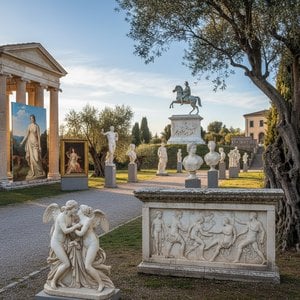
Neoclassical Art: 10 Masterpieces That Shaped History |
Explore 10 defining Neoclassical masterpieces by David, Ingres & Canova. Discover the history, symbolism & artistry behind these iconic paintings and sculptures. Find museum-quality art reproductions at – elevate your home with timeless beauty.

Andrea del Sarto: Florentine Grace, Technical Mastery & Artistic Ambition
Explore the life & art of Andrea del Sarto, a Florentine Renaissance master renowned for harmonious compositions & technical brilliance. Discover his frescoes, portraits, and lasting influence on art history.