


The picture follows your choices: , .
Collectible Description
 Read More
Artist Biography
Discover Alphonse Mucha (1860-1939), the Art Nouveau master! Explore his iconic posters, beautiful women & the monumental 'Slav Epic'. A Czech artistic legend.
Hand Made Oil Reproduction
Hand-painted oil on canvas in your size and frame, made to order by our artists. ( Switch to Print Switch to Digital Image)
More about this painting
 Preview
 Send
Send Share
Share
 Details
 Guide
Guide

 Download
 Similars
 X-Ray
X-Ray Diaporama
 Q&A
Q&A Stats
StatsOrder your painting in four simple steps
Take your time. You can change any answer; the price in your order card follows each choice.
1 Step one of four
Which size would you like?
These sizes keep the proportions of the original painting. The drawing shows your choice on a wall, above a two-metre sofa.
Or give your own measurements
Pick from our preset sizes that match the artwork's original proportions.

Type the width and the height you need, to fit your frame or your wall. This is hand-painted, so for a size with a different shape the artist can paint a bit more around the picture, or cut a bit — you choose. We send you a digital mockup to approve before the painting starts. The picture shown on this page does not show the real result — only the mockup does.
2 Step two of four
How should it be prepared: rolled, stretched or framed?
The prices below are for the size you chose in step one.
Choose the edges of the stretched canvas
Choose your frame

White $1

Blurside $1

Extended $1

P118B $10

P118H $10

P118W $10

P438Z $10

P508JH $12

P508YH $12

P805H $10

P805Z $10

P919BZ $10

P919G $10

P919XJ $10

P959ZH $10

P968JZ $12

W106C $8

W218G $10

W218JH $8

W218Y $10

W307PJ $10

W316G $10

W316PJ $8

W316Y $10

W398PJ $8

W4111J $10

W500HY $15

W500JH $15

W692G $12

W849H $8

W940BG $15

W953PJ $8

H24-GOLD $30

H24-SILVER $30

H36-GOLD $45

H36-SILVER $45
Framed
Moulding: . Overall size with the frame: .
3 Step three of four
Would you like anything changed in the painting?
Most people answer no. Because each painting is made by hand, our artist can also adapt it for you.
After order, ArtsDot.com team will email client for instructions and provide a mockup preview
4 Step four of four
A few finishing options
All of them are optional. The answers already selected cost nothing extra.
Who paints it?
Worldwide Delivery () in 3/4 weeks instead of standard 5 weeks. (14 November). No compromise on quality.
A nameplate, as in a museum?
Engraved Bronze Plaque Details
This elegant plaque features the artist's name and the title of the artwork, finely engraved for a timeless presentation.
It is made from bronze with a refined, elegant finish. The text is precisely laser-engraved for a sharp and permanent result. Measuring 9x2 cm, the plaque is compact yet easy to read. It's built to be durable and scratch-resistant, offering a professional, museum-quality look. Mounting is simple thanks to the included adhesive backing.
Transparent Acrylic Plaque Details
The plaque includes essential engraved details such as the artist's name, the title of the artwork, the date it was created, the type of media used-like oil on canvas or watercolor-a brief description of the piece, and a QR code that links to the complete artwork information.
It is crafted from clear acrylic, offering a sleek, modern appearance. The text is UV-engraved in black to ensure strong visual contrast. With a size of 10x15 cm, it ensures optimal readability. It comes equipped with two metal hooks for secure wall mounting. The plaque is designed to be weather-resistant, making it suitable for various environments, and it includes interactive features that work seamlessly with smartphone scanning.
Black Acrylic Plaque Details
This elegant plaque includes engraved information such as the artist's name, the title of the artwork, the date it was created, the type of media used (like oil on canvas or watercolor), a short description of the artwork, and a QR code for quick access to more information.
The plaque itself is made from refined black acrylic with a premium finish. The text is laser-engraved in white for high contrast and readability. Its size is 10x15 cm, designed to be easy to read. It comes with two metal hooks for professional mounting. The design is sleek and fits any interior style. It is also weather-resistant and durable, with built-in digital integration for mobile compatibility.
A protective varnish?
When do you need it?
✓ Check and order
Your painting, as you ordered it

The Moon
Reproduction Medium
Reproduction Size
-

Elite Senior Artist
More detail, finesse, and extra production time
-

Reproduction Frame
-
-
For artworks or reproductions larger than 105 cm (approximately 41 inches) on any side, the frame will be shipped as a kit, disassembled. This method ensures safe delivery and prevents damage during transport.
Professional assembly required - this is not a DIY product.
The kit must be assembled and the canvas stretched by an experienced professional framer, using wood glue (not supplied), a canvas stretching plier and clamps to hold the bars square while the glue dries. Incorrect assembly or uneven canvas tension can permanently damage the artwork and is not covered by our warranty.
 For artworks or reproductions larger than 105 cm (approximately 41 inches) on any side, the frame will be shipped as a kit, disassembled. This method ensures safe delivery and prevents damage during transport.
All solid wood bars are included, precisely cut to size.
Assembled with the screws provided, plus wood glue for the corner joints, which is not supplied and must be sourced by your framer.
Professional tools are required and not included: a canvas stretching plier (tensioner) and clamps to hold the bars square while the glue dries.
Important:
The corner joints require wood glue, the bars must be held with clamps until the glue is fully dry, and tightening the canvas on the assembled frame requires a canvas stretching plier. None of these are included in the kit. Please arrange an experienced professional framer before ordering this size.

Nameplate
-
-

Protective Varnish
Glossy Varnish (enhances colors, protects against light/moisture)
-

Customize My Artwork
Examples of what can be changed: Replace face with customer photo; Add pet (e.g., replace cat with dog); Include hidden message in background; Change background landscape or elements.
-

Urgent
Worldwide Delivery () in 3/4 weeks instead of standard 5 weeks. (14 November). No compromise on quality.
-
Express Shipping
Worldwide Delivery () in 5 weeks. (21 November).
Included
Total Price
$ 263
Glass option is only available in size under 110 CM
Included with every order
- Free Worldwide Express Shipping
- High-Quality Linen Canvas
- Full Shipping Insurance
- Customs Tax Refund Guarantee
- True Color Matching Guarantee
- 100-Day Return Policy (Defects Only)
- 100% Money-Back Guarantee
- Bulk Discount Offer


The Moon by Alphonse Mucha: A Nocturne of Femininity and Celestial Grace
Alphonse Mucha’s “The Moon” is more than just a beautiful image; it's a portal to the heart of Art Nouveau, a movement defined by its celebration of natural forms, flowing lines, and an almost dreamlike quality. This captivating poster, depicting a woman bathed in the ethereal glow of a crescent moon, embodies Mucha’s signature style – a harmonious blend of decorative elegance and profound symbolism. It's a piece that speaks to our enduring fascination with the night sky, the allure of feminine beauty, and the power of artistic embellishment.
The composition immediately draws the eye to the central figure, a woman whose pose is both graceful and slightly melancholic. Her upward gaze towards the moon suggests contemplation, perhaps even a yearning for something beyond the earthly realm. The surrounding floral motifs – lilies, irises, and other blooms – aren’t merely decorative; they are integral to the artwork's narrative, echoing themes of rebirth, beauty, and the cyclical nature of life itself. Mucha masterfully utilizes symmetry, creating a balanced yet dynamic visual experience that invites prolonged observation.
A Symphony of Color and Line
Mucha’s palette is a testament to his understanding of color theory. The dominant warm tones – rich browns, golds, and creamy whites – evoke a sense of warmth and tranquility, while subtle accents of pink and blue-green introduce an element of mystery and dreaminess. This careful orchestration of hues contributes significantly to the artwork's overall mood, creating a visual experience that is both soothing and stimulating. The prevalence of flowing, curvilinear lines—a hallmark of Art Nouveau—is particularly striking. They ripple across the woman’s gown, intertwine with the floral elements, and even seem to emanate from the moon itself, conveying a sense of movement and fluidity.
Crafting Illusion: Technique and Materials
“The Moon” was almost certainly created using the lithographic process, a technique Mucha expertly employed throughout his career. Lithography allowed for incredibly detailed renderings and vibrant colors – essential elements in achieving the poster’s distinctive aesthetic. The artist meticulously layered inks to build up the intricate patterns and textures, creating a surface that appears both smooth and richly embellished. The use of paper was carefully considered, likely a high-quality stock chosen to best capture the nuances of color and detail. It's fascinating to consider how this image was originally produced – a testament to the skill and dedication required to create such a visually arresting work.
Symbolism and Legacy
Beyond its purely aesthetic qualities, “The Moon” is rich in symbolism. The moon itself has long been associated with femininity, intuition, and the cycles of nature. The woman’s pose, gazing upwards towards this celestial body, reinforces these associations. Furthermore, Mucha's work frequently featured idealized female figures, representing a romanticized vision of beauty and grace. “The Moon” stands as a powerful example of Art Nouveau’s ability to blend decorative art with profound symbolism, creating an image that continues to resonate with viewers today. It remains a timeless representation of feminine allure and the captivating mystery of the night.
Questions & Answers
What does "The Moon" by Alphonse Mucha depict?
The subjects of "The Moon" are moon, mucha, artnouveau, woman, celestial, floral, symbolism, decorative.
How much light do the colors of "The Moon" appear to reflect?
"The Moon" by Alphonse Mucha has a gentle luminance luminance. Luminance describes how much light the colors appear to reflect.
Who is "The Moon" suggested for as a present, and for what use?
The gift recommendation for "The Moon" by Alphonse Mucha combines wedding with statement.


Alphonse Mucha
1860 - 1939, Czech Republic
Artist Biography
Early Life and Education
- Born: July 15, 1860, in Ivanačice, Moravia (now part of the Czech Republic)
- Showed artistic talent from a young age.
- Studied at the Academy of Fine Arts in Prague but became disillusioned with traditional approaches.
- Moved to Paris in 1887 to pursue his own style.
Artistic Style and Notable Works
- Known for distinctive Art Nouveau style characterized by flowing lines, organic forms, and a sense of movement.
- Influenced by artists like Pierre-Auguste Renoir and Gustave Moreau.
- Notable Works:
- The Slavonic Uprising - Showcases blending traditional Czech motifs with modern Art Nouveau elements.
- Salon des Cent
- Paintings inspired by works like The Daughters of Tespio by Gustave Moreau, and La Ribambelle des Gobelins by Piero Dorazio.
- Illustrations based on Young Farmers Breaking Flax by Sir Hubert von Herkomer.
- Frequently featured idealized women in flowing robes surrounded by lush flowers.
Career Highlights and Major Commissions
- Sarah Bernhardt Collaboration: Created posters and designs for the actress Sarah Bernhardt, starting with the poster for Gismonda (1894), which launched his career.
- Universal Exhibition in Paris (1900): His Art Nouveau style gained international recognition at this exhibition. He decorated the Bosnia and Herzegovina Pavilion and collaborated on the Austrian Pavilion.
- Charles Richard Crane Patronage: Received support from Charles Richard Crane, which enabled him to create the monumental series The Slav Epic (1912-30).
- Post-Independence Czechoslovakia: Designed postage stamps, banknotes, and government documents for newly independent Czechoslovakia.
Influences and Legacy
- Influenced by Czech artistic traditions and modern European art movements.
- His unique style paved the way for future generations of artists in Art Nouveau and Secessionism.
- Inspired other artists like Eva Prokopcová.
- Legacy extends beyond his artwork to influence design and aesthetics.
Later Life and Death
- Married Maruska (Marie/Maria) Chytilová in 1906.
- Visited the United States from 1906-1910, where their daughter Jaroslava was born.
- Died on July 14, 1939, in Prague, Czechoslovakia.


Related Articles
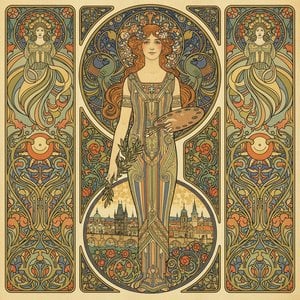
Alphonse Mucha: A Comprehensive Exploration of Art Nouveau's Master of Decorative Symbolism
Explore the life & art of Alphonse Mucha, master of Art Nouveau! Discover his iconic posters, stunning illustrations, and the monumental Slav Epic. A comprehensive guide for collectors & enthusiasts.

Thorns and Tenderness: Tracing the Symbolism of Roses from Antiquity to Impressionism
Explore the profound history of rose symbolism from ancient myths to Impressionism. Trace this floral evolution through the masters.

Whistler's Masterpieces: Explore 25 Iconic Paintings & Aesthetic Art for Your Home
Journey through 25 iconic James Abbott McNeill Whistler paintings! Explore his masterpieces of Aestheticism, from 'Nocturne in Black and Gold' to captivating portraits. Find museum-quality art reproductions & elevate your home decor with ArtsDot.com. Discover the full collection online.