


 Preview
 Send
Send Share
Share
 Details

 Download
 Similars
 X-Ray
X-Ray Diaporama
Lorenzaccio

 Read More
Giclée / Art Print
Museum-quality giclée or canvas print with fast production and flexible finish options. ( Buy Hand Made Painting Buy Image)




P118B $10

P118H $10

P118W $10

P438Z $10

P508JH $12

P508YH $12

P805H $10

P805Z $10

P919BZ $10

P919G $10

P919XJ $10

P959ZH $10

P968JZ $12

W106C $8

W218G $10

W218JH $8

W218Y $10

W307PJ $10

W316G $10

W316PJ $8

W316Y $10

W398PJ $8

W4111J $10

W500HY $15

W500JH $15

W692G $12

W849H $8

W940BG $15

W953PJ $8




Pick from our preset sizes that match the artwork's original proportions.

You may enter your own dimensions to fit a specific frame or space. If your selected size does not match the original image's proportions, we will either crop the artwork or extend the image with a mirrored or solid-fill edge. A digital mockup will be sent for your approval before production begins.
Please note that the on-screen preview does not reflect the actual cropping or extension. Only the mockup will accurately show the final composition.
While custom sizes are available, we recommend selecting a dimension from the predefined list to preserve the original proportions.
Worldwide Delivery () in 2 weeks instead of standard 4/5 weeks. (14 August)

Free Worldwide Express Shipping

High-Quality Linen Canvas

Full Shipping Insurance

Customs Tax Refund Guarantee

True Color Matching Guarantee

60-Day Return Policy (Defects Only)

100% Money-Back Guarantee

Bulk Discount Offer
 Glass option is only available in size under 110 CM

Lorenzaccio
Giclée / Art Print
Reproduction Size
-


Total Price
$ 63
Collectible Description
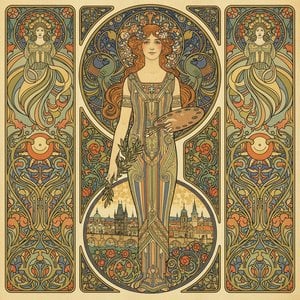
Lorenzaccio: Mucha’s Vision of Dramatic Elegance
The poster for Alphonse Mucha's play “Lorenzaccio” stands as a quintessential emblem of Art Nouveau, transporting viewers back to the opulent Belle Époque and immersing them in a world brimming with stylized beauty and symbolic depth. More than just an advertisement for theatrical performance, it’s a meticulously crafted visual poem that encapsulates the movement’s core tenets—organic forms, flowing lines, and an idealized representation of human experience—resulting in an artwork that continues to captivate audiences today.A Symphony of Line and Color
Mucha's masterful technique employed lithography, a printing process favored during his era for its ability to reproduce intricate designs with remarkable clarity and vibrancy. This medium allowed him to translate his vision onto paper with astonishing precision, capturing the subtle nuances of shading and texture that would have been impossible with earlier methods. The color palette—dominated by warm browns, golds, and oranges—is deliberately chosen to evoke a sense of grandeur and theatrical warmth. Accents of emerald green and muted reds punctuate the composition, adding visual interest and subtly hinting at themes of passion and decay – elements crucial to understanding Mucha’s artistic intent.The Anatomy of Composition: Flowing Forms and Central Focus
The poster's vertical format immediately establishes a feeling of upward movement, mirroring the dramatic narrative unfolding within the play itself. At its heart lies a young man—likely Lorenzaccio—positioned slightly off-center, gazing downwards with an expression that speaks volumes about contemplation and perhaps regret. This posture is countered by the expansive floral borders surrounding him; these aren’t merely decorative embellishments but integral components of Mucha's compositional strategy. The swirling patterns within the borders amplify the sense of dynamism, mirroring the turbulent emotions at play in Lorenzaccio’s psyche. Geometric shapes—rectangles and circles—provide structural stability against this fluid backdrop, creating a harmonious balance between organic and geometric elements.Symbolism Woven into Every Detail
Beyond its formal beauty, “Lorenzaccio” is laden with symbolic imagery reflecting Art Nouveau's fascination with mythology and folklore. The stylized floral motifs – lilies, roses, and vines – represent rebirth, purity, and the cyclical nature of life—themes pertinent to Lorenzaccio’s journey from youthful idealism to moral disillusionment. Mucha skillfully utilizes light and shadow to heighten emotional impact; the soft glow illuminating the figure underscores his vulnerability while simultaneously emphasizing the richness of color within the floral borders. The downward gaze of Lorenzaccio serves as a poignant reminder of introspection and sorrow—a visual manifestation of the play’s central preoccupation with human psychology.A Legacy of Artistic Innovation
“Lorenzaccio” exemplifies Mucha's unwavering commitment to artistic innovation, pushing boundaries against academic conventions and establishing himself as one of Art Nouveau’s foremost practitioners. Its enduring appeal lies not only in its aesthetic splendor but also in its ability to convey profound emotional truths—a testament to Mucha’s genius as both a visual artist and storyteller. Today, reproductions of this iconic poster continue to inspire designers and collectors alike, securing Lorenzaccio's place as an unforgettable masterpiece of Art Nouveau artistry.Related Artworks


Artist Biography
Early Life and Education
- Born: July 15, 1860, in Ivanačice, Moravia (now part of the Czech Republic)
- Showed artistic talent from a young age.
- Studied at the Academy of Fine Arts in Prague but became disillusioned with traditional approaches.
- Moved to Paris in 1887 to pursue his own style.
Artistic Style and Notable Works
- Known for distinctive Art Nouveau style characterized by flowing lines, organic forms, and a sense of movement.
- Influenced by artists like Pierre-Auguste Renoir and Gustave Moreau.
- Notable Works:
- The Slavonic Uprising - Showcases blending traditional Czech motifs with modern Art Nouveau elements.
- Salon des Cent
- Paintings inspired by works like The Daughters of Tespio by Gustave Moreau, and La Ribambelle des Gobelins by Piero Dorazio.
- Illustrations based on Young Farmers Breaking Flax by Sir Hubert von Herkomer.
- Frequently featured idealized women in flowing robes surrounded by lush flowers.
Career Highlights and Major Commissions
- Sarah Bernhardt Collaboration: Created posters and designs for the actress Sarah Bernhardt, starting with the poster for Gismonda (1894), which launched his career.
- Universal Exhibition in Paris (1900): His Art Nouveau style gained international recognition at this exhibition. He decorated the Bosnia and Herzegovina Pavilion and collaborated on the Austrian Pavilion.
- Charles Richard Crane Patronage: Received support from Charles Richard Crane, which enabled him to create the monumental series The Slav Epic (1912-30).
- Post-Independence Czechoslovakia: Designed postage stamps, banknotes, and government documents for newly independent Czechoslovakia.
Influences and Legacy
- Influenced by Czech artistic traditions and modern European art movements.
- His unique style paved the way for future generations of artists in Art Nouveau and Secessionism.
- Inspired other artists like Eva Prokopcová.
- Legacy extends beyond his artwork to influence design and aesthetics.
Later Life and Death
- Married Maruska (Marie/Maria) Chytilová in 1906.
- Visited the United States from 1906-1910, where their daughter Jaroslava was born.
- Died on July 14, 1939, in Prague, Czechoslovakia.

Alphonse Mucha
1860 - 1939 , Czech Republic
Quick Facts
- Artistic Movement Or Style: Art Nouveau
- Artists Or Movements Influenced By This Artist: ['Eva Prokopcová']
- Artists Who Influenced This Artist:
- Pierre-Auguste Renoir
- Gustave Moreau
- Dante Gabriel Rossetti
- Date Of Birth: July 15, 1860
- Date Of Death: 1939
- Full Name: Alphonse Maria Mucha
- Nationality: Czech
- Notable Artworks:
- Slavic Uprising
- Salon des Cent
- The Daughters of Tespio
- La Ribambelle des Gobelins
- Young Farmers Breaking Flax
- Place Of Birth: Brno, Czech Republic
Related Articles
Alphonse Mucha: A Comprehensive Exploration of Art Nouveau's Master of Decorative Symbolism
Explore the life & art of Alphonse Mucha, master of Art Nouveau! Discover his iconic posters, stunning illustrations, and the monumental Slav Epic. A comprehensive guide for collectors & enthusiasts.

Art Nouveau's Golden Age: 10 Masterpieces for Your Home |
Journey into Art Nouveau's golden age! Explore 10 masterpieces by Klimt, Mucha & more. Discover captivating stories behind iconic paintings, floral motifs & flowing lines. Find museum-quality art reproductions for your home at .

The Flowing Line & Flourishing Form: Exploring Art Nouveau's Aesthetic Legacy
Explore the captivating world of Art Nouveau! Discover its origins, key artists like Horta & Mucha, regional styles, innovative techniques, and lasting influence on architecture & design. A comprehensive guide for art enthusiasts.

F.A.Q.: Poster Prints – Durability, Comparison to Canvas, & Sizes for Elite Collectors
provides elite collectors with detailed insights into our poster print quality, comparing durability & materials to canvas. Explore sizing options and discover museum-quality art reproductions for lasting investment value.

Raphael Kirchner: A Poetic Vision of Belle Époque Society Through Art Nouveau Lithography
Explore the captivating world of Raphael Kirchner, a master of Art Nouveau illustration during the Belle Époque. Discover his iconic 'Kirchner Girls,' pioneering pin-up art & lasting influence.



