


 Preview
 Send
Send Share
Share
 Details
 Guide
Guide

 Download
 Similars
 X-Ray
X-Ray Diaporama
 Stats
StatsHamlet

 Read More
Hand Made Oil Reproduction
Hand-painted oil on canvas in your size and frame, made to order by our artists. ( Switch to Print Switch to Digital Image)




P118B $10

P118H $10

P118W $10

P438Z $10

P508JH $12

P508YH $12

P805H $10

P805Z $10

P919BZ $10

P919G $10

P919XJ $10

P959ZH $10

P968JZ $12

W106C $8

W218G $10

W218JH $8

W218Y $10

W307PJ $10

W316G $10

W316PJ $8

W316Y $10

W398PJ $8

W4111J $10

W500HY $15

W500JH $15

W692G $12

W849H $8

W940BG $15

W953PJ $8




Pick from our preset sizes that match the artwork's original proportions.

Type the width and the height you need, to fit your frame or your wall. This is hand-painted, so for a size with a different shape the artist can paint a bit more around the picture, or cut a bit — you choose. We send you a digital mockup to approve before the painting starts. The picture shown on this page does not show the real result — only the mockup does.
After order, ArtsDot.com team will email client for instructions and provide a mockup preview
Worldwide Delivery () in 3/4 weeks instead of standard 5 weeks. (25 October). No compromise on quality.

Free Worldwide Express Shipping

High-Quality Linen Canvas

Full Shipping Insurance

Customs Tax Refund Guarantee

True Color Matching Guarantee

100-Day Return Policy (Defects Only)

100% Money-Back Guarantee

Bulk Discount Offer
 Glass option is only available in size under 110 CM

Hamlet
Reproduction Medium
Reproduction Size
-


Total Price
$ 263
A Symphony in Gold and Bloom: Alphonse Mucha’s “Age of Reason”
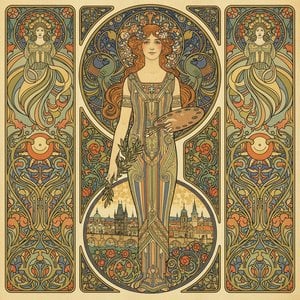
The painting "Age of Reason," attributed to Alphonse Maria Mucha, isn't merely an image; it’s a carefully constructed meditation on illumination and serenity—a cornerstone of Art Nouveau’s aesthetic philosophy. Created circa 1896-1897 during Mucha’s Parisian zenith, this monumental canvas transcends the decorative impulse often associated with the movement, delving into profound thematic concerns that resonate powerfully even today. Its impact extends beyond the realm of visual art, influencing interior design trends and shaping perceptions of beauty itself.- Subject Matter: Mucha’s vision centers on a luminous garden bathed in dappled sunlight—a deliberate contrast to the anxieties prevalent at the time concerning industrialization and societal upheaval. Figures emerge from the foliage, engaged in quiet contemplation, suggesting an antidote to the frenetic pace of modern life.
- Style: Mucha’s signature Art Nouveau style dominates every element of the composition. The undulating lines—characteristic of the movement—are not merely decorative; they embody a belief in organic harmony and fluidity, mirroring the natural world he seeks to capture. These curves dominate the canvas, creating an illusion of constant motion while simultaneously conveying stability.
- Technique: Mucha employed meticulous glazing techniques—applying thin layers of translucent pigment over opaque undercoats—to achieve breathtaking luminosity and depth. This painstaking process allowed him to reproduce the subtle gradations of color found in natural light, elevating the painting beyond mere representation into a realm of emotive expression.
Historical Context: Embracing Aesthetic Idealism Amidst Industrial Change
“Age of Reason” emerged during a period marked by significant social and technological transformations—the rapid expansion of factories and cities challenging traditional values. Mucha, acutely aware of these developments, responded with an artistic stance rooted in idealism. He championed the notion that beauty could serve as a moral compass, offering solace and inspiration amidst uncertainty. The painting’s serene depiction of nature reflects this broader philosophical preoccupation.Symbolism: Light, Flowers, and Contemplative Presence
The garden itself is laden with symbolic significance. Sunlight represents enlightenment—spiritual illumination—a concept central to Art Nouveau’s intellectual currents. The flowers—primarily lilies and roses—symbolize purity and love—values upheld by Mucha's artistic vision. More importantly, the figures embody contemplative presence—a deliberate rejection of materialism and an affirmation of inner peace.Emotional Impact: A Balm for the Soul
Ultimately, “Age of Reason” succeeds in conveying a profound emotional resonance. Its tranquil atmosphere invites viewers to pause and reflect—to reconnect with their own sense of wonder and appreciation for beauty. Mucha’s masterful handling of color and line creates an immersive experience that transcends time, securing its place as one of Art Nouveau's most enduring masterpieces.Questions & Answers
What color saturation does "Hamlet" by Alphonse Mucha have?
The palette of "Hamlet" is clear color presence in saturation.
How does the style of "Hamlet" relate to its creator's era?
"Hamlet" belongs to the Art Nouveau movement, and its creator worked in the 19th-Century era.
What does "Hamlet" share with the rest of Alphonse Mucha's output?
"Hamlet" shares with Alphonse Mucha's other works its Art Nouveau style and the recorded themes: symbolic art nouveau, theater promotion, czech nationalism, decorative elegance, artist legacy.
Related Artworks


Artist Biography
Early Life and Education
- Born: July 15, 1860, in Ivanačice, Moravia (now part of the Czech Republic)
- Showed artistic talent from a young age.
- Studied at the Academy of Fine Arts in Prague but became disillusioned with traditional approaches.
- Moved to Paris in 1887 to pursue his own style.
Artistic Style and Notable Works
- Known for distinctive Art Nouveau style characterized by flowing lines, organic forms, and a sense of movement.
- Influenced by artists like Pierre-Auguste Renoir and Gustave Moreau.
- Notable Works:
- The Slavonic Uprising - Showcases blending traditional Czech motifs with modern Art Nouveau elements.
- Salon des Cent
- Paintings inspired by works like The Daughters of Tespio by Gustave Moreau, and La Ribambelle des Gobelins by Piero Dorazio.
- Illustrations based on Young Farmers Breaking Flax by Sir Hubert von Herkomer.
- Frequently featured idealized women in flowing robes surrounded by lush flowers.
Career Highlights and Major Commissions
- Sarah Bernhardt Collaboration: Created posters and designs for the actress Sarah Bernhardt, starting with the poster for Gismonda (1894), which launched his career.
- Universal Exhibition in Paris (1900): His Art Nouveau style gained international recognition at this exhibition. He decorated the Bosnia and Herzegovina Pavilion and collaborated on the Austrian Pavilion.
- Charles Richard Crane Patronage: Received support from Charles Richard Crane, which enabled him to create the monumental series The Slav Epic (1912-30).
- Post-Independence Czechoslovakia: Designed postage stamps, banknotes, and government documents for newly independent Czechoslovakia.
Influences and Legacy
- Influenced by Czech artistic traditions and modern European art movements.
- His unique style paved the way for future generations of artists in Art Nouveau and Secessionism.
- Inspired other artists like Eva Prokopcová.
- Legacy extends beyond his artwork to influence design and aesthetics.
Later Life and Death
- Married Maruska (Marie/Maria) Chytilová in 1906.
- Visited the United States from 1906-1910, where their daughter Jaroslava was born.
- Died on July 14, 1939, in Prague, Czechoslovakia.

Alphonse Mucha
1860 - 1939 , Czech Republic
Quick Facts
- Full Name: Alphonse Maria Mucha
- Nationality: Czech
- Date Of Birth: 1860
- Date Of Death: 1939
- Place Of Birth: Brno, Czech Republic
- Notable Artworks:
- Slavic Uprising
- Salon des Cent
- The Daughters of Tespio
- La Ribambelle des Gobelins
- Young Farmers Breaking Flax
- Artistic Movement Or Style: Art Nouveau
- Artists Who Influenced This Artist:
- Pierre-Auguste Renoir
- Gustave Moreau
- Dante Gabriel Rossetti
- Artists Or Movements Influenced By This Artist: ['Eva Prokopcová']
Related Articles

Playful Masterpieces: Top 10 Artworks for a Joyful Home | ArtsDot
Find joy & inspiration! Explore 10 playful masterpieces by Monet, Matisse & more. Discover art history, vibrant colors & uplifting stories behind these iconic paintings. Museum-quality reproductions at ArtsDot.com – explore the full collection online!

The Flowing Line & Flourishing Form: Exploring Art Nouveau's Aesthetic Legacy
Explore the captivating world of Art Nouveau! Discover its origins, key artists like Horta & Mucha, regional styles, innovative techniques, and lasting influence on architecture & design. A comprehensive guide for art enthusiasts.

Art Nouveau's Golden Age: 10 Masterpieces for Your Home |
Journey into Art Nouveau's golden age! Explore 10 masterpieces by Klimt, Mucha & more. Discover captivating stories behind iconic paintings, floral motifs & flowing lines. Find museum-quality art reproductions for your home at .
Alphonse Mucha: A Comprehensive Exploration of Art Nouveau's Master of Decorative Symbolism
Explore the life & art of Alphonse Mucha, master of Art Nouveau! Discover his iconic posters, stunning illustrations, and the monumental Slav Epic. A comprehensive guide for collectors & enthusiasts.

Raphael Kirchner: A Poetic Vision of Belle Époque Society Through Art Nouveau Lithography
Explore the captivating world of Raphael Kirchner, a master of Art Nouveau illustration during the Belle Époque. Discover his iconic 'Kirchner Girls,' pioneering pin-up art & lasting influence.


