


 Preview
 Send
Send Share
Share
 Details
 Guide
Guide

 Download
 Similars
 X-Ray
X-Ray Diaporama
 Stats
Stats(45)

 Read More
Hand Made Oil Reproduction
Hand-painted oil on canvas in your size and frame, made to order by our artists. ( Switch to Print Switch to Digital Image)




P118B $10

P118H $10

P118W $10

P438Z $10

P508JH $12

P508YH $12

P805H $10

P805Z $10

P919BZ $10

P919G $10

P919XJ $10

P959ZH $10

P968JZ $12

W106C $8

W218G $10

W218JH $8

W218Y $10

W307PJ $10

W316G $10

W316PJ $8

W316Y $10

W398PJ $8

W4111J $10

W500HY $15

W500JH $15

W692G $12

W849H $8

W940BG $15

W953PJ $8




Pick from our preset sizes that match the artwork's original proportions.

Type the width and the height you need, to fit your frame or your wall. This is hand-painted, so for a size with a different shape the artist can paint a bit more around the picture, or cut a bit — you choose. We send you a digital mockup to approve before the painting starts. The picture shown on this page does not show the real result — only the mockup does.
After order, ArtsDot.com team will email client for instructions and provide a mockup preview
Worldwide Delivery () in 3/4 weeks instead of standard 5 weeks. (20 October). No compromise on quality.

Free Worldwide Express Shipping

High-Quality Linen Canvas

Full Shipping Insurance

Customs Tax Refund Guarantee

True Color Matching Guarantee

100-Day Return Policy (Defects Only)

100% Money-Back Guarantee

Bulk Discount Offer
 Glass option is only available in size under 110 CM

(45)
Reproduction Medium
Reproduction Size
-


Total Price
$ 263
Alphonse Mucha: The Poet of Decorative Art
Alphonse Maria Mucha (1860 – 1939), born in Ivanačice, Moravia, stands as a towering figure within the Art Nouveau movement—a stylistic revolution that swept across Europe between 1890 and 1910. Rejecting academic conventions, Mucha forged his own path toward an aesthetic rooted in organic forms, flowing lines, and meticulous ornamentation, establishing himself as arguably the most prolific and influential illustrator of his era.
Early Life and Artistic Aspirations
From a young age, Mucha demonstrated exceptional artistic talent. Despite facing challenges securing acceptance into the Academy of Fine Arts in Prague—where he felt stifled by rigid rules—he persevered, honing his skills independently before relocating to Paris in 1887. This decisive move proved pivotal, immersing him in the vibrant intellectual and artistic milieu of the Belle Époque and propelling him toward the realization of his distinctive vision.
The Art Nouveau Style: A Symphony of Line and Form
Mucha’s artistic style is instantly recognizable—a mesmerizing blend of curvilinear lines, stylized floral motifs, and graceful curves that embody the movement's core principles. Heavily influenced by artists like Pierre-Auguste Renoir and Gustave Moreau, Mucha skillfully incorporated elements from Japanese art and Celtic symbolism into his compositions.
Notable Illustrations: Capturing Beauty and Myth
Mucha’s prolific output yielded a remarkable body of work—primarily illustrations for theater posters and advertising campaigns—that cemented his reputation as the “Poet of Decorative Art.” His celebrated images include “The Slavonic Uprising,” which deftly combines Czech nationalistic themes with Art Nouveau aesthetics; “Salon des Cent,” showcasing collaborations with fellow artists like Piero Dorazio; and evocative depictions inspired by works such as Gustave Moreau’s “The Daughters of Tespio” and Sir Hubert von Herkomer's "Young Farmers Breaking Flax." These pieces transcend mere visual representation, conveying profound narratives imbued with mythological references and psychological depth.
Technique and Symbolism: Craftsmanship Meets Imagination
Mucha’s technique involved painstaking hand-painting—primarily utilizing oil paints—with meticulous attention to detail and layering. He embraced innovative printing methods, experimenting with chromolithography and halftone printing to achieve stunning color reproductions. Recurring motifs—such as irises, lilies, and stylized female figures—carried symbolic significance, reflecting themes of femininity, spirituality, and the harmonious relationship between humanity and nature.
Emotional Impact: A Legacy of Elegance and Enchantment
Ultimately, Mucha’s art possesses an enduring emotional resonance—capturing a sense of romanticism, elegance, and enchantment that continues to inspire artists and designers today. His masterful manipulation of line and color creates images that are both visually captivating and psychologically stimulating, transporting viewers into worlds of beauty and wonder. Alphonse Maria Mucha remains not merely an artist but a cultural icon—a testament to the transformative power of artistic vision.
Questions & Answers
Where and for what purpose is "(45)" recommended?
Use (accent) and space (living room) are the two recommendations recorded for "(45)" by Alphonse Mucha.
Can the image of "(45)" by Alphonse Mucha be freely reproduced?
Regarding copyright, "(45)" is in the public domain - its copyright has expired.
Is "(45)" a famous Art Nouveau artwork?
"(45)" by Alphonse Mucha is classified as iconic and belongs to the Art Nouveau movement.


Artist Biography
Early Life and Education
- Born: July 15, 1860, in Ivanačice, Moravia (now part of the Czech Republic)
- Showed artistic talent from a young age.
- Studied at the Academy of Fine Arts in Prague but became disillusioned with traditional approaches.
- Moved to Paris in 1887 to pursue his own style.
Artistic Style and Notable Works
- Known for distinctive Art Nouveau style characterized by flowing lines, organic forms, and a sense of movement.
- Influenced by artists like Pierre-Auguste Renoir and Gustave Moreau.
- Notable Works:
- The Slavonic Uprising - Showcases blending traditional Czech motifs with modern Art Nouveau elements.
- Salon des Cent
- Paintings inspired by works like The Daughters of Tespio by Gustave Moreau, and La Ribambelle des Gobelins by Piero Dorazio.
- Illustrations based on Young Farmers Breaking Flax by Sir Hubert von Herkomer.
- Frequently featured idealized women in flowing robes surrounded by lush flowers.
Career Highlights and Major Commissions
- Sarah Bernhardt Collaboration: Created posters and designs for the actress Sarah Bernhardt, starting with the poster for Gismonda (1894), which launched his career.
- Universal Exhibition in Paris (1900): His Art Nouveau style gained international recognition at this exhibition. He decorated the Bosnia and Herzegovina Pavilion and collaborated on the Austrian Pavilion.
- Charles Richard Crane Patronage: Received support from Charles Richard Crane, which enabled him to create the monumental series The Slav Epic (1912-30).
- Post-Independence Czechoslovakia: Designed postage stamps, banknotes, and government documents for newly independent Czechoslovakia.
Influences and Legacy
- Influenced by Czech artistic traditions and modern European art movements.
- His unique style paved the way for future generations of artists in Art Nouveau and Secessionism.
- Inspired other artists like Eva Prokopcová.
- Legacy extends beyond his artwork to influence design and aesthetics.
Later Life and Death
- Married Maruska (Marie/Maria) Chytilová in 1906.
- Visited the United States from 1906-1910, where their daughter Jaroslava was born.
- Died on July 14, 1939, in Prague, Czechoslovakia.

Alphonse Mucha
1860 - 1939 , Czech Republic
Quick Facts
- Full Name: Alphonse Maria Mucha
- Nationality: Czech
- Date Of Birth: 1860
- Date Of Death: 1939
- Place Of Birth: Brno, Czech Republic
- Notable Artworks:
- Slavic Uprising
- Salon des Cent
- The Daughters of Tespio
- La Ribambelle des Gobelins
- Young Farmers Breaking Flax
- Artistic Movement Or Style: Art Nouveau
- Artists Who Influenced This Artist:
- Pierre-Auguste Renoir
- Gustave Moreau
- Dante Gabriel Rossetti
- Artists Or Movements Influenced By This Artist: ['Eva Prokopcová']
Related Articles
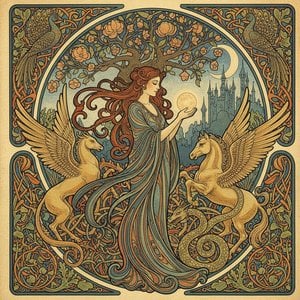
Edmund Dulac: A Master of Golden Age Illustration – Exploring Myth, Symbolism & Art Nouveau Legacy
Explore the captivating world of Edmund Dulac, a master of Golden Age illustration! Discover his enchanting fairy tales, Art Nouveau style, and lasting influence on art & design. Learn about *The Rubaiyat* and more.
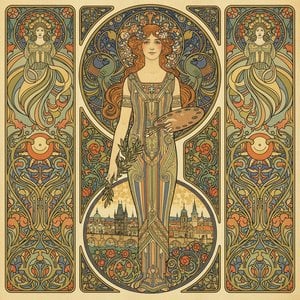
Alphonse Mucha: A Comprehensive Exploration of Art Nouveau's Master of Decorative Symbolism
Explore the life & art of Alphonse Mucha, master of Art Nouveau! Discover his iconic posters, stunning illustrations, and the monumental Slav Epic. A comprehensive guide for collectors & enthusiasts.

The Enduring Power of Illustration: A Historical Survey of Narrative Art & Visual Storytelling
Explore the rich history of illustration! From ancient cave paintings to Art Nouveau masterpieces, discover how visual storytelling has shaped culture. Expert insights & stunning examples.

Kay Rasmus Nielsen: A Golden Age Illustrator's Enchanting Legacy of Symbolism & Narrative
Explore the captivating world of Kay Rasmus Nielsen, a celebrated Golden Age illustrator renowned for his Art Nouveau fairy tale art & Disney contributions. Discover his unique style, enduring legacy, and how to collect his enchanting works.

Angelo Chiacchio: A Mid-Century American Illustration Master & the Rise of Commercial Art
Explore the captivating world of Angelo Chiacchio, a master of mid-century American illustration. Discover his evolution, signature style, and lasting impact on commercial art & design. Learn about his legacy at the Museum of American Illustration.


