

- 65.0 x 50.0 cm


The picture follows your choices: , .
Collectible Description
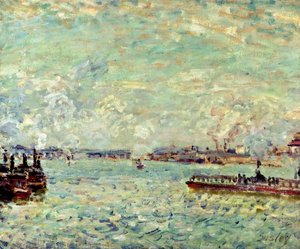
Capture the serene beauty of Impressionism with Alfred Sisley's 1875 rural landscape; explore this masterful depiction of light and nature today.
 Read More
Artist Biography
Impressionist master Alfred Sisley captured serene landscapes like the Thames. Discover his tranquil river scenes and beautiful light today.
Hand Made Oil Reproduction
Hand-painted oil on canvas in your size and frame, made to order by our artists. ( Switch to Print Switch to Digital Image)
More about this painting
 Preview
 Send
Send Share
Share
 Details
 Guide
Guide

 Download
 Similars
 X-Ray
X-Ray Diaporama
 Q&A
Q&A Stats
StatsOrder your painting in four simple steps
Take your time. You can change any answer; the price in your order card follows each choice.
1 Step one of four
Which size would you like?
These sizes keep the proportions of the original painting. The drawing shows your choice on a wall, above a two-metre sofa.
Or give your own measurements
Pick from our preset sizes that match the artwork's original proportions.

Type the width and the height you need, to fit your frame or your wall. This is hand-painted, so for a size with a different shape the artist can paint a bit more around the picture, or cut a bit — you choose. We send you a digital mockup to approve before the painting starts. The picture shown on this page does not show the real result — only the mockup does.
2 Step two of four
How should it be prepared: rolled, stretched or framed?
The prices below are for the size you chose in step one.
Choose the edges of the stretched canvas
Choose your frame

White $1

Blurside $1

Extended $1

P118B $10

P118H $10

P118W $10

P438Z $10

P508JH $12

P508YH $12

P805H $10

P805Z $10

P919BZ $10

P919G $10

P919XJ $10

P959ZH $10

P968JZ $12

W106C $8

W218G $10

W218JH $8

W218Y $10

W307PJ $10

W316G $10

W316PJ $8

W316Y $10

W398PJ $8

W4111J $10

W500HY $15

W500JH $15

W692G $12

W849H $8

W940BG $15

W953PJ $8

H24-GOLD $30

H24-SILVER $30

H36-GOLD $45

H36-SILVER $45
Framed
Moulding: . Overall size with the frame: .
3 Step three of four
Would you like anything changed in the painting?
Most people answer no. Because each painting is made by hand, our artist can also adapt it for you.
After order, ArtsDot.com team will email client for instructions and provide a mockup preview
4 Step four of four
A few finishing options
All of them are optional. The answers already selected cost nothing extra.
Who paints it?
Worldwide Delivery () in 3/4 weeks instead of standard 5 weeks. (13 November). No compromise on quality.
A nameplate, as in a museum?
Engraved Bronze Plaque Details
This elegant plaque features the artist's name and the title of the artwork, finely engraved for a timeless presentation.
It is made from bronze with a refined, elegant finish. The text is precisely laser-engraved for a sharp and permanent result. Measuring 9x2 cm, the plaque is compact yet easy to read. It's built to be durable and scratch-resistant, offering a professional, museum-quality look. Mounting is simple thanks to the included adhesive backing.
Transparent Acrylic Plaque Details
The plaque includes essential engraved details such as the artist's name, the title of the artwork, the date it was created, the type of media used-like oil on canvas or watercolor-a brief description of the piece, and a QR code that links to the complete artwork information.
It is crafted from clear acrylic, offering a sleek, modern appearance. The text is UV-engraved in black to ensure strong visual contrast. With a size of 10x15 cm, it ensures optimal readability. It comes equipped with two metal hooks for secure wall mounting. The plaque is designed to be weather-resistant, making it suitable for various environments, and it includes interactive features that work seamlessly with smartphone scanning.
Black Acrylic Plaque Details
This elegant plaque includes engraved information such as the artist's name, the title of the artwork, the date it was created, the type of media used (like oil on canvas or watercolor), a short description of the artwork, and a QR code for quick access to more information.
The plaque itself is made from refined black acrylic with a premium finish. The text is laser-engraved in white for high contrast and readability. Its size is 10x15 cm, designed to be easy to read. It comes with two metal hooks for professional mounting. The design is sleek and fits any interior style. It is also weather-resistant and durable, with built-in digital integration for mobile compatibility.
A protective varnish?
When do you need it?
✓ Check and order
Your painting, as you ordered it

The Rising Path
Reproduction Medium
Reproduction Size
-

Elite Senior Artist
More detail, finesse, and extra production time
-

Reproduction Frame
-
-
For artworks or reproductions larger than 105 cm (approximately 41 inches) on any side, the frame will be shipped as a kit, disassembled. This method ensures safe delivery and prevents damage during transport.
Professional assembly required - this is not a DIY product.
The kit must be assembled and the canvas stretched by an experienced professional framer, using wood glue (not supplied), a canvas stretching plier and clamps to hold the bars square while the glue dries. Incorrect assembly or uneven canvas tension can permanently damage the artwork and is not covered by our warranty.
 For artworks or reproductions larger than 105 cm (approximately 41 inches) on any side, the frame will be shipped as a kit, disassembled. This method ensures safe delivery and prevents damage during transport.
All solid wood bars are included, precisely cut to size.
Assembled with the screws provided, plus wood glue for the corner joints, which is not supplied and must be sourced by your framer.
Professional tools are required and not included: a canvas stretching plier (tensioner) and clamps to hold the bars square while the glue dries.
Important:
The corner joints require wood glue, the bars must be held with clamps until the glue is fully dry, and tightening the canvas on the assembled frame requires a canvas stretching plier. None of these are included in the kit. Please arrange an experienced professional framer before ordering this size.

Nameplate
-
-

Protective Varnish
Glossy Varnish (enhances colors, protects against light/moisture)
-

Customize My Artwork
Examples of what can be changed: Replace face with customer photo; Add pet (e.g., replace cat with dog); Include hidden message in background; Change background landscape or elements.
-

Urgent
Worldwide Delivery () in 3/4 weeks instead of standard 5 weeks. (13 November). No compromise on quality.
-
Express Shipping
Worldwide Delivery () in 5 weeks. (20 November).
Included
Total Price
$ 263
Glass option is only available in size under 110 CM
Included with every order
- Free Worldwide Express Shipping
- High-Quality Linen Canvas
- Full Shipping Insurance
- Customs Tax Refund Guarantee
- True Color Matching Guarantee
- 100-Day Return Policy (Defects Only)
- 100% Money-Back Guarantee
- Bulk Discount Offer


Composition and Style
The composition of The Rising Path is well-balanced, with the dirt road serving as a focal point that connects all the elements together. The use of light and color in the painting is characteristic of Impressionism, with soft brushstrokes and vivid colors used to create a sense of movement and energy. As seen in other works by Sisley, such as Railroad Embankment at Sevres and Haystack, the artist's dedication to capturing the beauty of the natural world is evident.Artist and Museum Information
Alfred Sisley was a prominent figure in the Impressionist movement, and his work can be found in many notable museums, including the Musée des Beaux-Arts d'Angers. To learn more about Sisley's life and work, visit /art/list/?Filter=8DNVEG-Alfred-Sisley-The-Rising-Path. For a deeper understanding of the Impressionist movement, explore the collection at /en/art/show/art-8dnveg-en/- Key Features: Oil on canvas, 65 x 50 cm, Impressionist style
- Influences: Claude Monet, Pierre-Auguste Renoir
- Museum Collections: Musée des Beaux-Arts d'Angers, https://ArtsDot.com
For more information on Alfred Sisley and his works, visit /art/list/?Filter=A@D3APVK-Discover-the-Masterpieces-of-Musee-des-Beaux-Arts-d-Angers-(Angers-France).
Questions & Answers
How do movement and era meet in "The Rising Path" by Alfred Sisley?
"The Rising Path" belongs to the Impressionism movement, and its creator worked in the 19th-Century era.
Where do the visitors of "The Rising Path" by Alfred Sisley come from?
A Stats page exists for "The Rising Path". It charts the monthly visits of the artwork and of the artist's other works, with country and language breakdowns.
What type of artwork is "The Rising Path" by Alfred Sisley?
In the catalog, "The Rising Path" by Alfred Sisley is filed as wall art. The category helps find similar works.
Related Artworks


Alfred Sisley
1839 - 1899, France
Artist Biography
Early Life, Family and Training
Alfred Sisley was born in Paris on October 30, 1839. His upbringing was shaped by the intersection of two cultures, as his parents, William Sisley and Felicia Sell, were British expatriates living in France. His father worked as a merchant of imported luxury goods, providing a comfortable, bourgeois environment for the young boy. This background meant that Alfred grew up navigating a bilingual world, becoming equally comfortable in French and English.
The path laid out for him was not originally one of brushes and canvas. His father had intended for him to follow the family business, and at age eighteen, Alfred traveled to London to prepare for a life in commerce. However, the pull of the visual arts proved stronger than the demands of trade. He eventually returned to Paris in 1861 to begin formal training, seeking a way to turn his interest into a profession.
He entered the studio of the Swiss artist Marc-Charles-Gabriel Gleyre at the École des Beaux-Arts. In this academic setting, he began to develop the technical foundation that would support his later explorations of nature. It was during these formative years in Paris that he began to move away from the rigid structures of traditional instruction toward a more direct observation of the world around him.
The Impressionist Circle in Paris
In the studios of Paris, Alfred Sisley found a community of like-minded rebels. He studied under the Swiss artist Marc-Charles-Gabriel Gleyre at the École des Beaux-Arts, an environment where he formed deep, lasting friendships with Claude Monet, Pierre-Auguste Renoir, and Frédéric Bazille. These four young men shared a common goal: to move away from the rigid, formal rules of academic painting. They preferred to take their canvases outdoors, seeking to capture the immediate, changing qualities of light and atmosphere directly from the natural world.
This shared rebellion eventually led them to challenge the established art world. The official Salon of the Académie de Beaux-Arts, the gatekeeper of artistic legitimacy at the time, refused to invite their work. To the society of the era, their approach was too new and too different to be recognized as real art. Rather than waiting for approval from the traditional institutions, the group took matters into their own hands. In April 1874, they organized and participated in the First Impressionist Exhibition, a bold move that helped define a new movement.
A Life Dedicated to Landscape Painting
While many of his contemporaries drifted between different genres, Sisley’s focus remained remarkably singular. His entire body of work consists almost exclusively of landscapes. He sought to capture the natural world through a steadfast commitment to en plein air painting, often working outdoors to catch the shifting light as it happened. This devotion to the immediate, lived experience of nature made him perhaps the most consistent of the Impressionists in his method.
His life was deeply rooted in the French countryside, even though he held British citizenship. He moved through various landscapes, finding inspiration in the quiet corners of France. His path took him through Paris and Louveciennes, and he spent significant time in Marly-le-Roi, Sèvres, Veneux-les-Sablons, and Moret-sur-Loing. These locations provided the steady backdrop for a career spent observing the subtle changes in the sky and the water.
This constant presence in the landscape allowed him to develop a deep familiarity with the terrain he painted. He did not look for grand or dramatic scenes, but rather for the quiet reality of the places where he lived and worked. His work reflects a life spent in quiet observation of the earth and the atmosphere above it.
Painting the English Coast and Thames
Though his life was largely rooted in France, Sisley felt a pull toward the landscapes of Britain, visiting the country on three separate occasions. In 1874, he traveled to London accompanied by his patron, Jean-Baptiste Faure. During this trip, he found a quiet subject in the non-tidal stretches of the Thames. Around Hampton Court Bridge, near East Molesey, he produced twenty paintings that captured the river's specific light and movement. These works reflect a period of focused observation, away from the familiar French riverbanks.
His connection to the British landscape was not always easy. In 1881, he had planned to paint the Isle of Wight, but the trip ended in frustration when his essential materials and canvases were never delivered. This setback prevented him from fully exploring the coastal light he had sought. Later, in the summer of 1897, he made a final trip to Wales alongside his wife, Eugénie. These excursions allowed him to encounter different atmospheres and light qualities than those found in the Seine valley.
The Serenity of Moret-sur-Loing
Moret-sur-Loing became a central part of Sisley's life, a place where he spent many years finding his footing. He felt a deep connection to the town, noting that his art developed most while he was surrounded by its dense nature and the shifting waters of the Loing. The river was a constant presence in his work, offering a quiet subject that allowed him to study the way light moved across the surface of the water.
He spent much of his time capturing the local landscape, often focusing on the canals and bridges that defined the town's character. These scenes were not about grand drama, but about the stillness of a specific place. He sought to record the way the sky met the water and how the structures of the town sat within the greenery. His time in Moret-sur-Loing was a long period of observation that lasted until his death there on January 29, 1899, at the age of fifty-nine.
- Moret at Sunset (about 1888)
- The Moret Bridge in the Sunlight (1892)
- River Landscape by Moret sur Loing (1890)
Technique and Artistic Style
Sisley’s approach to the canvas was rooted in a quiet, steady observation of the natural world. He did not seek out the dramatic or the loud; instead, his work focused on a subtle rendering of light and a sense of profound tranquility. To achieve this, he often began his paintings by working on the sky first. By establishing the heavens before the earth, he could better capture the specific mood of a moment and ensure the light felt integrated into the entire scene. This method allowed him to master the way light interacts with the surface of water and the vastness of the sky, creating a sense of atmosphere that felt lived-in rather than staged.
His palette was never aggressive. He preferred a delicate range of colors, often washing his landscapes in pale shades of green, pink, and purple. You will frequently see dusty blue and cream tones used to suggest the soft haze of a morning or the gentle reflection of a river. He applied paint with a diverse touch, varying his brushwork to handle the interplay of light and shadow. This technique helped him move beyond simple representation, allowing him to portray the way light shifts across a landscape as the day progresses.
- The Saint Martin Canal in Paris (1870)
- A February Morning at Moret sur Loing (about 1881)
- The Lock of Saint-Mammès (1885)
Key Works and Notable Subjects
Sisley found his purpose in the quiet movement of the natural world. He looked toward rivers, canals, and the sea, often finding a specific kind of peace in the way light interacted with water. He was just as comfortable painting the heavy, white stillness of snow as he was the shifting currents of a river. His focus remained on these elements, seeking to capture how a landscape felt in a single, passing moment.
In 1870, he produced The Saint Martin Canal in Paris, a work that reflects his early interest in the waterways of the city. As his career progressed, he became deeply attached to the rhythms of the French countryside. This connection is felt in A February Morning at Moret sur Loing, painted in 1881, where the atmosphere of a winter morning is rendered through soft, layered tones. He also turned his attention to the more dramatic shifts in nature, such as the flooding of the Seine at Port-Marly in 1875, which he documented through a series of paintings.
- The Saint Martin Canal in Paris (1870)
- A February Morning at Moret sur Loing (1881)
Legacy and Enduring Influence
Alfred Sisley’s place in art history is marked by a quiet, steady persistence. While many of his contemporaries sought fame or social change through their canvases, he remained focused on the subtle shifts of the sky and the movement of water. He acted as a vital link between the Barbizon school, with its grounded realism, and the full flowering of Impressionism. This connection helped bridge the gap between traditional landscape painting and the new, experimental ways of seeing the world.
His recognition did not arrive during his lifetime. While he labored through financial hardship and often worked in relative obscurity, the value of his work changed significantly after he passed away. The prices of his canvases skyrocketed, finally granting the financial security that had eluded him while he was alive. Today, his paintings continue to draw people who find something profound in his ability to reveal the extraordinary within the ordinary. He showed that a simple riverbank or a cloudy morning held enough depth to sustain a lifetime of study.
The influence of his approach can be seen in the work of later landscape painters. These artists looked to his method for capturing the ephemeral qualities of light and the way atmosphere changes a scene. His dedication to painting en plein air helped establish a standard for how artists engage directly with the natural world. His legacy is found in that specific, delicate way of recording a moment before the light shifts and the scene is gone.
Where to See the Works Today
To experience the quiet light of Sisley’s landscapes in person, one must travel to several major institutions across Europe and North America. In Paris, his presence is felt strongly within the Musée d'Orsay, which holds a significant number of his canvases. The Louvre also maintains works from his collection, ensuring his vision remains part of the city's deep artistic history. For those visiting the United Kingdom, the National Gallery in London offers a chance to see his hand, while the National Gallery of Wales provides further insight into his dedication to the natural world.
His reach extends far beyond the borders of France, with many of his paintings finding homes in prominent American collections. The Art Institute of Chicago and the Metropolitan Museum of Art in New York both hold his work, allowing viewers to encounter his subtle color palettes in different settings. In the United States, the Nelson-Atkins Museum of Art in Kansas City also preserves his paintings, making his serene river scenes accessible to a wide audience across the Atlantic.
- Bridge at Villeneuve la Garenne, about 1872
- Grand Jatte, about 1873
- The Saint Martin Canal in Paris, about 1870
- Moret at Sunset, about 1888




Related Articles

Impressionism: A Revolution of Light & Color That Changed Art History
Explore the revolutionary world of Impressionism! Discover its history, key artists like Monet & Renoir, defining techniques, and lasting impact on modern art. A comprehensive guide for art lovers.

The Allure of Open Airs: Exploring Representations of Outdoors in Art History
Explore the rich history of outdoor painting! From Romantic landscapes to Impressionism's revolution, discover key artists, techniques & the enduring legacy of capturing light and nature in art. Learn more at ArtsDot.

Alfred Sisley: Capturing the Ephemeral Essence of Impressionist Landscape
Explore the life & art of Alfred Sisley, a master of Impressionist landscape painting. Discover his dedication to 'en plein air' techniques and serene depictions of nature. Learn about his legacy & find high-quality reproductions at ArtsDot.