

 Preview
 Send
Send Share
Share
 Details
 Guide
Guide

 Download
 Similars
 X-Ray
X-Ray Diaporama
 Q&A
Q&A Stats
StatsIntersections N° 6

 Read More
The artwork displayed on this page is protected by copyright law, which means we cannot legally create or sell an identical reproduction. This protection is enforced under international agreements such as the Berne Convention and by national laws, including those outlined by the U.S. Copyright Law - Title 17.
This method fully complies with copyright regulations because it does not involve copying or duplicating the protected artwork. Instead, it is a creative reinterpretation - a new painting that is influenced by the original but not identical to it.
Giclée / Art Print
Museum-quality giclée or canvas print with fast production and flexible finish options. ( Buy Hand Made Painting Switch to Digital Image)




































Pick from our preset sizes that match the artwork's original proportions.

Type the width and the height you need, to fit your frame or your wall. A print can only be cut, never made bigger than the picture, so a size with a different shape loses a part of the image. We send you a digital mockup to approve before we print anything. The picture shown on this page does not show the real cut — only the mockup does.
Worldwide Delivery () in 2 weeks instead of standard 4/5 weeks. (2 November)

Free Worldwide Express Shipping

High-Quality Linen Canvas

Full Shipping Insurance

Customs Tax Refund Guarantee

True Color Matching Guarantee

100-Day Return Policy (Defects Only)

100% Money-Back Guarantee

Bulk Discount Offer
 Glass option is only available in size under 110 CM

Intersections N° 6
Giclée / Art Print
Reproduction Size
-


Total Price
$ 63
Related Artworks


Artist Biography
Early Life and Artistic Awakening
Alberto Magnelli, born in Florence on July 1st, 1888, emerged as a pivotal figure in the evolution of abstract art, though his path to pure abstraction was anything but direct. Unlike many artists formally trained within established academies, Magnelli was largely self-taught. His initial artistic spark ignited during a family vacation in the Tuscan Apennines in 1907, accompanying an antiques dealer and painter—a formative experience that set him on a lifelong creative trajectory. By 1909, remarkably quickly, he had gained enough recognition to exhibit at the prestigious Venice Biennale, signaling his early promise within the Italian art world. These initial works were characterized by a vibrant Fauvist sensibility, revealing a fascination with bold color and expressive brushwork. However, Magnelli’s artistic spirit was restless; he soon sought broader horizons, embarking on journeys that would fundamentally reshape his aesthetic vision.Parisian Encounters and Early Abstraction
The year 1914 proved transformative as Magnelli made his first sojourn to Paris, a city then pulsating with avant-garde energy. It was here, amidst the burgeoning Cubist movement, that he forged crucial connections with leading figures like Apollinaire, Picasso, Gris, and Léger. These encounters profoundly impacted his artistic development, prompting him to experiment with simplified forms and flattened perspectives. He began developing an “elliptical form of figurative painting,” as described by scholars, a style that gradually distilled into abstraction through a process of deliberate reduction. This period saw the emergence of *Explosions lyriques* (Lyric Explosions) in 1918, works demonstrating a dynamic interplay between constructive figuration and nascent abstract elements. Yet, Magnelli remained an independent voice, resisting complete assimilation into any single school or ideology.A Period of Reflection and Return to Abstraction
The outbreak of World War I prompted Magnelli’s return to Italy, leading to a surprising shift in his artistic focus. He temporarily moved away from abstraction, exploring more traditional landscapes and figurative compositions—albeit rendered with an abstracted sensibility. This period represented a moment of reflection, a departure from the radical experimentation of his Parisian years. However, this detour proved temporary. In the early 1930s, a visit to the marble quarries of Carrara reignited his passion for abstraction. The immense blocks of stone inspired the *Pierres éclatées* (Shattered Stones) series, marking a crucial turning point in his artistic journey and laying the foundation for his mature style. In October 1931, Magnelli definitively settled in Paris, embracing the city as his permanent creative base.Concrete Art and Lasting Legacy
From 1937 onward, Magnelli’s work irrevocably embraced abstraction, solidifying his position as a pioneer of Concrete art—an artistic movement focused on pure geometric forms and non-representational compositions. His canvases became arenas for the interplay of elegant shapes, balanced color palettes, and dynamic spatial relationships. He skillfully combined subjective form with rigorous discipline, creating works that were both visually compelling and intellectually stimulating. During the challenging years of World War II, Magnelli continued to create, finding solace in his art despite limited resources. This period saw him explore collage and *ardoises* (slate paintings), innovative techniques born out of necessity. After the war, he actively participated in exhibitions like Salon des Réalités Nouvelles, championing a vision of abstract art that prioritized imagination and dynamism. Alberto Magnelli passed away in 1971, leaving behind a rich body of work that continues to inspire artists and captivate audiences with its timeless elegance and enduring power. His legacy lies not only in his pioneering role within Concrete art but also in his unwavering commitment to artistic independence and the pursuit of pure visual expression.
Alberto Magnelli
1888 - 1971 , Italy
Quick Facts
- Full Name: Josef Albers
- Nationality: German-American
- Date Of Birth: 1888
- Date Of Death: 1971
- Place Of Birth: Florence, Italy
- Notable Artworks:
- Homage to the Square
- Yellow Hexagons
- Artistic Movement Or Style: Abstract painting, Color theory
- Artists Who Influenced This Artist:
- Paul Klee
- Wassily Kandinsky
- Artists Or Movements Influenced By This Artist:
- Color Field painting
- Bauhaus movement
Related Articles

Beyond Form & Color: Geometric Abstraction's Enduring Legacy in Art History
Explore the captivating world of geometric abstraction! Discover its origins, key artists like Malevich & Mondrian, and why this movement remains highly valued by art collectors today. Expert insights at ArtsDot.

Beyond Form & Color: Geometric Abstraction's Evolution in 20th/21st Century Art
Explore the evolution of geometric abstraction from Cubism to contemporary art. Discover key artists like Malevich & Mondrian, investment insights, and expert collecting advice at ArtsDot.
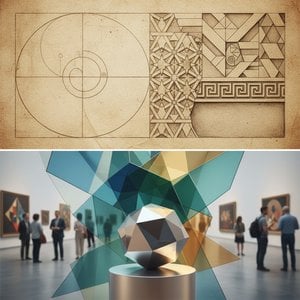
Geometric Design in Art: A Historical Survey & Contemporary Appeal for Collectors
Explore the enduring legacy of geometric abstraction! Discover key artists, historical movements & investment insights for discerning art collectors. Expert guidance from ArtsDot.

Geometric Abstraction's 10 Defining Masterpieces | Art for Your Home - ArtsDot
Explore 10 defining masterpieces of Geometric Abstraction! Discover Kandinsky, Mondrian & Malevich’s iconic works. Find museum-quality art reproductions and curated decor ideas to elevate your home at ArtsDot.com.

Beyond Form & Function: A History of Geometric Art's Enduring Appeal
Explore the captivating history of geometric abstraction, from its revolutionary origins to contemporary masters. Expert insights for art collectors & investors. Discover key artists and build your collection with ArtsDot.


