


The picture follows your choices: , .
Collectible Description
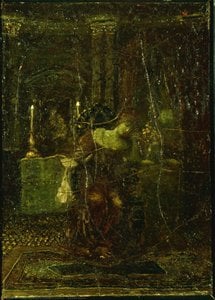
Discover 'The Monastery' by Albert Pinkham Ryder (1847-1917). A haunting tonalist landscape of ruins & mystery, evoking melancholy & solitude. Influential work by a pioneer of American Symbolism.
 Read More
Artist Biography
Discover Albert Pinkham Ryder (1847-1917), a visionary American painter renowned for his evocative seascapes, dreamlike landscapes & influence on modern art like Pollock. Explore Tonalism & Symbolism.
Hand Made Oil Reproduction
Hand-painted oil on canvas in your size and frame, made to order by our artists. ( Switch to Print Switch to Digital Image)
More about this painting
 Preview
 Send
Send Share
Share
 Details
 Guide
Guide

 Download
 Similars
 X-Ray
X-Ray Diaporama
 Q&A
Q&A Stats
StatsOrder your painting in four simple steps
Take your time. You can change any answer; the price in your order card follows each choice.
1 Step one of four
Which size would you like?
These sizes keep the proportions of the original painting. The drawing shows your choice on a wall, above a two-metre sofa.
Or give your own measurements
Pick from our preset sizes that match the artwork's original proportions.

Type the width and the height you need, to fit your frame or your wall. This is hand-painted, so for a size with a different shape the artist can paint a bit more around the picture, or cut a bit — you choose. We send you a digital mockup to approve before the painting starts. The picture shown on this page does not show the real result — only the mockup does.
2 Step two of four
How should it be prepared: rolled, stretched or framed?
The prices below are for the size you chose in step one.
Choose the edges of the stretched canvas
Choose your frame

White $1

Blurside $1

Extended $1

P118B $10

P118H $10

P118W $10

P438Z $10

P508JH $12

P508YH $12

P805H $10

P805Z $10

P919BZ $10

P919G $10

P919XJ $10

P959ZH $10

P968JZ $12

W106C $8

W218G $10

W218JH $8

W218Y $10

W307PJ $10

W316G $10

W316PJ $8

W316Y $10

W398PJ $8

W4111J $10

W500HY $15

W500JH $15

W692G $12

W849H $8

W940BG $15

W953PJ $8

H24-GOLD $30

H24-SILVER $30

H36-GOLD $45

H36-SILVER $45
Framed
Moulding: . Overall size with the frame: .
3 Step three of four
Would you like anything changed in the painting?
Most people answer no. Because each painting is made by hand, our artist can also adapt it for you.
After order, ArtsDot.com team will email client for instructions and provide a mockup preview
4 Step four of four
A few finishing options
All of them are optional. The answers already selected cost nothing extra.
Who paints it?
Worldwide Delivery () in 3/4 weeks instead of standard 5 weeks. (2 November). No compromise on quality.
A nameplate, as in a museum?
Engraved Bronze Plaque Details
This elegant plaque features the artist's name and the title of the artwork, finely engraved for a timeless presentation.
It is made from bronze with a refined, elegant finish. The text is precisely laser-engraved for a sharp and permanent result. Measuring 9x2 cm, the plaque is compact yet easy to read. It's built to be durable and scratch-resistant, offering a professional, museum-quality look. Mounting is simple thanks to the included adhesive backing.
Transparent Acrylic Plaque Details
The plaque includes essential engraved details such as the artist's name, the title of the artwork, the date it was created, the type of media used-like oil on canvas or watercolor-a brief description of the piece, and a QR code that links to the complete artwork information.
It is crafted from clear acrylic, offering a sleek, modern appearance. The text is UV-engraved in black to ensure strong visual contrast. With a size of 10x15 cm, it ensures optimal readability. It comes equipped with two metal hooks for secure wall mounting. The plaque is designed to be weather-resistant, making it suitable for various environments, and it includes interactive features that work seamlessly with smartphone scanning.
Black Acrylic Plaque Details
This elegant plaque includes engraved information such as the artist's name, the title of the artwork, the date it was created, the type of media used (like oil on canvas or watercolor), a short description of the artwork, and a QR code for quick access to more information.
The plaque itself is made from refined black acrylic with a premium finish. The text is laser-engraved in white for high contrast and readability. Its size is 10x15 cm, designed to be easy to read. It comes with two metal hooks for professional mounting. The design is sleek and fits any interior style. It is also weather-resistant and durable, with built-in digital integration for mobile compatibility.
A protective varnish?
When do you need it?
✓ Check and order
Your painting, as you ordered it

The Monastery
Reproduction Medium
Reproduction Size
-

Elite Senior Artist
More detail, finesse, and extra production time
-

Reproduction Frame
-
-
For artworks or reproductions larger than 105 cm (approximately 41 inches) on any side, the frame will be shipped as a kit, disassembled. This method ensures safe delivery and prevents damage during transport.
Professional assembly required - this is not a DIY product.
The kit must be assembled and the canvas stretched by an experienced professional framer, using wood glue (not supplied), a canvas stretching plier and clamps to hold the bars square while the glue dries. Incorrect assembly or uneven canvas tension can permanently damage the artwork and is not covered by our warranty.
 For artworks or reproductions larger than 105 cm (approximately 41 inches) on any side, the frame will be shipped as a kit, disassembled. This method ensures safe delivery and prevents damage during transport.
All solid wood bars are included, precisely cut to size.
Assembled with the screws provided, plus wood glue for the corner joints, which is not supplied and must be sourced by your framer.
Professional tools are required and not included: a canvas stretching plier (tensioner) and clamps to hold the bars square while the glue dries.
Important:
The corner joints require wood glue, the bars must be held with clamps until the glue is fully dry, and tightening the canvas on the assembled frame requires a canvas stretching plier. None of these are included in the kit. Please arrange an experienced professional framer before ordering this size.

Nameplate
-
-

Protective Varnish
Glossy Varnish (enhances colors, protects against light/moisture)
-

Customize My Artwork
Examples of what can be changed: Replace face with customer photo; Add pet (e.g., replace cat with dog); Include hidden message in background; Change background landscape or elements.
-

Urgent
Worldwide Delivery () in 3/4 weeks instead of standard 5 weeks. (2 November). No compromise on quality.
-
Express Shipping
Worldwide Delivery () in 5 weeks. (9 November).
Included
Total Price
$ 263
Glass option is only available in size under 110 CM
Included with every order
- Free Worldwide Express Shipping
- High-Quality Linen Canvas
- Full Shipping Insurance
- Customs Tax Refund Guarantee
- True Color Matching Guarantee
- 100-Day Return Policy (Defects Only)
- 100% Money-Back Guarantee
- Bulk Discount Offer


A Vision of Decay and Transcendence
In the shadowy recesses of American art history, few figures loom as enigmatically as Albert Pinkham Ryder. His masterpiece, “The Monastery,” painted around 1885, serves as a profound window into a psyche that sought not to replicate the world, but to evoke its hidden, spiritual essence. The painting presents a hauntingly beautiful landscape where ancient, crumbling architecture sits partially submerged in a dark expanse of water. It is a scene that feels less like a documented location and more like a fragment of a dream, captured in the quiet moments before dawn or during the heavy shroud of a rain-soaked twilight. Through his unique lens, Ryder transforms a desolate ruin into a site of profound contemplation, inviting the viewer to look past the surface of decay to find a flickering, eternal light.
The technical execution of “The Monastery” is nothing short of visceral. Eschewing the precise, academic clarity favored by many of his contemporaries, Ryder employed a thick, textured application of oil on canvas that gives the work a palpable, weathered skin. The palette is masterfully restrained, dominated by deep ochres, somber blacks, and muted browns that bleed into one another through loose, expressive brushwork. This deliberate blurring of edges creates an atmospheric depth, suggesting a misty environment where the boundaries between stone, water, and sky are perpetually dissolving. For the discerning collector or interior designer, this heavy texture and organic movement offer a sophisticated tactile quality, making the piece a commanding focal point that breathes life into any space through its sheer physical presence.
Symbolism and the Poetics of Solitude
Beyond its striking aesthetic, “The Monastery” is steeped in a rich layer of symbolism that resonates with the themes of Romanticism and early Modernism. The ruins themselves act as powerful metaphors for the passage of time and the inevitable impermanence of human endeavor. Yet, there is no sense of mere tragedy here; instead, there is a sense of transcendence. As Ryder famously noted to an impatient patron, “To an impatient eye it may seem like nothing but darkness; but I assure you there is light.” This philosophy is embedded in the very soul of the composition. The way the subdued, diffused light catches the edges of the crumbling forms suggests that even within dissolution and loss, there remains a sacred, enduring spirit.
For those seeking to incorporate art into a curated environment, this painting offers an unparalleled emotional depth. It evokes feelings of solitude, melancholy, and a quiet, introspective peace. It is a work designed for slow looking—a piece that rewards the patient observer with new layers of meaning and mood each time it is encountered. Whether placed in a library, a study, or a contemporary living space, a high-quality reproduction of “The Monastery” brings with it an aura of historical weight and poetic mystery, serving as a constant reminder of the beauty found in the ephemeral and the profound strength found in stillness.
Questions & Answers
How strong are the colors of "The Monastery"?
The colors of "The Monastery" by Albert Pinkham Ryder show a subtle color saturation with a monochromatic intensity.
How much light do the colors of "The Monastery" appear to reflect?
The luminance recorded for "The Monastery" by Albert Pinkham Ryder is dark.
Can I see "The Monastery" by Albert Pinkham Ryder on my own wall before buying?
"The Monastery" has an augmented reality preview: the artwork's AR Preview page shows it in your own space on a compatible device.
Related Artworks


Albert Pinkham Ryder
1847 - 1917, United States of America
Artist Biography
Early Life and Artistic Beginnings
Albert Pinkham Ryder, born March 19, 1847, in New Bedford, Massachusetts, remains a somewhat enigmatic figure in American art history. Details of his childhood are scarce, shrouded in the mists that would later become so characteristic of his paintings. However, it is known that he began to explore his artistic inclinations early on, capturing the landscapes of his native New Bedford with nascent skill. This coastal upbringing, steeped in the atmosphere of a bustling whaling port, undoubtedly left an indelible mark on his imagination and would resurface throughout his career as a recurring source of inspiration.
In the late 1860s, Ryder’s family relocated to New York City, where his brother managed the renowned Hotel Albert in Greenwich Village. This move placed young Albert within a vibrant cultural milieu, offering opportunities for artistic development and exposure to new ideas. While assisting with family responsibilities, he continued to pursue his passion for painting, laying the groundwork for his future artistic journey.
Formal Training and European Influences
Ryder’s formal art education began with studies under William Edgar Marshall in New York City. He then enrolled at the National Academy of Design, attending between 1870 and 1875, where he exhibited his first work in 1873 and forged a lifelong friendship with fellow artist Julian Alden Weir. These formative years provided him with a solid foundation in traditional techniques and introduced him to the established art world.
However, Ryder’s artistic vision extended beyond conventional academic training. Between 1877 and 1903, he embarked on four journeys to Europe, immersing himself in the artistic currents of the Old World. He was particularly drawn to the French Barbizon school, with its emphasis on naturalism and plein air painting, and the Dutch Hague School, known for its atmospheric landscapes and muted color palettes. These influences profoundly shaped his aesthetic sensibilities, contributing to the development of his unique style.
A Unique Artistic Vision: Style and Themes
Albert Pinkham Ryder’s artistic signature is instantly recognizable—a captivating blend of Symbolism, Tonalism, and a deeply personal vision. His paintings are not mere representations of reality but rather evocative interpretations of nature infused with mood, mystery, and spiritual resonance. He favored broad, often ill-defined shapes and stylized figures set within dreamlike landscapes or seascapes, creating an atmosphere that is both ethereal and haunting.
Light plays a crucial role in Ryder’s work. His scenes are frequently illuminated by dim sunlight filtering through eerie clouds or the soft glow of moonlight, casting long shadows and enhancing the sense of drama and introspection. He masterfully manipulated color to create subtle variations and atmospheric effects, often employing a limited palette to achieve maximum emotional impact.
Notable works such as Misty Moonlight, inspired by his childhood memories of coastal New Bedford, exemplify Ryder’s ability to transform personal experiences into universal expressions of longing and contemplation. Other significant paintings, like Siegfried and the Rhine Maidens, demonstrate his fascination with mythology and symbolism.
Later Years and Lasting Legacy
After 1900, Ryder's creative output diminished significantly. He became increasingly reclusive, spending much of his time reworking existing paintings in a relentless pursuit of perfection. Despite this decline in productivity, his earlier works continued to garner attention and admiration.
Albert Pinkham Ryder passed away on March 28, 1917, leaving behind a body of work that continues to captivate audiences today. A memorial exhibition held at the Metropolitan Museum of Art in New York in 1918 solidified his reputation as a major figure in American art.
Ryder’s influence extends far beyond his immediate contemporaries. His emphasis on form, color, and emotional expression paved the way for later generations of artists, including Jackson Pollock, who acknowledged Ryder as a significant precursor to Abstract Expressionism. He remains celebrated as a pioneer of American Tonalism and Symbolism, an artist whose mystical paintings continue to inspire awe and wonder.
Key Characteristics of Albert Pinkham Ryder’s Art
- Dreamlike Atmospheres: His landscapes and seascapes evoke a sense of mystery and otherworldliness.
- Symbolism & Mythology: Frequent use of symbolic imagery and references to mythological narratives.
- Tonalist Influences: Subtle variations in color and emphasis on atmospheric effects.
- Emotional Resonance: Paintings that convey a deep sense of longing, contemplation, and spiritual yearning.
- Unique Brushwork: Broad, expressive brushstrokes that contribute to the overall mood and texture.




Related Articles

Albert Goodwin: Capturing Victorian Light & Atmosphere – A Study in Landscape Painting
Explore the captivating landscapes of Albert Goodwin (1845-1932), a celebrated Victorian watercolourist influenced by Turner & Ruskin. Discover his techniques, prolific collection, and lasting legacy in British art history.

Romantic Landscapes: 10 Masterpieces for Your Home | ArtsDot
Journey through 10 Romantic landscape masterpieces by Friedrich, Turner & Cole. Explore emotional art, sublime nature scenes & iconic 19th-century paintings. Find museum-quality reproductions for your home at ArtsDot.com – discover the full collection online!

Mastering the English Landscape: The Top 25 John Constable Artworks
Experience the soul of English landscapes through John Constable's top 25 works. Explore the full collection online at ArtsDot.com.