

 Preview
 Send
Send Share
Share
 Details
 Guide
Guide

 Download
 Similars
 X-Ray
X-Ray Diaporama
 Q&A
Q&A Stats
StatsGrey Day

- 39.0 x 59.0 cm


 Read More
The artwork displayed on this page is protected by copyright law, which means we cannot legally create or sell an identical reproduction. This protection is enforced under international agreements such as the Berne Convention and by national laws, including those outlined by the U.S. Copyright Law - Title 17.
This method fully complies with copyright regulations because it does not involve copying or duplicating the protected artwork. Instead, it is a creative reinterpretation - a new painting that is influenced by the original but not identical to it.
Giclée / Art Print
Museum-quality giclée or canvas print with fast production and flexible finish options. ( Buy Hand Made Painting Switch to Digital Image)




































Pick from our preset sizes that match the artwork's original proportions.

Type the width and the height you need, to fit your frame or your wall. A print can only be cut, never made bigger than the picture, so a size with a different shape loses a part of the image. We send you a digital mockup to approve before we print anything. The picture shown on this page does not show the real cut — only the mockup does.
Worldwide Delivery () in 2 weeks instead of standard 4/5 weeks. (6 November)

Free Worldwide Express Shipping

High-Quality Linen Canvas

Full Shipping Insurance

Customs Tax Refund Guarantee

True Color Matching Guarantee

100-Day Return Policy (Defects Only)

100% Money-Back Guarantee

Bulk Discount Offer
 Glass option is only available in size under 110 CM

Grey Day
Giclée / Art Print
Reproduction Size
-


Total Price
$ 63
The Artist's Background
Adolf Dehn was an American artist known for his work in lithography, illustration, drawing, watercolors, and casein painting. Born on November 22, 1895, in Waterville, Minnesota, Dehn began creating artwork at the age of six and went on to produce nearly 650 images throughout his career. He was a two-time recipient of the Guggenheim Fellowship and was known for his technical skills and high-spirited depictions of human foibles.The Painting
Grey Day is a beautiful example of Dehn's work, showcasing his ability to capture the essence of everyday life. The piece features a cityscape with snow on the ground, trees that have lost their leaves, and people scattered throughout the scene. Two dogs are also present in the painting, adding a touch of warmth and humanity to the otherwise cold and snowy landscape.- Medium: Color lithograph on paper
- Size: 15 3/8 x 23 1/4 in.
- Location: Smithsonian American Art Museum
To learn more about Adolf Dehn and his work, check out his biography on Wikipedia.
Questions & Answers
What color saturation does "Grey Day" by Adolf Dehn have?
The colors of "Grey Day" by Adolf Dehn have a balanced soft saturation. Saturation describes how vivid or muted the colors are.
Is "Grey Day" by Adolf Dehn in the public domain, and why?
The copyright status of "Grey Day" - still protected by copyright - follows from the artist's death in 1968.
What is "Grey Day" about?
"Grey Day" by Adolf Dehn depicts: winter scene, cityscape, snowfall, urban landscape, dehn artwork, american art, 1960s art, gray palette.
Related Artworks


Artist Biography
Early Life and Education
- Born: November 22, 1895, in Waterville, Minnesota
- Parents: Arthur Clark Dehn (father) and Emilie Haas Dehn (mother), both socialists.
- Early artistic talent evident from the age of six.
- Graduated as valedictorian from Waterville High School in 1914.
- Attended the Minneapolis School of Art (later Minneapolis College of Art and Design) from 1914 to 1917. Studied under Robert Kohler.
- Formed a close friendship with Wanda Gág, also an artist.
- Received a scholarship to the Art Students League of New York in 1917.
World War I and Early Career
- Drafted into World War I in 1918 but declared himself a conscientious objector.
- Imprisoned for four months in Spartanburg, South Carolina, due to his objection.
- Later worked as a painting teacher at an army rehabilitation hospital in Asheville, North Carolina.
- Returned to the Art Students League for further study.
- Created his first lithograph, *The Harvest*, around 1920.
- Exhibited his lithographs at the Weyhe Gallery in New York City in 1921.
European Period and Development as an Artist
- Traveled to Europe in 1921, residing primarily in Paris and Vienna.
- Associated with a group of intellectuals and artists including Andrée Ruellan, Gertrude Stein, and E.E. Cummings.
- Supported himself through illustration work for magazines like *Vanity Fair*.
- Developed his distinctive style characterized by unusual tonal and textural effects in printmaking.
- His work began to reflect the social scene of Europe, particularly Vienna and Berlin.
Return to America and Mature Artistic Style
- Returned to New York City in 1929.
- Artwork featured in magazines such as *The New Yorker* and *Vogue*.
- Began focusing on watercolor painting in the mid-1930s, achieving significant recognition.
- Received a Guggenheim Fellowship in 1939, enabling travel to the Western United States and Mexico.
- His watercolors depicted scenes of farms and farmlands in rural America, inspired by trips back to Minnesota.
- Became known for his vibrant landscapes and depictions of everyday life.
- Second Guggenheim Fellowship awarded in 1951.
Legacy and Historical Significance
- Elected as a full academician to the National Academy of Design and a member of the National Institute of Arts and Letters.
- His works are held in over 100 museums worldwide, including the Smithsonian American Art Museum, Metropolitan Museum of Art, and Museum of Modern Art.
- Recognized for his contributions to lithography, watercolor painting, and caricature.
- Influenced other artists, notably Jackson Pollock, with his innovative techniques.
- Died on May 19, 1968, leaving behind a prolific body of work that reflects his diverse experiences and artistic evolution.
- His art is considered representative of Regionalism, Social Realism, and caricature movements in American art.

Adolf Dehn
1895 - 1968 , United States of America
Quick Facts
- Full Name: Adolf Dehn
- Nationality: American
- Date Of Birth: 1895
- Date Of Death: 1968
- Place Of Birth: Waterville, United States of America
- Artistic Movement Or Style:
- Regionalism
- Social Realism
- Caricature
- Artists Or Movements Influenced By This Artist: ['Jackson Pollock']
Related Articles

Gainsboro's Palette: 10 Masterpieces of Subtle Tone & Timeless Art | ArtsDot
Explore 10 iconic paintings defined by Gainsboro's subtle grey tones & masterful portraiture. Discover the stories behind Thomas Gainsborough and Rococo art’s elegance. Find museum-quality reproductions for your home at ArtsDot.com.

Whistler's Masterpieces: Explore 25 Iconic Paintings & Aesthetic Art for Your Home
Journey through 25 iconic James Abbott McNeill Whistler paintings! Explore his masterpieces of Aestheticism, from 'Nocturne in Black and Gold' to captivating portraits. Find museum-quality art reproductions & elevate your home decor with ArtsDot.com. Discover the full collection online.
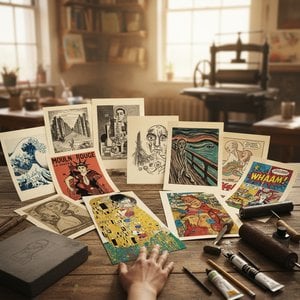
Top 10 Lithographs That Revolutionized Art | ArtsDot
Explore 10 legendary lithographs by Toulouse-Lautrec, Munch & Picasso that redefined art! Discover the stories behind these iconic prints and find museum-quality reproductions for your home decor at ArtsDot.com. Explore the full collection online.

Josef Kriehuber: A Life Immersed in Viennese Topography – From Lithographic Precision to Romantic Observation
Explore the life and work of Josef Kriehuber, a master lithographer who captured 19th-century Vienna. Discover his portraits of nobility, landscapes, & artistic techniques. A guide for collectors & art enthusiasts.

25 Iconic Roy Lichtenstein Masterpieces That Defined Pop Art
Explore 25 iconic Roy Lichtenstein Pop Art masterpieces. Discover the stories behind these legends on ArtsDot.com.


