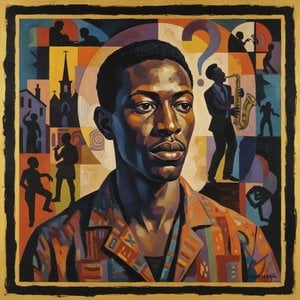
A Tapestry of Resilience: The Soulful Vision of William H. Johnson
The story of William Henry Johnson is one of profound transformation, a journey that began in the humble landscapes of Florence, South Carolina, and ascended to the heights of the international modernist stage. Born in 1901 into a poor African American family during the era of Jim Crow, Johnson’s early life was shaped by the rhythms of the American South—the spiritual echoes of gospel music, the richness of oral storytelling, and the deep-seated traditions of his heritage. This foundational connection to Black culture would later serve as the heartbeat of his most enduring works, providing a wellspring of imagery that transcended mere representation to reach the realm of the universal.
His path toward artistic mastery was paved with immense personal determination. Moving to New York at the age of seventeen, Johnson worked tirelessly to fund his education at the prestigious National Academy of Design. In the halls of the academy, he mastered the rigorous, classical standards of European tradition, yet his spirit remained tethered to the vibrant textures of his roots. This tension between formal academic training and a yearning for cultural authenticity would become the defining characteristic of his evolving style.
From European Modernism to Folk Art Mastery
The late 1920s marked a pivotal departure in Johnson’s career as he traveled to Europe, immersing himself in the avant-garde movements of France. It was during this period of wandering and discovery that his brushwork began to shed its classical constraints, embracing the emotional intensity of Expressionism. His time in Scandinavia, particularly his marriage to the Danish artist Holcha Krake, introduced him to the aesthetics of primitivism and folk art. These influences acted as a catalyst, prompting him to simplify forms and utilize bold, unadorned colors to convey deeper psychological truths.
Upon returning to the United States in 1938, Johnson emerged as a vital voice of the Harlem Renaissance. He did not merely observe African American life; he celebrated it through a unique visual language that blended modernist abstraction with a soulful, folk-inspired aesthetic. His canvases became windows into the dignity of the Black experience, utilizing techniques such as impasto to create palpable textures that mirrored the grit and grace of his subjects. Whether depicting the rhythmic energy of dancers in works like Jitterbugs (III) or the serene stillness of a seated figure, Johnson’s work possessed an unmistakable emotional clarity.
A Legacy of Cultural Significance
The significance of William H. Johnson lies in his ability to weave together disparate worlds—the spiritual and the secular, the local and the global, the classical and the primitive. His oeuvre is a monumental archive of African American identity, featuring subjects that range from historical icons like Harriet Tubman to the everyday beauty of rural landscapes and social gatherings. Notable masterpieces such as The Black Christ demonstrate his profound use of Yoruba symbolism, bridging the gap between ancestral spirituality and contemporary struggle.
Though he faced periods of being overlooked by the mainstream art establishment during his lifetime, Johnson’s legacy has undergone a powerful reclamation. Today, he is recognized not just as a painter of his era, but as a visionary who transformed the language of modernism to honor the resilience of his people. His life remains a testament to the power of art to preserve history, celebrate identity, and find beauty within the most complex human experiences.
Questions & Answers
Where can I see the color profile of William H. Johnson's work?
William H. Johnson's use of color across the works listed on this website can be studied on the artist's Palette Genome page.
Can I sort William H. Johnson's artworks by color?
William H. Johnson's works can be explored by color on the artist's Spectral Index page.
Is there an overview of all the subjects William H. Johnson painted?
The Subject Atlas of William H. Johnson is a page that maps the artist's artworks by their subjects.