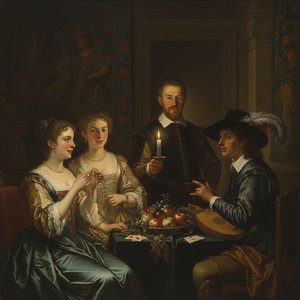
Willem van Mieris (1662 - 1747): The Master of Elegant Detail
Willem van Mieris (1662-1747) stands as a pivotal figure in the Leiden fijnschilders’ movement, embodying the culmination of Dutch Baroque artistic ideals. Born in Leiden on June 3rd, 1662, he descended from a lineage steeped in artistic tradition—his father, Frans van Mieris the Elder (1635-1681), was himself a celebrated genre painter who had established a formidable reputation for capturing the nuances of upper-class society. This familial legacy profoundly shaped Willem’s formative years and instilled within him an unwavering dedication to upholding his father's esteemed position as Leiden’s foremost fijnschilder—a commitment that would define his entire artistic career.- Early Training & Influences:
- Frans van Mieris the Elder’s profound impact on Willem’s technique and aesthetic sensibilities cannot be overstated. Guided by the tutelage of his father, Willem honed his skills under the watchful eye of Gerrit Dou (1613-1675), a master of chiaroscuro and meticulous observation—a stylistic approach that would become synonymous with Leiden fijnschilders.
The Leiden Tradition & Pieter Post’s Vision
Willem van Mieris's artistic trajectory was inextricably linked to the broader intellectual currents of his time. The influence of Pieter Post (1659-1734), a Dutch art theoretician and humanist, proved particularly transformative. Post championed the notion that genre painters should transcend mere representation—rather, they ought to elevate their subjects through classical ideals of beauty and proportion. This conviction spurred Willem to meticulously analyze sculptural masterpieces from antiquity, incorporating their compositional principles into his paintings.A Career Defined by Patronage & Artistic Innovation
Willem’s professional life unfolded amidst a landscape of considerable artistic patronage—he secured commissions from prominent figures such as Madam Oortmans and Pieter de la Court van der Voort, cementing his reputation as one of Leiden's most sought-after artists. Notably, he served as Dean of the Guild of Saint Luke in 1693, demonstrating not only his artistic prowess but also his engagement with the intellectual and social fabric of Leiden.Style & Technique: The Pursuit of Perfection
Willem van Mieris’s distinctive style—characterized by an unparalleled attention to detail and a masterful command of chiaroscuro—represented the apex of Leiden fijnschilders' artistic ambition. Like his father, Willem meticulously studied the works of Gerrit Dou, adopting his technique and stylistic approach. He skillfully rendered textures and surfaces with remarkable accuracy, capturing subtle nuances that breathed life into his subjects. Furthermore, he frequently employed classical poses borrowed from sculptures by Francis van Bossuit—a deliberate gesture aimed at elevating genre painting to the level of monumental art.Legacy & Historical Significance
Willem van Mieris’s oeuvre comprises a vast collection of genre scenes and portraits, reflecting the tastes and sensibilities of his era. His paintings offer invaluable insights into Dutch society during the Baroque period—depicting opulent interiors, refined costumes, and psychologically astute portrayals of human character. Willem's enduring influence extends beyond his artistic achievements; he established Leiden’s Drawing Academy alongside Jacob Toorenvliet and Carel de Moor, fostering a new generation of artists committed to upholding the Leiden tradition—a legacy that continues to resonate within Dutch art history today.Questions & Answers
Can I browse Willem van Mieris's works by color palette?
Willem van Mieris's works can be browsed by color palette on the artist's By Palettes page.
Where are Willem van Mieris's artworks grouped by keywords?
Willem van Mieris's works can be explored by keyword on the artist's By Keywords page. Each keyword groups the related artworks.
Where are Willem van Mieris's artworks grouped by art movement?
Willem van Mieris's works can be browsed by movement on the artist's All Movements page.