Portrait of Albert Anker

Albert Anker's Most Famous Paintings: All 83, Ranked

Updated October 2026 · ranked by our popularity score (searches, visits and orders for each work) · 83 works by Albert Anker in our catalogue

In short

The Albert Anker painting most people know is Writing lessons (also known as Schreibunterricht) (1865). Right after it come The Prodigal Son (1858) and Sunday afternoon (1862). Out of 83 works by Albert Anker in our catalogue, these 83 are the best known. Each one comes with its year, its museum and a short note on what makes it stand out.

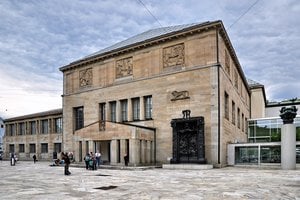
1831 – 1910, Ins Realism Most works: Kunsthaus Zürich

Albert Anker's top 10: the pieces everyone knows

1
Writing lessons (also known as Schreibunterricht) (1865) by Albert Anker

Writing lessons (also known as Schreibunterricht)

1865 · Oil On Canvas

Writing lessons (also known as Schreibunterricht) is an oil on canvas work by the Swiss artist Albert Anker. Executed in 1865, the painting captures a quiet moment of instruction between two children. The piece gained early recognition when it was exhibited at the Salon Paris in 1866, appearing as entry number 28.

Keep exploring Albert Anker: 11 to 83

11The Milk Soup at Kappel (1869) by Albert AnkerThe Milk Soup at Kappel1869 · Kunsthaus Zürich 12Bathers (1865) by Albert AnkerBathers1865 13The song of the homeland (1874) by Albert AnkerThe song of the homeland1874 14The little knitters (1875) by Albert AnkerThe little knitters1875 · Kunst Museum Winterthur | Reinhart am Stadtgarten 15Porträt der Emilie Weiss (1874) by Albert AnkerPorträt der Emilie Weiss1874 16An Old Huguenot (1875) by Albert AnkerAn Old Huguenot1875 17Young mother contemplating her sleeping child in candlelight (1875) by Albert AnkerYoung mother contemplating her sleeping child in candlelight1875 18The artist's daughter Louise (1874) by Albert AnkerThe artist's daughter Louise1874 · Kunst Museum Winterthur | Reinhart am Stadtgarten 19Queen Bertha and the Spinners (1881) by Albert AnkerQueen Bertha and the Spinners1881 · Musée cantonal des Beaux-Arts 20Children at Breakfast (1879) by Albert AnkerChildren at Breakfast1879 · Kunstmuseum Basel 21Girl with a cat (1881) by Albert AnkerGirl with a cat1881 22Boy in a red waistcoat (1885) by Albert AnkerBoy in a red waistcoat1885 23Knitting girl watching the toddler in a cradle (1885) by Albert AnkerKnitting girl watching the toddler in a cradle1885 24Portrait of a girl (1885) by Albert AnkerPortrait of a girl1885 25Schoolgirl doing homework (1879) by Albert AnkerSchoolgirl doing homework1879 26The Genius of Death (1890) by Albert AnkerThe Genius of Death1890 27Fleissig / Appliquée (1886) by Albert AnkerFleissig / Appliquée1886 28Knitting girl (1888) by Albert AnkerKnitting girl1888 29Girl playing with cat (1887) by Albert AnkerGirl playing with cat1887 30Girl peeling potatoes (1886) by Albert AnkerGirl peeling potatoes1886 31Girl Braiding Her Hair (1887) by Albert AnkerGirl Braiding Her Hair1887 32Civil marriage (1887) by Albert AnkerCivil marriage1887 · Kunsthaus Zürich 33Portrait of a Girl in Bernese Costume (1897) by Albert AnkerPortrait of a Girl in Bernese Costume1897 34The Poor Man's Soup (1893) by Albert AnkerThe Poor Man's Soup1893 · Kunstmuseum Bern 35Girl eating soup (1898) by Albert AnkerGirl eating soup1898 36Bertha Gugger with daughter (1898) by Albert AnkerBertha Gugger with daughter1898 37The Zaeslin siblings (1896) by Albert AnkerThe Zaeslin siblings1896 38Old Man drinking Herbal Tea (1895) by Albert AnkerOld Man drinking Herbal Tea1895 39Reading Girl (1905) by Albert AnkerReading Girl1905 40Old man eating Mid-Morning Snack (Gyp) (1901) by Albert AnkerOld man eating Mid-Morning Snack (Gyp)1901 41Boy with Slate Tablet (1910) by Albert AnkerBoy with Slate Tablet1910 42Girl with Loaf of Bread (1910) by Albert AnkerGirl with Loaf of Bread1910 43Reading Old Farmer (1910) by Albert AnkerReading Old Farmer1910 44Girl with Slate Tablet (1910) by Albert AnkerGirl with Slate Tablet1910 45The Convalescent (1908) by Albert AnkerThe Convalescent1908 46Boy with a hat eating (1910) by Albert AnkerBoy with a hat eating1910 47Old farmer at the table (22 April 1907) (1907) by Albert AnkerOld farmer at the table (22 April 1907)1907 48Still Life: Two Glass of Red Wine, a Bottle of Wine, a Corkscrew and a Plate of Biscuits on a Tray by Albert AnkerStill Life: Two Glass of Red Wine, a Bottle of Wine, a Corkscrew and a Plate of Biscuits on a Tray 49The LIttle Musician (1873) by Albert AnkerThe LIttle Musician1873 50The Whistle Carver (1858) by Albert AnkerThe Whistle Carver1858 51An Interior with Mother and Children (1870) by Albert AnkerAn Interior with Mother and Children1870 52Still-life: Tea and Melted Bread (1873) by Albert AnkerStill-life: Tea and Melted Bread1873 53Still life with coffee setting and cognac bottle (1882) by Albert AnkerStill life with coffee setting and cognac bottle1882 54Sierre (1880) by Albert AnkerSierre1880 55Farmhouse parlor with green stove (1883) by Albert AnkerFarmhouse parlor with green stove1883 56Portrait of a Young Boy (1890) by Albert AnkerPortrait of a Young Boy1890 57Still life: Tasteful tea (1897) by Albert AnkerStill life: Tasteful tea1897 58Still Life with Wine and Chestnuts (1897) by Albert AnkerStill Life with Wine and Chestnuts1897 59Still-Life with Coffee, Milk and Potatoes (1896) by Albert AnkerStill-Life with Coffee, Milk and Potatoes1896 · Kunstmuseum Bern 60Der alte Feissli mit Kind auf Ofenbank (1898) by Albert AnkerDer alte Feissli mit Kind auf Ofenbank1898 61Still life, herrings (1899) by Albert AnkerStill life, herrings1899 62Strickende junge Frau mit Blumenstrauss (1903) by Albert AnkerStrickende junge Frau mit Blumenstrauss1903 63Der Schaffner (1899) by Albert AnkerDer Schaffner1899 64At the cemetery by Albert AnkerAt the cemetery 65Knitting Bernese woman with child by Albert AnkerKnitting Bernese woman with child 66Sitting bioy peeling vegetables by Albert AnkerSitting bioy peeling vegetables 67Portrait of a Girl by Albert AnkerPortrait of a Girl 68Portrait of a girl by Albert AnkerPortrait of a girl 69Sleeping girl on a wooden bench by Albert AnkerSleeping girl on a wooden bench 70Farmer reading in Bed I by Albert AnkerFarmer reading in Bed I 71Unterwalden (traditional costumes after Josef Reinhart) by Albert AnkerUnterwalden (traditional costumes after Josef Reinhart) 72A Farmer's Wife, Sewing by Albert AnkerA Farmer's Wife, Sewing 73Portrait of boy by Albert AnkerPortrait of boy 74Farmer with his cap holding his pen in his mouth and reading a letter by Albert AnkerFarmer with his cap holding his pen in his mouth and reading a letter 75Portrait of a Young Girl by Albert AnkerPortrait of a Young Girl 76Child at a Table (1908) by Albert AnkerChild at a Table1908 77Portrait of a girl with red necklace by Albert AnkerPortrait of a girl with red necklace 78Two Girls on the Stove Bench (1895) by Albert AnkerTwo Girls on the Stove Bench1895 · Kunsthaus Zürich 79Corner of a Room with Laundry Basket by Albert AnkerCorner of a Room with Laundry Basket 80Peasant Woman by Albert AnkerPeasant Woman 81A Seated Farmer with a Pipe by Albert AnkerA Seated Farmer with a Pipe 82Portrait of a girl by Albert AnkerPortrait of a girl 83Creche (1890) by Albert AnkerCreche1890 · Kunst Museum Winterthur | Reinhart am Stadtgarten

What Albert Anker painted most

The four subjects that come up most often in these pieces, each with its best-known example.

Where you can see Albert Anker's paintings

The 7 museums that hold the most of the paintings on this page.

Museum City Works by Albert Anker Paintings from this list
Kunsthaus Zürich, ZurichKunsthaus Zürich Zurich 3 The Milk Soup at Kappel, Civil marriage, Two Girls on the Stove Bench
Kunst Museum Winterthur | Reinhart am Stadtgarten, WinterthurKunst Museum Winterthur | Reinhart am Stadtgarten Winterthur 3 The little knitters, The artist's daughter Louise, Creche
Musee d'art et d'histoire, NeuchâtelMusee d'art et d'histoire Neuchâtel 2 Sunday afternoon, The Bourbakis
Kunstmuseum Bern, БернKunstmuseum Bern Берн 2 The Poor Man's Soup, Still-Life with Coffee, Milk and Potatoes
Palais des Beaux-Arts de Lille, LillePalais des Beaux-Arts de Lille Lille 1 In the Woods
Musée cantonal des Beaux-Arts, LosannaMusée cantonal des Beaux-Arts Losanna 1 Queen Bertha and the Spinners
Kunstmuseum Basel, BaselKunstmuseum Basel Basel 1 Children at Breakfast

One famous Albert Anker piece for every decade

Works per decade

Pick a decade to see its standout piece.

Albert Anker paintings: what people want to know

What painting is Albert Anker best known for?See the answer

Top of the list is Writing lessons (also known as Schreibunterricht) (1865). Right behind it: The Prodigal Son (1858) and Sunday afternoon (1862).

How old was Albert Anker at the time of Writing lessons (also known as Schreibunterricht)?See the answer

34 years old. Albert Anker was born in 1831, and Writing lessons (also known as Schreibunterricht) dates from 1865.

Which 10 Albert Anker paintings are the most famous?See the answer

Writing lessons (also known as Schreibunterricht), The Prodigal Son, Sunday afternoon, The Bourbakis, In the Woods, The Wine Festival, Betende im Beinhaus von Stans, Baptism, Boy at table II and Girl, drinking coffee. You'll find the year and the museum of each in the list above.

How many Albert Anker works are there?See the answer

We have 83 works by Albert Anker in our catalogue, dated 1858 to 1910.

Which museums have Albert Anker's best-known paintings?See the answer

You'll find most of them in Kunsthaus Zürich (Zurich), Kunst Museum Winterthur | Reinhart am Stadtgarten (Winterthur) and Musee d'art et d'histoire (Neuchâtel). The museum list above has the full breakdown.

When were Albert Anker's most famous pieces painted?See the answer

In 1890s, more than any other time: 16 of the 83 pieces on this page date from then, The Genius of Death among them.

What are the oldest and newest famous paintings by Albert Anker?See the answer

The earliest piece here is The Prodigal Son (1858); the most recent is Boy with Slate Tablet (1910).

What did Albert Anker paint most?See the answer

Children (3), Rural life (3) and Swiss art (3), out of the 83 pieces on this page.

What did Albert Anker usually paint with?See the answer

Oil On Canvas, used in 2 of the 83 pieces on this page.

Which art movement is Albert Anker linked to?See the answer

Realism and Contemporary realism, as you can see in the pieces on this page.

What can you see by Albert Anker at the Kunsthaus Zürich?See the answer

You can see 3 of the pieces on this page at the Kunsthaus Zürich, Zurich, including The Milk Soup at Kappel, Civil marriage and Two Girls on the Stove Bench.

Can I order a Albert Anker reproduction for my home?See the answer

Yes. Every painting on this page is available as a hand-painted oil reproduction or a print, in the size that suits you. Just open the painting's page to order.

Meet Albert Anker

Early Life and Artistic Beginnings

Albert Samuel Anker, a name synonymous with idyllic Swiss scenes and heartwarming portrayals of rural life, was born on April 1st, 1831, in the small town of Ens, Switzerland. His father, Samuel Anker, was a respected veterinarian who also served within the political arena as a member of the Canton of Bern’s constituent assembly. This blend of scientific practicality and civic duty would subtly influence young Albert's own path. The family relocated to Neuchâtel in 1836, providing a new landscape for his developing sensibilities. It was here that Anker first demonstrated an aptitude for art, receiving initial guidance from Frédéric-Wilhelm Moritz, sparking a passion that would define his life’s work. He continued his formal training alongside Auguste Bachelin under the tutelage of Louis Wallinger from 1845 to 1848, laying a solid foundation in draftsmanship and observation. However, Anker's early ambitions weren’t solely artistic; he pursued theological studies at the Universities of Bern and Halle in Germany after completing his Matura in 1851. It was during these academic years, surrounded by rich art collections, that his dedication to painting solidified, ultimately gaining his father’s blessing in 1854 to pursue a career as an artist.

Parisian Influences and the Development of a Distinct Style

The decision to dedicate himself to art led Anker to Paris, the epicenter of artistic innovation during the mid-19th century. He enrolled at the prestigious École nationale supérieure des Beaux-Arts, studying under Charles Gleyre. This period proved pivotal in his development, exposing him to contemporary French trends and solidifying his technical skills. While absorbing influences from the Realist movement—a reaction against Romanticism that emphasized depicting life as it truly was—Anker didn’t simply mimic its tenets. He forged a distinctive style characterized by meticulous detail, subtle emotional expression, and an unwavering focus on everyday scenes of Swiss rural existence. He wasn't interested in grand historical narratives or dramatic allegories; his canvas became a window into the quiet dignity of peasant life. Anker’s work reflects a deep appreciation for simplicity and authenticity, portraying children, farmers, and domestic interiors with remarkable realism and tenderness. The influence of Dutch Masters like Johannes Vermeer is palpable in his attention to light, composition, and the intimate portrayal of interior spaces—a quality that lends a timeless serenity to his paintings.

Themes, Major Works, and Artistic Legacy

Albert Anker became celebrated for capturing the essence of 19th-century Swiss rural life, earning him the affectionate title of “the national painter” of Switzerland. His canvases are populated with scenes that resonate with a sense of nostalgia and genuine affection for his subjects. Among his most beloved works is "The Little Musician," a charming depiction of a young boy engrossed in playing the violin—a testament to Anker’s ability to capture youthful innocence and concentration. “Portrait of a Young Girl,” similarly, showcases his skill in portraying delicate features and conveying inner emotion. “A Farmer's Wife, Sewing” is a poignant study of domestic tranquility, revealing beauty in the mundane tasks of daily life. Beyond these iconic images, Anker’s dedication to documenting Swiss cultural heritage is evident in works like “Unterwalden (traditional costumes after Josef Reinhart),” a series of watercolor studies meticulously preserving traditional dress. His artistic output extended beyond paintings to include portraits, still lifes, and genre scenes that reflected the values and aesthetics of his time. Even his charcoal study "Old Farmer at the Table (22 April 1907)” demonstrates his mastery of line and form, conveying a wealth of character with minimal means. Recurring themes in Anker’s oeuvre—childhood, family life, rural traditions, and the beauty of the Swiss landscape—are interwoven to create a cohesive vision of a harmonious world.

Recognition and Enduring Significance

Throughout his lifetime, Albert Samuel Anker enjoyed considerable recognition, exhibiting his work in numerous national and international exhibitions and earning critical acclaim. He was appointed a knight of the Légion d'honneur in 1878, solidifying his reputation within the European art world. His paintings played a crucial role in shaping the image of 19th-century Switzerland, offering both a romanticized yet realistic view of rural life that resonated deeply with audiences. Anker’s contribution to Swiss Realism was significant, influencing subsequent generations of artists who sought to depict their own national identities and cultural landscapes. He served on the Swiss Federal Art Commission from 1889-1893 and again from 1895-1898, further demonstrating his commitment to fostering artistic growth within his country. He received an honorary doctorate from the University of Bern in 1900. Though a stroke limited his ability to paint in later years, his legacy remained secure. Albert Samuel Anker passed away on July 16th, 1910, in Ins, Switzerland, leaving behind a body of work that continues to be admired for its technical skill, emotional depth, and enduring historical significance—a testament to the power of art to capture the spirit of a nation and the beauty of everyday life.

All 83 works by Albert Anker →