A Victorian Life in Art: The World of Robert William Buss
Robert William Buss, born in the bustling heart of London in 1804, was a quintessential product of his era – a versatile artist navigating the shifting currents of Victorian taste and ambition. His life story is one woven with threads of artistic dedication, familial support, and a touch of poignant regret. From his earliest days amidst the tools of his father’s engraving workshop to his later explorations of literary illustration, Buss embodied the industrious spirit and diverse skillset valued in 19th-century Britain. He wasn't merely a painter; he was an etcher, a portraitist, a historical scene-setter, and a devoted family man whose legacy extends beyond the canvas into the realm of educational reform.Early Training and Theatrical Beginnings
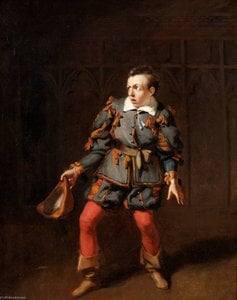
Buss’s artistic journey began within the family trade. His father, a master engraver and enameller, provided an initial immersion in craftsmanship that would inform his later work. This practical foundation was then augmented by formal training under George Clint, a respected figure known for his miniatures, watercolours, and mezzotint engravings. Clint’s influence instilled in Buss a command of diverse techniques – a crucial asset in a period where artists were expected to be proficient across multiple mediums. Initially, Buss found success capturing the likenesses of prominent actors. The theatre world provided both subject matter and patronage; his portraits of William Charles Macready, John Pritt Harley, and John Baldwin Buckstone demonstrate a keen eye for character and an ability to translate stage presence onto canvas. These early works weren’t simply representations but rather celebrations of Victorian theatrical culture, capturing the glamour and drama of the era's most celebrated performers.The *Pickwick Papers* and Literary Aspirations
A pivotal moment – and a source of lifelong disappointment – arrived with the commission to illustrate Charles Dickens’ *The Pickwick Papers*. Following the untimely death of the original illustrator, Robert Seymour, Buss was approached by Chapman & Hall. While his preliminary sketches were deemed adequate, he lacked expertise in steel plate etching, necessitating the hiring of an external etcher. The resulting printed images failed to meet expectations, leading to his dismissal from the project. This setback deeply affected Buss, yet it didn’t diminish his admiration for Dickens. Instead, it fueled a desire to visually interpret Dickens's work on his own terms. This culminated in *Dickens’ Dream*, an unfinished watercolour now housed at the Charles Dickens Museum. The painting is a remarkable testament to Buss’s literary devotion – a dreamscape populated by characters from Dickens’ novels surrounding the author as he dozes in his study at Gad’s Hill Place. It's not merely an illustration, but a heartfelt tribute, capturing the imaginative power and enduring appeal of Dickens’ storytelling. Beyond *Pickwick Papers*, Buss also lent his illustrative talents to works by Frederick Marryat (*Peter Simple*) and Frances Trollope (*The Widow Married*), showcasing his versatility and adaptability as an artist. He further contributed designs for wood engravings in Charles Knight’s editions of *London*, Shakespeare, and *Old England*.Family, Education, and a Lasting Legacy
Robert William Buss's life wasn't solely defined by artistic pursuits. In 1826, he married Frances Fleetwood, and together they established a home in Camden Town, London, raising ten children – six of whom survived infancy. Their daughter, Frances Mary Buss, would become a pioneering figure in girls’ education, and Robert William actively supported her endeavors. Driven by financial concerns, his wife founded a school for boys and girls in 1845, with Frances Mary subsequently establishing a morning school offering a liberal education to young ladies within the same premises. Robert William contributed to this educational venture, teaching drawing, science, literature, and elocution. He was also an active scholar, researching earlier British printmakers and delivering lectures accompanied by visual examples. In 1874, he published *English Graphic Satire*, a testament to his scholarly interests and a celebration of the artistic predecessors who paved the way for his own work.A Versatile Talent Remembered
Robert William Buss passed away in 1875, leaving behind a legacy as a versatile artist – a skilled portraitist, illustrator, and engraver whose career spanned several decades of Victorian artistic life. While the *Pickwick Papers* incident cast a shadow over his professional path, it ultimately underscored his deep admiration for Dickens and inspired one of his most poignant works. His contributions to girls’ education through his unwavering support of his daughter Frances Mary Buss further solidify his place in history. Today, *Dickens’ Dream* stands as a powerful reminder of his talent, dedication, and the enduring connection between art and literature – a fitting tribute to an artist who embraced the multifaceted nature of Victorian creativity.- Born: Aldersgate, United Kingdom (1804)
- Died: 1875
Questions & Answers
Can I explore Robert William Buss's works by keyword?
The By Keywords page of Robert William Buss groups the artist's artworks by their keywords.
What moods do Robert William Buss's artworks express?
The artist's Mood Room page shows Robert William Buss's artworks arranged by their atmosphere.
How do I find works by Robert William Buss in a specific palette?
The By Palettes page groups Robert William Buss's artworks by their color palettes.