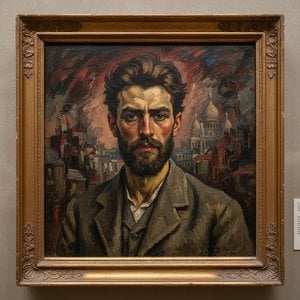
A Berlin Energy: The Life and Art of Rainer Fetting
Rainer Fetting, born in Wilhelmshaven, Germany, in 1949, is a pivotal figure in the resurgence of figurative painting during the late 20th century. His journey began not within the traditional confines of art school, but with a practical apprenticeship as a carpenter and stage designer at the Landesbühne Niedersachsen. This early exposure to craft and theatricality instilled in him a foundational understanding of form, space, and narrative – elements that would later become hallmarks of his artistic expression. Moving to Berlin in the early 1970s, Fetting enrolled at the Hochschule der Künste (Academy of Fine Arts), studying under Professor Hans Jaenisch. However, it was outside the academy walls, within the burgeoning counter-culture scene of West Berlin, that his true artistic identity began to take shape.The ‘Junge Wilde’ and a Rejection of Convention
In 1977, Fetting co-founded the Galerie am Moritzplatz alongside Helmut Middendorf, Bernd Zimmer, Salomé, Anne Jud, and Berthold Schepers. This gallery became the epicenter for a group of young artists who would soon be dubbed the ‘Junge Wilde’ (Young Wild Ones) or ‘Neue Wilde’ (New Wilds). The movement represented a deliberate rebellion against the prevailing artistic trends of minimalism and conceptual art that had dominated the German art scene. The 'Junge Wilde' embraced an unapologetic expressiveness, favoring bold colors, raw emotion, and a return to figuration – a direct challenge to the intellectual austerity of their predecessors. Fetting’s early work, deeply rooted in his Berlin surroundings, captured the city’s fragmented energy, its stark contrasts, and the palpable sense of division that characterized the Cold War era. These weren't polished depictions; they were visceral responses to an urban landscape brimming with tension and possibility.Evolution of Style: From Cityscapes to Human Experience
Fetting’s artistic style underwent a significant evolution throughout his career. Initially, his paintings focused on Berlin cityscapes – gritty, angular representations of buildings and streets that reflected the city's post-war reconstruction and political climate. He also explored portraiture and figurative compositions, often depicting individuals within these urban settings. Over time, his work moved away from strictly representational forms towards a more dynamic and expressive style. Strong lines, vibrant colors, and an increasingly loose brushwork became defining characteristics of his paintings. He began experimenting with diverse materials, notably incorporating driftwood assemblages into his canvases, adding texture and a sense of organic decay to his compositions. Throughout this evolution, however, Fetting consistently explored themes of urban life, human relationships, and personal experiences – subjects that resonated deeply with the anxieties and aspirations of his generation. His work is not merely about *what* he depicts, but *how* he feels about it; a raw emotionality permeates every brushstroke.International Recognition and Lasting Legacy
Fetting’s talent quickly garnered international attention. A DAAD scholarship in 1978 provided him with the opportunity to live and work in New York, exposing his art to a wider audience and influencing his artistic development. He participated in landmark exhibitions such as ‘A New Spirit in Painting’ at the Royal Academy of Arts in London (1981) and “Zeitgeist” in the Martin-Gropius-Bau, Berlin (1982), solidifying his position within the international art world. His work has since been featured in major museums including the MoMA and the Guggenheim Museum, attesting to its enduring significance. Beyond painting, Fetting also received notable commissions, creating sculptures for prominent locations like the Willy Brandt House in Berlin and portraits of influential figures such as Henri Nannen and Helmut Schmidt. Influenced by artists like Van Gogh and the German Expressionists, Fetting forged a unique artistic voice that revitalized figurative painting in Germany during the 1980s. He continues to live and work between Berlin and New York, remaining an active and influential figure in contemporary art, his legacy secured as a key innovator who challenged conventions and captured the spirit of a generation. His paintings are not simply images; they are windows into a world felt with intense passion and unwavering honesty.Questions & Answers
What are the birth city and country of Rainer Fetting?
Rainer Fetting was born in Wilhelmshaven, in Germany.
Is there an overview of all the subjects Rainer Fetting painted?
The Subject Atlas page maps Rainer Fetting's artworks by subject.
Where can I see all artworks by Rainer Fetting?
Every work by Rainer Fetting on this website can be browsed from the artist's All Artworks page.