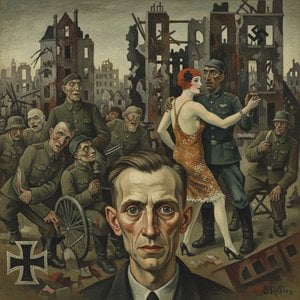
Early Life, Family and Artistic Training
Untermhaus, Germany, 2 December 1891. The environment shaping Otto Dix is one of stark industrial labor and quiet, poetic undertones. His father, Franz Dix, works in an iron foundry, a setting defined by heavy toil. His mother, Louise, a seamstress, carries a history of writing poetry. This domestic landscape provides the first, subtle friction between the grit of manual labor and the impulse toward creative expression.
The path toward professional training begins in 1906. Dix enters an apprenticeship under the painter Carl Senff, a period of study that lasts until 1910. This formative training moves him away from the domestic sphere and into the technical discipline of the craft. By 1910, he moves to Dresden to enter the Kunstgewerbeschule, the institution known today as the Dresden Academy of Fine Arts. His early focus remains on applied arts and crafts rather than the fine painting that would later define his reputation.
The Brutal Reality of World War I
August 1914. The outbreak of World War I triggers a surge of patriotic fervor. Dix volunteers for the German army, trading the studio for the front lines. He serves as a machine gunner, facing the mechanized slaughter of both the Eastern and Western Fronts. The war is a landscape of mud, decay, and relentless suffering. He survives the carnage, eventually earning an Iron Cross for his service.
The trenches leave a psychological wound that refuses to heal. The experience of mechanized warfare becomes a central, haunting presence in his psyche. He witnesses the grotesque reality of combat—not the sanitized heroism of propaganda, but the visceral truth of destruction. These harrowing memories provide the raw material for his later work. After 1920, he begins to translate this trauma into a relentless, anti-war visual language.
Technique and Artistic Style
Dix operates through a lens of ruthless and harshly realistic depictions. He rejects the soft edges of romanticism, opting instead for a stylized realism that confronts the viewer with the grit of German society. His hand moves with clinical precision, whether he is applying glaze techniques to a canvas or scratching into a metal plate. This technical rigor allows him to document the physical and psychological decay of the Weimar era without the buffer of abstraction.
The medium often dictates the intensity of the message. In his printmaking, he employs a sophisticated combination of drypoint, aquatint, and etching to achieve deep, tonal shadows and sharp, biting lines. These methods allow for a granular level of detail in his depictions of war and urban life. Beyond the heavy textures of print, he utilizes silverpoint on prepared paper, a demanding technique requiring absolute control and leaving no room for error. His work oscillates between the broad application of paint and the meticulous, almost surgical precision of fine drawing.
- The Trench (about 1923)
- The Skat Players (1920)
- Portrait of the Journalist Sylvia Von Harden (1926)
- Metropolis (1928)
Key Works and Masterpieces
The aftermath of the Great War finds its most unsettling reflection in 1920 with The Skat Players. This oil-on-canvas work captures the despair and social upheaval of post-war Germany through a Dadaist lens. It moves the viewer into a world of struggle and survival. By 1923, the focus shifts from social tension to the visceral carnage of the front lines. The Trench causes immediate controversy when it is first exhibited in Cologne. The graphic portrayal of the conflict strips away any sense of heroism, replacing it with the raw reality of the battlefield.
In 1924, the intensity of the war is distilled into The War, a series of 50 drypoint and aquatint etchings. These prints offer a relentless look at the madness of mechanized warfare. The precision of the graphic art confronts the viewer with the physical and psychological scars of the era. This period of unflinching observation continues into the urban landscape. Portrait of the Journalist Sylvia Von Harden, painted in 1926, captures the specific character of the era. By 1928, the gaze turns toward the decadence of the city. Metropolis makes its first appearance in Dresden, presenting a scathing indictment of urban life, filled with scenes of social alienation and debauchery.
- The Skat Players (1920)
- The Trench (1923)
- The War (1924)
- Portrait of the Journalist Sylvia Von Harden (1926)
- Metropolis (1928)
Persecution and Later Years
The political climate shifts violently in 1933. The Nazi-affiliated German Art Society targets Dix, labeling his work as "degenerate." This designation carries immediate consequences: he is dismissed from his teaching position at the Dresden Academy of Fine Arts. The artist retreats from the political vitriol of the era, seeking seclusion in the small town of Hemmenhofen on Lake Constance. Even in this quietude, the tension remains. He paints religious allegories, often using them as a way to secretly criticize the regime.
The pressure intensifies in 1939. The Gestapo arrests Dix on suspicion of involvement in a plot to kill Hitler. He spends two weeks in interrogation before being released. The shadow of the Second World War looms large, and Dix finds himself conscripted into the Volkssturm during the waning months of the conflict. He survives the chaos of the war, eventually finding a period of renewed recognition in post-war Germany. He remains a significant figure in the cultural landscape until his death on 25 July 1969 in Singen, Hohentwiel (DE).
Legacy and Global Influence
Otto Dix remains a central figure in 20th-century German painting. His presence in the permanent collections of major institutions, such as the Museum of Modern Art in New York, confirms his lasting importance. He did not merely document the era; he forced a confrontation with the physical and psychological wreckage of war and the moral decay of the Weimar Republic. His etchings, particularly the series The War, are recognized as significant achievements in graphic art, utilizing drypoint and aquatint to capture the visceral reality of the trenches.
The impact of his work extends through subsequent generations of artists. Those who seek to challenge societal norms or confront difficult truths find a precedent in his uncompromising realism. He moved beyond the emotional abstraction of Expressionism to embrace a clinical, often harsh, clarity. This approach ensured that the struggles of the marginalized and the scars of conflict remained visible long after the political landscapes that birthed them had shifted.
- The War (1924)
- Metropolis (1928)
- The Skat Players (1920)
Where to See His Works Today
The physical presence of Dix’s vision remains scattered across major international institutions. In London, the British Museum preserves a complete set of the folio prints from his series The War. These etchings offer a direct encounter with the graphic intensity of his wartime observations. Across the channel in Paris, the Centre Pompidou holds the 1926 Portrait of the Journalist Sylvia Von Harden, a work that captures the specific social atmosphere of the Weimar era.
The reach of his output extends to the United States, where the Museum of Modern Art in New York City maintains Shock Troops Advance under Gas. This piece brings the visceral tension of the front lines into a contemporary museum setting. In Germany, the Museum Folkwang in Essen houses Nelly among Flowers, providing a different perspective on his ability to handle intimate subject matter.
- The Skat Players
- Pragerstrasse
- The Trench
Questions & Answers
How many artworks by Otto Dix are available to browse?
You can browse 373 artworks by Otto Dix on the All Artworks page.
How did Otto Dix's art evolve over time?
A chronological account of Otto Dix's work is available on the artist's Chronicle page, where the artworks pass in order of creation, chapter by chapter.
Where is Otto Dix from?
Otto Dix was born in Germany.