Early Life, Family and Training
Oskar Kokoschka entered the world in 1886 in Pöchlarn, Croatia. He was the second child born to Gustav Josef Kokoschka, a man who worked as a goldsmith, and Maria Romana Kokoschka. Growing up in a household shaped by the precision of her husband's craft, he shared his early years with his sister, Berta, and his brother, Bohuslav.
His path toward art was not a traditional one. He never received formal training in painting, a fact that allowed him to approach a canvas without the constraints of academic rules. Instead, he sought out the Kunstgewerbeschule in Vienna, where he studied between 1904 and 1909. This period of study helped him find his footing, even as he moved away from the structured methods taught in the academies.
The Viennese and Berlin Years
In the creative atmosphere of Vienna, Kokoschka’s early career was shaped by the Jugendstil movement. He found work with the Wiener Werkstätte, the Viennese Workshops, where he began to develop his unique approach to design and form. This period was marked by a growing interest in the psychological depths of his subjects, moving away from the polished realism favored by the academies. By 1910, he moved to Berlin, Germany, seeking new directions for his developing vision. In this bustling city, he began working as an illustrator for Herwarth Walden’s magazine, Der Sturm, contributing drawings that reflected the shifting sensibilities of the era.
The stability of his artistic life was abruptly interrupted by the outbreak of World War I. Kokoschka volunteered for service in the Austrian army, facing the harsh realities of the conflict firsthand. The physical toll of the war was significant; he was severely wounded in 1915. These experiences of combat and injury left a lasting imprint on his psyche, influencing the way he perceived the world and the people within it. The tension of these years, both personal and political, would continue to inform his work as he moved through the next stages of his life.
- 1909: Veronica
- 1914: Bride of the Wind
Life in Dresden and Prague
After the upheaval of the First World War, Kokoschka found a period of relative stability in Dresden. He remained based in this city until 1923, a time when his focus shifted toward the instruction of others. Between 1919 and 1923, he worked as an art educator in Dresden, sharing his perspectives on vision and form with students. This period allowed him to refine his own understanding of how the inner imagination interacts with the physical world.
His movements continued through the changing political landscape of Europe. He returned to Vienna, living there from 1931 until 1934. The atmosphere in the city was heavy with tension, and the rise of fascism soon made his position increasingly precarious. Seeking a new sense of belonging and security, he moved to Prague in 1934. It was during this time in Prague that he took out Czech citizenship, a decision that would soon be tested by the shifting borders and political pressures of the late 1930s.
Exile in the United Kingdom
The political shadows lengthening over Europe in the late 1930s eventually forced Kokoschka into a life of displacement. In 1938, he fled to London, leaving behind the instability of Prague. He was not alone in this flight; he traveled with Olda Palkovska, the woman who would become his wife. This period of exile was marked by the uncertainty of being a refugee, a status that mirrored the tensions he had long captured in his paintings. He eventually found a sense of belonging in his new home, becoming a British citizen around 1946 or 1947.
His time in the United Kingdom was not spent solely in the bustle of the city. He found a place in the quieter landscape of Polperro, Cornwall. This coastal setting offered a different rhythm to his life, away from the immediate pressures of the war and the political upheaval of the continent. Even as he settled into British life, his connection to the shifting borders of Europe remained a part of his identity, as he held Austrian, Czech, and British citizenship throughout his life.
The later chapters of his life eventually moved away from the British Isles. After 1953, he spent most of his time living in Switzerland. This transition marked the final movement of a life that had been shaped by constant motion and the search for a place where his vision could exist without the threat of persecution.
Technique and Artistic Style
Kokoschka’s approach to the canvas was far from the polished, academic methods taught in traditional schools. He developed a nervously animated style, using bold lines and imagery that drew inspiration from Medieval compositions. His work often felt restless, as if the paint itself were struggling to settle. He was a leading figure of the Expressionist movement, moving away from simple visual accuracy to capture something much deeper. His focus was frequently on the human condition, exploring the tensions of the subconscious and the unsettling realities of decomposition.
The way he handled his materials was deeply personal and highly technical. He often combined thin, translucent layers of paint with areas of heavy impasto, creating a surface that had physical weight and depth. This layering allowed him to build a sense of transparency and opacity within a single work. By tracing sharp, dynamic lines through the paint, he could unite these different textures, making the surface of the painting feel as layered and complex as the emotions he sought to portray.
- The Dreaming Boys
- Veronica
- Self-portrait as a “Degenerate Artist”
- Thésée et Antiope
Key Works and Major Themes
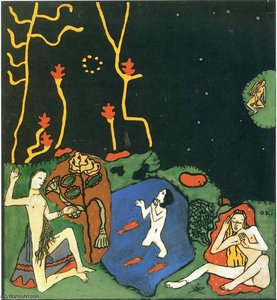
Kokoschka’s art was rarely about the surface of things. He was less interested in how a person looked and more concerned with how they felt, often choosing to depict subjective emotional experience rather than the literal external reality. This focus on the inner landscape meant his subjects often appeared through a lens of psychological tension. In his early years, this manifested in works like The Dreaming Boys, painted about 1908, which showed a departure from the polished realism of his contemporaries. He used his brush to reach into the subconscious, seeking to reveal the hidden truths of the human condition through distorted forms and a nervous, animated energy.
His personal life and the political upheavals of Europe frequently bled into his canvases. The turbulence of his own relationships found expression in The Bride of the Wind, created in 1914. This work captures a sense of emotional instability, using swirling forms to mirror a fraught connection. As the political climate in Europe darkened, his work became a way to process the pressures of the era. In 1937, he responded to the persecution of avant-garde artists by painting Self-portrait as a “Degenerate Artist,” a piece that used imagery of hunters and deer to allude to the reality of flight and persecution. Even in his more introspective moments, such as Self-portrait from Two Sides in 1923, there is a constant search for the truth of the self, stripped of academic pretension.
- The Dreaming Boys, about 1908
- The Bride of the Wind, 1914
- Self-portrait from Two Sides, 1923
- Self-portrait as a “Degenerate Artist”, 1937
Legacy and Enduring Influence
Kokoschka’s influence reached far beyond the edges of a canvas. He was a man who used his voice to confront the darkness of his era, remaining a steadfast and outspoken critic of the Nazi regime and Fascism. This commitment to social justice and human rights meant his art was never detached from the struggles of the people. He believed that art should maintain a connection to the concrete world, a philosophy that helped shape the development of Expressionism in Vienna and across Europe. His work did not seek to hide from reality but to reveal the tensions of the human condition through a lens of psychological depth.
His creative energy was not confined to painting. He was a prolific writer and playwright, exploring the human experience through many different mediums. In 1909, he wrote the short play Murderer, the Hope of Women, which is often recognized as one of the first Expressionist dramas. This ability to translate his vision into words and stagecraft showed a restless, multifaceted intellect. He sought to develop an art of "seeing" that prioritized how we perceive the world through our inner imagination rather than just through optical sight.
- Murderer, the Hope of Women (1909)
Later Years and Death
In his final decade, Kokoschka continued to engage with the public and the political landscape of Europe. A notable moment of recognition came in 1966, when he won a competition to paint a portrait of Konrad Adenauer for the German Bundestag. This achievement highlighted his enduring presence in the European art scene, even as he moved toward the quieter surroundings of Switzerland. He eventually settled in Villeneuve, where he lived from 1953 until his passing.
The end of his life arrived in Montreux, Switzerland. He died there on 22 February 1980, following complications from influenza. His death marked the end of a long life that had seen him navigate the most turbulent shifts of the twentieth century. To honor his memory and his contributions to the visual arts, the Oskar Kokoschka Prize was established in 1980, coinciding with his birthday.
Questions & Answers
Where is Oskar Kokoschka from?
Oskar Kokoschka was born in Austria.
Where can I find statistics about Oskar Kokoschka's works?
Statistics about Oskar Kokoschka's works are available on the artist's Stats page.
Can I explore Oskar Kokoschka's works by keyword?
Oskar Kokoschka's works can be explored by keyword on the artist's By Keywords page. Each keyword groups the related artworks.