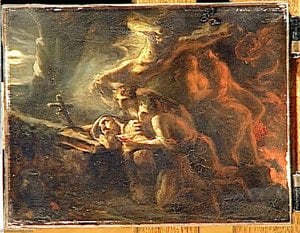
The Shadow of Industry: Exploring the Art of William Frederick Lutkin (1800-1874)
William Frederick Lutkin, born in 1800 and tragically passing away in 1874, stands as a pivotal figure bridging the late Romantic era with the nascent Realism that would dominate much of the 19th century. While often overshadowed by his contemporaries – Turner, Constable, and the burgeoning Impressionists – Lutkin’s work offers a unique and compelling perspective on the rapidly changing landscape of Britain during a period of immense industrial growth and social upheaval. His canvases are not merely depictions of scenery; they are imbued with a palpable sense of atmosphere, a haunting awareness of humanity's relationship to both nature and the burgeoning machinery that reshaped their world.Early Life and Artistic Training
Lutkin’s early life remains somewhat shrouded in mystery, though it is known he received his initial artistic training from his father, William Lutkin Sr., a landscape painter who instilled in him a deep appreciation for the beauty of the English countryside. This foundational grounding in traditional Romanticism – characterized by dramatic light, sublime landscapes, and an emphasis on emotional response – profoundly shaped Lutkin’s early work. However, unlike many of his contemporaries who remained firmly rooted in this aesthetic, Lutkin demonstrated a growing fascination with the industrial world around him, particularly the ironworks and factories that were beginning to proliferate across the British landscape. This nascent interest would ultimately define his artistic trajectory.A Painter of Atmospheric Landscapes
Lutkin’s most celebrated works are undoubtedly his atmospheric landscapes, often depicting scenes of moorland, coastline, and dramatic weather conditions. He possessed a remarkable ability to capture the fleeting effects of light and shadow, creating paintings that possess an almost hallucinatory quality. His use of color is particularly noteworthy – he favored muted tones of grey, brown, and blue, layering them in subtle gradations to evoke a sense of mood and atmosphere. His technique involved meticulous observation combined with a willingness to experiment with unusual brushstrokes and glazing techniques, resulting in surfaces that shimmered with reflected light. He was deeply influenced by the works of J.M.W. Turner, particularly his ability to convey the power and drama of nature through atmospheric effects, but Lutkin developed a distinctly personal style, characterized by a greater emphasis on the human element within the landscape.- Notable Works: *The Moorland Scene*, *Storm Over the Coast*, *Evening on the Moors*, *The Ironworks at Coalbrookdale*
- Technique: Layered glazing, meticulous observation of light and shadow, use of muted color palettes.
The Influence of Industrialization and Social Commentary
As the 19th century progressed, Lutkin’s artistic focus shifted increasingly towards depicting the impact of industrialization on the English landscape. He wasn't simply documenting factories; he was exploring the psychological effects of this transformation – the sense of alienation, isolation, and loss that accompanied the decline of traditional rural life. His paintings of ironworks and coal mines are often imbued with a melancholic tone, reflecting his own anxieties about the social and environmental consequences of industrial progress. He frequently depicted solitary figures within these landscapes, suggesting a profound disconnect between humanity and its environment. This subtle yet powerful commentary on the era’s social changes distinguishes Lutkin from many of his contemporaries who largely ignored the dramatic shifts occurring around them.Legacy and Historical Significance
William Frederick Lutkin's work represents a fascinating transitional moment in British art history. He embodies the lingering influence of Romanticism while simultaneously foreshadowing the Realist movement that would soon emerge. His atmospheric landscapes, coupled with his subtle yet poignant depictions of industrialization, offer a valuable insight into the social and emotional landscape of 19th-century Britain. While he may not be as widely recognized as some of his more celebrated contemporaries, Lutkin’s paintings continue to resonate today, reminding us of the complex relationship between humanity and the natural world in an age of rapid technological change. His work serves as a poignant reminder that even amidst progress, beauty and melancholy can coexist.Questions & Answers
Can I visit a virtual museum of Nicolas François Octave Tassaert's works?
The 3D Museum of Nicolas François Octave Tassaert is a page that displays the artist's artworks in a virtual three-dimensional gallery.
Where is Nicolas François Octave Tassaert from?
Nicolas François Octave Tassaert was born in France.
Can I explore Nicolas François Octave Tassaert's works by color spectrum?
The Spectral Index of Nicolas François Octave Tassaert is a page that organizes the artist's artworks by their colors.