Early Life, Family and Training
To understand the foundation of modern Armenian painting, one must look back to the specific circumstances of Martiros Sarian's birth. He was born on February 16 [February 28, New Style], 1880, in Nakhichevan-on-Don, Russia. As the seventh child of Sargis Saryan and Ustian Chiligaryan, his early environment was shaped by a large family structure. His initial education did not come from a formal institution but from his eldest brother, Hovhannes Saryan, who provided his primary instruction.
The technical rigor that defined his later output was forged during his years at the Moscow School of Painting, Sculpture, and Architecture. Between 1897 and 1903, Sarian moved beyond the domestic instruction of his brother into the professional sphere of the Russian art scene. This period was not merely about learning technique; it was about absorbing the specific methodologies of the era's most significant instructors. He worked within the studios of Konstantin Korovin and Valentin Serov, two figures who provided the technical grounding necessary for his subsequent stylistic developments.
This training provided more than just skill. It offered a direct connection to the evolving standards of the time. By studying under Korovin and Serov, Martiros Sarian acquired a professional discipline that allowed him to eventually move beyond simple representation. His transition from a student in Moscow to a central figure in Armenian art was predicated on this specific combination of familial guidance and rigorous academic study.
Travels and Artistic Inspiration
Saryan’s work finds its logic in a deliberate search for a specific visual language rooted in his homeland. His 1901 trip to Armenia was not a casual excursion but a focused artistic research project. By traversing regions like Lori, Shirak, Echmiadzin, Haghpat, Sanahin, Yerevan, and Sevan, he moved beyond mere observation to document the landscape through a personal lens. This period established the geographic and emotional foundation that would define his entire output.
His perspective expanded through strategic movement across the Middle East and North Africa. He was in Constantinople in 1910, Egypt in 1912, southwestern Armenia in 1913, and Persia in 1914. These travels allowed him to absorb the light and motifs of these diverse locations, integrating them into a cohesive style. Even his brief period in Paris between 1926 and 1928 functioned as a way to engage with international aesthetics before his permanent return to the Armenian landscape.
Technique and Artistic Style
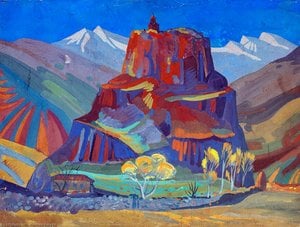
Sarian’s visual language relies on a directness that avoids unnecessary complexity. His expressionist approach captures scenes in a simple, almost child-like form, stripped of academic clutter. This clarity is driven by an intense use of color. He did not merely observe light; he used it to define the weight and presence of his subjects. His palette reflects the heavy influence of Impressionism, yet he pushed beyond mere light effects to embrace the bold, saturated tones found in the works of Paul Gauguin and Henri Matisse.
The geography of his travels dictates the composition of his canvases. His time spent in Armenia and the Middle East provided the essential visual data for his career. He did not just paint landscapes; he synthesized the specific light and atmosphere of these regions into a distinct national style. This synthesis included the integration of Persian motifs, which he wove into his compositions to ground his modernism in regional reality. The result is a style that feels both modern and deeply rooted in the specificities of the East.
Key Works and Notable Paintings
Saryan’s output reflects a persistent obsession with the specificities of the Armenian landscape and the seasonal shifts of the Middle East. His 1909 work, Steppe flowers, demonstrates an early command of color that moved away from the muted tones of his predecessors. By 1916, his focus shifted toward the immediate reality of his homeland with Flowers of Armenia. This period of his career shows a transition from mere observation to a more structured, almost graphic interpretation of nature. His 1924 piece, Mottled landscape, further proves his ability to manipulate light and texture to define space without relying on traditional perspective.
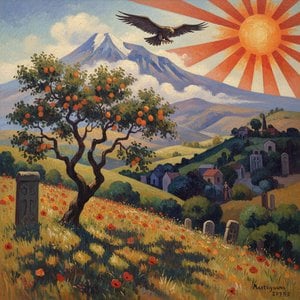
The artist’s later years saw a continued preoccupation with botanical subjects and the atmospheric qualities of the Armenian terrain. He returned to the motif of seasonal renewal in Apricot trees in blossom (1929) and again in Apricot tree in blossom (1942). These works are not mere studies; they are assertive declarations of a specific regional identity. His 1933 painting, Mountainous march of Armenian units, provides a stark contrast to his floral studies, grounding his aesthetic in the social and political realities of the era. Even in 1944, with April landscape, his commitment to capturing the specific light of the Armenian spring remained a central pillar of his practice.
- Steppe flowers (1909)
- Flowers of Armenia (1916)
- Mottled landscape (1924)
- Apricot trees in blossom (1929)
- Mountainous march of Armenian units (1933)
- Apricot tree in blossom (1942)
Later Years and Death
Saryan’s presence in Armenia became permanent following his move to Yerevan in 1921. While his earlier years involved navigating the shifting borders of the Russian Empire and brief excursions to Paris, his later life was defined by his residence in Soviet Armenia. From 1928 until his death, he remained a constant figure in the region, producing a vast body of work that documented the landscape and life of his adopted home. His output during these decades was prolific, maintaining a high level of productivity even as the political landscape around him shifted.
He remained active in the Armenian art scene for decades, eventually passing away in Yerevan, Armenian S.S.R., U.S.S.R. He died on May 5, 1972, at the age of 92. His long life spanned the transition from the late imperial era through the complexities of the Soviet period, leaving behind a massive archive of work that remains central to the history of Armenian painting.
Legacy and Influence
Martiros Sarian's impact is measured by his status as the founder of a modern Armenian national school of painting. He did not merely paint landscapes; he established a visual language for a nation. His institutional influence was significant during the Soviet era. He served as the president of the Artists' Union of Soviet Armenia from 1945 to 1951. This position allowed him to shape the professional landscape for his contemporaries. His standing was further solidified by his election as a member of the USSR Academy of Fine Arts in 1947. By 1960, he had achieved the title of People's Artist of the USSR.
His work remains a primary reference for Armenian identity in art. He moved away from purely academic traditions to create something specific to his homeland. This shift helped define the direction of Armenian modernism. His ability to synthesize international influences with local subject matter ensured his relevance long after his death in 1972. He remains a central figure in the history of Armenian visual culture.
Where to See the Works Today
To encounter the physical reality of Saryan’s output, one must travel to Yerevan, Armenia. The city serves as the primary repository for his visual legacy. The National Gallery of Armenia maintains a significant collection of his paintings, providing a centralized look at his development within the Armenian landscape. This institution holds the weight of his formal contributions to the national school of painting.
For a more intimate connection to the man behind the brush, the Martiros Saryan House-Museum offers a direct link to his private life. This museum is housed within his former three-story residence. Walking through this specific space allows for a confrontation with his personal environment, situated just a short distance from Freedom Square. It remains a vital site for understanding the scale and domestic context of his creative existence.
The Saryan Museum in Yerevan also functions as a key site for his work. Together, these locations ensure that his influence remains anchored in the geography he spent his life documenting. Visitors seeking his specific depictions of Armenian life or his Middle Eastern studies will find the necessary concentration of his work within these Yerevan institutions.
Questions & Answers
How many artworks by Martiros Saryan are available to browse?
You can browse 542 artworks by Martiros Saryan on the All Artworks page.
Can I browse Martiros Saryan's works by mood?
Martiros Saryan's works can be browsed by mood on the artist's Mood Room page, which arranges the artworks by their recorded moods.
How do I find works by Martiros Saryan in a specific palette?
The By Palettes page groups Martiros Saryan's artworks by their color palettes.