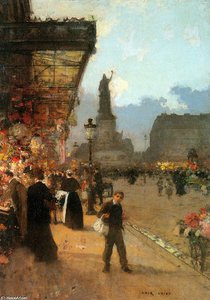
Luigi Loir: The Parisian Impressionist Painter
Luigi Loir (dit Luigi Loir), born Aloys François Joseph Loi in Paris in 1845, was a prolific French painter who achieved considerable renown during his lifetime and continues to be appreciated for his captivating depictions of Parisian life. Though overshadowed by the towering figures of Monet and Renoir, Loir’s distinctive style—characterized by luminous color palettes and meticulous attention to detail—established him as a significant contributor to Impressionist art.
Early Life and Artistic Training
Born into a family of artists – his father was also a painter – Loir received an early education in artistic pursuits, fostering a lifelong passion for visual representation. He honed his skills at the École Supérieure des Beaux-Arts in Paris, where he studied under Jean-Baptiste Camille Corot and Frédéric Bazille, influential figures who championed the Impressionist movement’s principles of capturing fleeting moments and prioritizing direct observation of nature. These formative influences profoundly shaped Loir's artistic vision and technique.
The Parisian Landscape Painter
Loir quickly gained recognition for his masterful renderings of Parisian landscapes—particularly scenes along the Seine River and in Montmartre. Unlike many Impressionists who focused on idyllic rural vistas, Loir deliberately chose to portray the bustling energy and atmosphere of the city, capturing its architectural grandeur alongside the vibrant colors of urban life. His canvases pulsated with light and movement, conveying a palpable sense of immediacy and spontaneity—qualities that epitomized the Impressionist ethos. He meticulously rendered buildings, bridges, and streets, utilizing layering techniques and subtle tonal variations to create depth and realism within his impressionistic framework.
Notable Works and Artistic Style
Among Loir’s most celebrated paintings are “La Seine au Pont Neuf” (The Seine at Pont Neuf), a panoramic view of Paris showcasing the iconic bridge and its surroundings bathed in golden afternoon light, and “Montmartre au Soleil Levant” (Montmartre at Dawn), which captures the misty dawn over Montmartre’s rooftops—a scene imbued with poetic beauty and symbolic resonance. His distinctive style was marked by several key characteristics: firstly, a masterful command of color theory; secondly, an innovative use of glazing techniques to achieve luminous effects; and thirdly, a meticulous attention to detail that ensured accuracy in portraying architectural elements and atmospheric conditions. He skillfully blended Impressionistic brushstrokes with realistic observation, resulting in artworks that were both aesthetically pleasing and intellectually stimulating.
Influence and Legacy
Luigi Loir’s artistic legacy extends beyond his individual paintings—he served as an influential teacher at the École Supérieure des Beaux-Arts, nurturing the talents of numerous aspiring artists who would go on to become prominent figures in French Impressionism. His unwavering dedication to capturing the essence of Parisian life inspired generations of painters and solidified his place within the movement's canon. Although he didn’t achieve the fame of Monet or Renoir, Loir’s contribution to Impressionist art remains significant—his evocative landscapes continue to captivate viewers today, reminding us of the enduring power of visual storytelling and the beauty found in everyday urban experiences. His work stands as a testament to the Impressionists' commitment to portraying the world as they perceived it – vibrant, dynamic, and imbued with emotion.