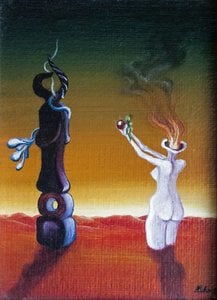
A Pioneer of Immersive Experience: The Life and Art of Lubo Kristek
Born in Brno, Czech Republic, in 1943, Lubo Kristek emerged as a significant voice in the post-war European art scene, defying easy categorization. His artistic journey began during the turbulent 1960s, a period ripe with experimentation and a questioning of established norms. From the outset, Kristek demonstrated a restless spirit, refusing to be confined by traditional mediums or approaches. He wasn’t simply interested in creating objects; he sought to orchestrate experiences, blurring the boundaries between art, life, and audience participation. This early inclination towards challenging conventions would become a defining characteristic of his prolific career. The political climate of Czechoslovakia at the time undoubtedly fueled this desire for artistic freedom, pushing him toward explorations that were both conceptually daring and subtly subversive.From Assemblage to ‘Holographic Perception’
Kristek's work is fundamentally rooted in assemblage – a technique of creating three-dimensional artworks from disparate found objects. However, he quickly transcended the purely formal aspects of this practice, imbuing his assemblages with layers of meaning and social commentary. His sculptures weren’t merely collections of materials; they were critical examinations of human vulnerability, medical ethics, and our complex relationship with the natural world. A pivotal moment in Kristek's artistic development came with his relocation to West Germany in 1968, following the Prague Spring. This move exposed him to new ideas and influences, solidifying his commitment to conceptual art, surrealism, and performance art. It was during this period that he began formulating his groundbreaking theory of “holographic perception.” Kristek believed that true artistic impact wasn’t achieved through a single, linear experience but rather through the simultaneous stimulation of multiple senses and emotions. He envisioned artworks as multifaceted environments designed to create a holistic, immersive experience for the viewer – akin to how a hologram contains all perspectives within its structure.Happenings, Nocturnal Vernissages, and Public Interventions
The practical application of Kristek’s “holographic perception” theory manifested most powerfully in his *happenings* and *nocturnal vernissages*. These weren't conventional art openings; they were carefully orchestrated events designed to disrupt expectations and engage the audience on a visceral level. Often taking place at night, these gatherings blurred the lines between artist, artwork, and spectator. Kristek’s interventions extended beyond gallery walls, frequently spilling into public spaces. Works like *Kristek House* in Brno – a building transformed into a surreal architectural assemblage – demonstrate his commitment to making art accessible and challenging established notions of urban landscape. Another striking example is *Promenade with a Neurotic Fox*, a performance piece that confronted societal taboos surrounding death and mortality, inviting viewers to grapple with uncomfortable truths. His work *Requiem for Mobile Telephones* served as a poignant critique of our increasing dependence on technology, prompting reflection on the human cost of constant connectivity.Legacy and Lasting Influence
Lubo Kristek’s contributions to contemporary art are profound and far-reaching. He didn't simply create artworks; he pioneered a new way of thinking about artistic experience. His emphasis on immersion, participation, and the integration of multiple media has influenced generations of artists working in performance art, installation art, and conceptual sculpture. While his work often tackles complex social and ethical issues, it never feels didactic or preachy. Instead, Kristek invites viewers to engage with these themes on their own terms, fostering critical thinking and emotional resonance. His legacy is preserved not only through the numerous museums and collections that house his works – including the Museum Kunstsalon Franke Schenk in Germany and the Cathedral Prague in the Czech Republic – but also through the continued exploration of his ideas by artists and scholars around the world. Discovering Kristek’s work, whether through reproductions or experiencing it firsthand, is an invitation to step outside conventional boundaries and embrace a more holistic, immersive understanding of art's power. His vision continues to inspire those who seek to create experiences that truly resonate with the human spirit.Questions & Answers
In which historical period did Lubo Kristek work?
Lubo Kristek worked in the Modern period. The period situates the artist's activity in history.
How did Lubo Kristek's art evolve over time?
The Chronicle of Lubo Kristek is a scroll-driven timeline that presents the artist's works in chronological order, grouped into career-period chapters.
Where are Lubo Kristek's artworks grouped by technique?
The All Medium page groups Lubo Kristek's artworks by technique.