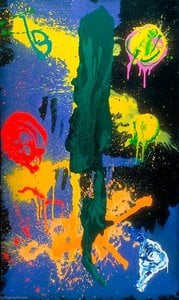
A Life Immersed in Color: The Journey of John Hoyland
John Hoyland, born in Sheffield in 1934, emerged as one of Britain’s most significant abstract painters, a figure whose canvases vibrated with an audacious use of color and a profound commitment to the expressive potential of paint. His path wasn't one of immediate acceptance; rather, it was forged through a determined exploration of artistic language, punctuated by moments of challenge and ultimately, resounding recognition. Growing up in a working-class family, Hoyland’s early exposure to art came through formal training at Sheffield School of Art and Crafts, followed by studies at Sheffield College of Art. These formative years were rooted in figurative work, but a pivotal shift began during his education at the Royal Academy Schools in London. It was there, amidst the traditional curriculum, that he encountered the burgeoning world of abstract art – first through the works of Nicholas de Staël and then, with electrifying force, the American Abstract Expressionists showcased at the Tate Gallery in 1959. This encounter proved transformative, igniting a passion for non-representational painting that would define his life’s work. A notorious incident during his time at the Royal Academy – the removal of his abstract paintings by Sir Charles Wheeler, who questioned Hoyland's ability to “paint properly” – underscored the prevailing resistance to abstraction within the British art establishment. The intervention of Peter Greenham ultimately secured their reinstatement, a small victory signaling a growing openness to new artistic directions.
Forging an Abstract Voice: Influences and Development
The 1960s proved crucial in Hoyland’s artistic development as he began to establish his distinctive style. He wasn't interested in merely replicating the American abstract expressionists, but rather absorbing their spirit of freedom and applying it to his own unique sensibility. A turning point arrived with a bursary from the Peter Stuyvesant Foundation that enabled him to travel to New York in 1964. This journey brought him into direct contact with key figures like Robert Motherwell, Mark Rothko, and Barnett Newman, fostering lasting friendships and profoundly influencing his artistic philosophy. Hoyland’s work began to coalesce around bold color, simplified shapes, and a flat picture surface – characteristics that aligned him with movements such as Post-Painterly Abstraction, Color Field painting, and Lyrical Abstraction. However, he resisted easy categorization, famously disliking the label “abstract” painter, preferring simply to be known as a "painter." He believed the term imposed unnecessary geometric constraints, hindering the organic flow of his creative process. Instead, Hoyland found inspiration in natural forms, particularly the circle, which he perceived as a powerful and inherently organic shape. His artistic lineage was broad, encompassing admiration for masters like Matisse, Van Gogh, Rouault, and Chaïm Soutine alongside the American giants who had so captivated him.
Career Highlights and Artistic Evolution
Hoyland’s career gained momentum throughout the late 1960s and 70s. His first solo exhibition at Marlborough New London Gallery in 1964 was followed by a significant museum show at the Whitechapel Art Gallery in 1967, curated by Bryan Robertson. He became involved with the influential Situation group, exhibiting large-scale abstract paintings designed to immerse viewers in color and form. In 1969, he achieved international recognition representing Great Britain alongside Anthony Caro at the São Paulo Biennale in Brazil. The 1970s witnessed a shift in his technique; his paintings grew more textured as he experimented with impasto and various materials. He exhibited extensively at Waddington Galleries in London and also found representation in New York with Robert Elkon Gallery and André Emmerich Gallery, expanding his reach to an international audience. Recognition continued to accrue throughout the following decades, culminating in prestigious awards such as the John Moores Painting Prize in 1982 and the Royal Academy’s Wollaston Award in 1998. Major retrospectives at the Serpentine Gallery (1979), the Royal Academy (1999), and Tate St Ives (2006) cemented his position as a leading figure in British art.
Legacy and Enduring Significance
John Hoyland’s contribution to British abstraction is undeniable. He played a vital role in championing non-representational painting within the UK art scene, challenging conventional norms and paving the way for future generations of artists. His bold use of color, dynamic compositions, and unwavering commitment to painterly expression have left an indelible mark on contemporary art. Hoyland’s works are now held in numerous public and private collections, including the Tate and even Damien Hirst's Murderme collection, a testament to his enduring artistic importance. In 1991, he was elected to the Royal Academy, and in 1999, appointed Professor of Painting at the Royal Academy Schools – positions that further solidified his influence within the art establishment. Though he passed away in 2011, his legacy continues to resonate. Hoyland’s paintings remain powerful statements about the expressive potential of color and form, inviting viewers to engage with art on a purely emotional and visceral level. He wasn't simply painting abstractions; he was creating worlds – vibrant, dynamic, and deeply personal realms that continue to captivate and inspire.
Key Characteristics of Hoyland’s Work
- Bold Color Palettes: Hoyland was renowned for his fearless use of color, often employing high-key hues and contrasting tones to create visually arresting compositions.
- Simplified Forms: His paintings typically feature simplified shapes and forms, emphasizing the interplay between color and space rather than representational detail.
- Textural Surfaces: Particularly in his later work, Hoyland experimented with texture, incorporating impasto and various materials to create richly layered surfaces.
- Emphasis on Painterly Expression: He prioritized the act of painting itself, allowing the physicality of the medium to become an integral part of the artwork’s meaning.
- Rejection of Geometric Constraints: Hoyland actively resisted rigid geometric structures, preferring organic and fluid compositions that reflected his intuitive approach.
Questions & Answers
What aliases or alternate names does John Hoyland have?
John Hoyland is also known as 约翰·霍伊兰德.
What are the birthplace and birth year of John Hoyland?
John Hoyland was born in Sheffield in 1934.
How many artworks by John Hoyland are available to browse?
You can browse 20 artworks by John Hoyland on the All Artworks page.