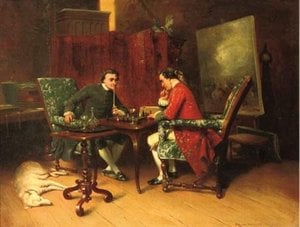
A Master of Miniature Realism: The Life and Art of Jean-Louis Ernest Meissonier
Jean-Louis Ernest Meissonier, a name synonymous with meticulous detail and historical narrative in 19th-century French painting, emerged as a pivotal figure bridging the gap between academic tradition and a burgeoning realism. Born in Lyon in 1815, his path to artistic renown was initially met with familial resistance. His father envisioned a career in business for young Ernest, yet the allure of art proved too strong to ignore. At seventeen, he secured permission to pursue his passion, embarking on a journey that would establish him as one of France’s most celebrated and financially successful artists. Early training under Léon Cogniet provided a foundational grounding, but it was through diligent study of the Dutch masters at the Louvre – painters like Gabriel Metsu and Gerard Douw – that Meissonier truly discovered his artistic voice. These masters, renowned for their intimate scenes of bourgeois life rendered with astonishing precision, profoundly influenced his developing style, inspiring a dedication to detail that would become his hallmark.From Genre Scenes to Grand Historical Narratives
Meissonier’s breakthrough arrived in 1831 with *Les Bourgeois Flamands* (Dutch Burghers), exhibited at the Salon. This work immediately signaled his unique talent – a capacity for recreating scenes of everyday life, or historical vignettes, with an almost microscopic level of accuracy. He wasn't merely depicting objects; he was meticulously reconstructing worlds, capturing textures, light, and atmosphere with breathtaking fidelity. This early success allowed him to refine his technique, producing a series of captivating genre paintings like *The Game of Chess* (1841) and *The Young Man Playing the 'Cello* (1842). These works weren’t simply exercises in technical skill; they were insightful observations of human character and social interaction. However, Meissonier's ambitions extended beyond intimate genre scenes. The political upheavals of 1848, during which he served with the National Guard, deeply impacted him, fueling a desire to address larger historical themes. This shift culminated in monumental works like *The Emperor at Solferino*, a departure from his earlier style that showcased his ability to handle complex compositions and grand narratives while retaining his signature precision.A Technique Defined by Patience and Precision
What truly set Meissonier apart was not simply what he painted, but *how* he painted. His technique was legendary for its painstaking detail. He wasn’t content with broad brushstrokes or impressionistic effects; each element within his compositions was rendered with meticulous care, built up layer upon layer to achieve a remarkable sense of realism. He undertook exhaustive research, meticulously studying costumes, weaponry, and architectural details to ensure historical accuracy. This dedication extended to the natural world as well – he famously studied horses extensively, analyzing their anatomy and movement to depict them convincingly in his battle scenes. Some critics even suggested that his work bordered on obsession, but it was precisely this unwavering commitment to detail that captivated audiences and established his reputation. John Ruskin, the influential English art critic, famously examined Meissonier’s paintings under a magnifying glass, marveling at the artist's “manual dexterity and eye for fascinating minutiae.”Legacy and Lasting Influence
By the latter half of the 19th century, Jean-Louis Ernest Meissonier had become one of France’s most celebrated artists. His works commanded exorbitant prices, allowing him to acquire a magnificent estate in Poissy, complete with dedicated studios designed to facilitate his meticulous process. He was lauded for his technical mastery and his ability to bring history to life with unparalleled realism. While some critics questioned the limited range of his subject matter – often focusing on military scenes or historical recreations – there is no denying his profound influence on subsequent generations of artists. His dedication to detail, his commitment to historical accuracy, and his masterful technique continue to inspire painters today. Museums worldwide, including the Musée d'Orsay in Paris and the National Gallery of Art in Washington D.C., proudly display his works, ensuring that his legacy endures as a testament to the power of patience, precision, and artistic vision. To explore more of Meissonier’s art, visit ArtsDot.com or the Musée d'Orsay website.Questions & Answers
Where is Jean-Louis Ernest Meissonier from?
Jean-Louis Ernest Meissonier was born in France.
Is there a timeline of Jean-Louis Ernest Meissonier's works?
The artist's Artwork Timeline page presents Jean-Louis Ernest Meissonier's works ordered by date, year by year.
Can I browse Jean-Louis Ernest Meissonier's works by movement?
Jean-Louis Ernest Meissonier's works can be browsed by movement on the artist's All Movements page.
What are the birth city and country of Jean-Louis Ernest Meissonier?
Jean-Louis Ernest Meissonier was born in Lyon, in France.
What are the birthplace and birth year of Jean-Louis Ernest Meissonier?
Jean-Louis Ernest Meissonier was born in Lyon in 1815.
Where can I see the color profile of Jean-Louis Ernest Meissonier's work?
The Palette Genome of Jean-Louis Ernest Meissonier is a page that presents the color profile of the artist's body of work.
Can I explore Jean-Louis Ernest Meissonier's works by color spectrum?
The Spectral Index page organizes Jean-Louis Ernest Meissonier's artworks by color.