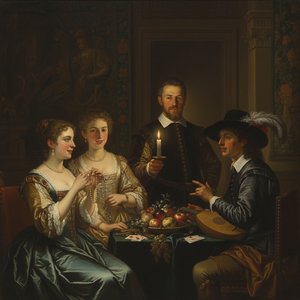
János Donát: A Viennese Classicist Capturing the Spirit of His Time
János Donát (1744-1830), a name perhaps less familiar than many of his contemporaries, nevertheless represents a significant figure in the artistic landscape of 18th and early 19th century Hungary. Born in Klosterneuzell, Germany, he ultimately established himself as a prominent painter within the vibrant artistic circles of Vienna and later Pest, leaving behind a legacy characterized by elegant Classicism, deeply felt religious scenes, and meticulously rendered mythological compositions. Donát’s career unfolded during a period of profound cultural exchange between Central Europe and Austria, shaping his style and subject matter in ways that reflect both local traditions and broader European trends.
Donát's artistic journey began under the tutelage of esteemed masters such as M. Meytens, V. Fischer, and Sambach in Vienna. These formative years exposed him to the prevailing stylistic conventions of Viennese Academic painting – a movement deeply rooted in classical ideals and emphasizing idealized beauty, balanced composition, and precise execution. This influence is immediately apparent in his early works, particularly his portraits, which demonstrate a remarkable ability to capture the likeness and bearing of his subjects with a dignified restraint. However, Donát wasn’t merely a follower; he subtly infused these classicist principles with a distinctly Hungarian sensibility, evident in the careful attention to detail and the nuanced portrayal of character.
A Portrait Painter of Nobility and Enlightenment
Donát's rise to prominence was largely due to his success as a portrait painter. He quickly gained recognition for his ability to immortalize members of Hungarian nobility and the burgeoning bourgeoisie, becoming one of the most sought-after artists of the 1810s and 1820s. His portraits weren’t simply representations of physical appearance; they were carefully constructed narratives, revealing the social standing, personality, and aspirations of his sitters. Notable commissions included those for Ferenc Kazinczy, a leading figure of the Hungarian Enlightenment, and Benedek Virág, reflecting Donát's engagement with the intellectual currents shaping Hungary at the time.
The portraits are notable for their detached decorativity, as described by art historians. While he avoided the dramatic flourishes and emotional intensity characteristic of Baroque painting, Donát’s work possessed a certain formality and elegance. He prioritized idealized representations over raw emotion, presenting his subjects with a measured detachment that reflected the values of the era. His skill lay in capturing not just likeness but also an aura of status and refinement.
Religious Visions and Mythological Tales
Beyond portraiture, Donát’s oeuvre encompassed a range of religious scenes and mythological compositions. Works like “Holy Family” exemplify his ability to imbue biblical narratives with a sense of drama and emotional intensity through the skillful use of color and composition. The painting is characterized by rich hues and a carefully orchestrated arrangement of figures, creating a powerful visual statement about faith and family. Similarly, pieces such as "Orpheus asks Hades …" demonstrate his engagement with classical mythology, translating these ancient tales into elegant and meticulously rendered paintings.
These religious and mythological works reveal Donát’s artistic versatility and his willingness to explore diverse subject matter. He skillfully blended classicist techniques with a deep understanding of symbolism and narrative, creating images that resonated with both aesthetic beauty and spiritual meaning. The meticulous detail evident in these pieces speaks to his dedication to craft and his commitment to capturing the essence of each scene.
Legacy and Influence
János Donát’s career spanned several decades, witnessing significant shifts in Hungarian art and culture. He remained a consistent figure within the artistic community, adapting his style while maintaining a core set of principles rooted in Classicism. While he may not be as widely celebrated as some of his contemporaries, Donát's contributions to Hungarian painting are undeniable. His portraits, religious scenes, and mythological compositions offer valuable insights into the artistic tastes and cultural values of his time. His work continues to be studied and appreciated for its elegance, technical skill, and subtle reflection of the spirit of 18th and early 19th century Central Europe.
Further exploration can be found through resources such as the Web Gallery of Art (https://www.wga.hu/html/d/donat/lanton_j.html) and the Art Renewal Center (https://www.artrenewal.org/artists/janos-donat/4204).