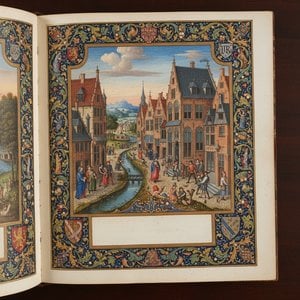
Jan August Hendrik Leys: A Flemish Visionary Bridging Romanticism and Realism
Jan August Hendrik Leys (18 February 1815 – 26 August 1869) was a Belgian painter and printmaker. He was a leading representative of the historical or Romantic school in Belgian art and became a pioneer of the Realist movement in Belgium. His history and genre paintings and portraits earned him a European-wide reputation and his style was influential on artists in and outside Belgium. Leys was born in Antwerp as the son of Hendrik-Jozef-Martinus Leys and Maria-Theresia Craen. His father ran a printing business specializing in religious images printed from old copper plates. Henry Leys was not very interested in school but was very keen on drawing. His parents supported his proclivity and let him study under a furniture painter who lived next door. He began his artistic training at the Antwerp Academy of Fine Arts, where he studied from the Antique and from 1832 to 1833 he studied drawing from life. During this period, Leys absorbed influences from artists like Eugène Delacroix and Franz Hals, establishing a foundation for his distinctive style. He quickly gained recognition for his ability to capture emotion and atmosphere with remarkable precision. Leys’s artistic career flourished in Bruges, where he established himself as a respected teacher and mentor. He founded the Bruges Drawing School, nurturing young talent and promoting innovative approaches to painting. His students included Henri De Braekeleer and Mattheus Ignatius van Bree, who would later become prominent artists themselves, demonstrating Leys's enduring legacy within Belgian art education. Leys’s oeuvre encompasses a diverse range of subjects—historical narratives, portraits, landscapes, and genre scenes—each imbued with a palpable sense of Romantic idealism tempered by Realist observation. His paintings are characterized by luminous color palettes, meticulous detail, and expressive brushwork that convey both psychological depth and visual splendor. Notable works include “Frans Floris Going to Saint Luke’s Day Feast” (1840) and “The Boschi Di Stefano Museum,” which exemplify his masterful command of technique and artistic vision. Leys's contribution to Belgian art history extends beyond his individual creations; he championed a new aesthetic that prioritized emotional resonance alongside accurate representation—a distinction that foreshadowed the burgeoning Realist movement. His influence can be discerned in the works of subsequent generations of Belgian artists, cementing his place as a pivotal figure in shaping the artistic landscape of 19th-century Europe. He died prematurely in Antwerp at the age of fifty-four, leaving behind an impressive body of work that continues to inspire admiration and scholarly inquiry.Major Influences & Artistic Style
Leys’s artistic style was profoundly shaped by several key influences—primarily Romantic painters like Eugène Delacroix and Franz Hals—and he skillfully blended these inspirations with meticulous Realist observation. He embraced the expressive dynamism of Delacroix's canvases, capturing dramatic moments and conveying intense emotion through vibrant color palettes and sweeping brushstrokes. Simultaneously, Leys drew inspiration from Hals’s masterful portraits, prioritizing anatomical accuracy and psychological insight to portray his subjects with remarkable realism. His technique involved layering thin glazes over textured surfaces—a method he adopted from Flemish masters—to achieve luminous effects and convey subtle nuances of light and shadow. He meticulously studied the human form, rendering figures with anatomical precision while simultaneously capturing their inner life through expressive gestures and facial expressions. Leys’s brushwork was characterized by loose, impasto strokes that created a palpable sense of texture and movement—a stylistic hallmark that distinguished him from more polished academic painters. Leys's artistic vision centered on conveying emotion and atmosphere with unwavering conviction—a principle he articulated as “the painter must strive to express what he sees.” He believed that art should serve as a conduit for capturing the essence of human experience, mirroring both its beauty and its sorrow. This commitment to emotional authenticity permeated his entire oeuvre, informing his compositional choices, color harmonies, and brushstroke techniques.Notable Works & Artistic Achievements
Leys produced an impressive array of paintings—spanning historical narratives, portraits, landscapes, and genre scenes—each demonstrating his exceptional artistic skill and stylistic versatility. Among his most celebrated works are “Frans Floris Going to Saint Luke’s Day Feast” (1840), a monumental depiction of a medieval religious procession that exemplifies his masterful command of color and composition; “The Boschi Di Stefano Museum,” which showcases Leys's meticulous attention to detail and his ability to capture atmospheric light—a technique he honed through extensive studies of Flemish landscapes. Furthermore, Leys’s portraits captured the psychological complexity of his subjects with remarkable sensitivity—revealing their inner thoughts and emotions through subtle gestures and facial expressions. His depictions of individuals from diverse social strata—aristocrats, clergymen, merchants, and artisans—demonstrated his artistic prowess across a broad spectrum of stylistic approaches. Leys's legacy extends beyond his individual creations; he established the Bruges Drawing School, fostering artistic innovation and nurturing young talent—a testament to his dedication as an educator and mentor. His influence can be discerned in the works of subsequent generations of Belgian artists who embraced his pioneering aesthetic—solidifying his place as a pivotal figure in shaping the artistic landscape of 19th-century Europe.Historical Significance & Legacy
Leys’s contribution to Belgian art history transcends mere stylistic innovation; he championed a new aesthetic that prioritized emotional resonance alongside accurate representation—a distinction that foreshadowed the burgeoning Realist movement. His insistence on capturing the essence of human experience—mirroring both its beauty and its sorrow—challenged prevailing artistic conventions and paved the way for more psychologically nuanced depictions of the human condition. Leys’s influence can be discerned in the works of artists who followed him—particularly those associated with the Hague School, which embraced his stylistic principles and championed a similar commitment to atmospheric observation. His legacy continues to inspire admiration and scholarly inquiry—affirming his place as a pivotal figure in shaping the artistic landscape of 19th-century Europe. Leys’s enduring vision—expressed as “the painter must strive to express what he sees”—remains relevant today, urging artists to embrace authenticity and pursue creative exploration with unwavering conviction.Questions & Answers
What are the birthplace and birth year of Jan August Hendrik Leys?
Jan August Hendrik Leys was born in Antwerp in 1815.
What are the birth city and country of Jan August Hendrik Leys?
Jan August Hendrik Leys was born in Antwerp, in Belgium.
Where can I find statistics about Jan August Hendrik Leys's works?
The Stats page of Jan August Hendrik Leys presents statistics computed from the artist's artworks listed on this website.
Where can I see Jan August Hendrik Leys's artworks in chronological order?
The artist's Artwork Timeline page presents Jan August Hendrik Leys's works ordered by date, year by year.
Where can I see the color profile of Jan August Hendrik Leys's work?
The color profile of Jan August Hendrik Leys's work is shown on the artist's Palette Genome page.
Where is Jan August Hendrik Leys from?
Jan August Hendrik Leys was born in Belgium.
Can I browse Jan August Hendrik Leys's works by medium?
Jan August Hendrik Leys's works can be browsed by medium on the artist's All Medium page.