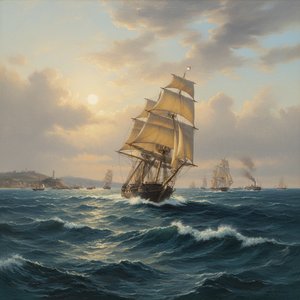
The Legacy of a Maritime Visionary
James Edward Buttersworth stands as a monumental figure in nineteenth-century maritime art, celebrated for his unparalleled ability to capture the dynamism and grandeur of sailing vessels against turbulent seas. Born in London in 1817 to Thomas Buttersworth Jr., a respected marine artist himself, James inherited a lineage steeped in artistic tradition. This heritage profoundly shaped his distinctive style and an unwavering dedication to documenting the era’s racing competitions. His canvases are instantly recognizable for their meticulous detail, masterful brushwork, and an arresting sense of movement that transports viewers directly into the heart of naval history.
Buttersworth's formative years were spent honing his skills under his father’s tutelage, absorbing the delicate techniques of watercolor painting and developing a keen eye for capturing atmospheric conditions—a skill he would later translate into breathtaking oil paintings. Around 1845, he embarked on a transatlantic journey to New Jersey, establishing a studio in West Hoboken, where he continued to refine his craft and cultivate connections within the burgeoning American art scene. He maintained a Brooklyn studio as well, demonstrating his versatility and commitment to artistic pursuits across geographical boundaries.
Mastery of the Sea and the Racing Spirit
The artist's career was marked by a remarkable ability to blend technical precision with emotional resonance. Notably, Buttersworth returned to England in 1851 for the Race for the Hundred Pound Cup, a pivotal event that cemented his reputation as one of America’s foremost ship portraitists. His sketches and paintings from this competition represent the definitive record of the season's racing fervor, showcasing a remarkable understanding of naval strategy and visual storytelling. Through his brush, the tension of the wind in the sails and the spray of the salt water become palpable to the observer.
His artistic vision was deeply influenced by the principles of Romanticism, a movement characterized by an emphasis on emotion, imagination, and dramatic landscapes. Drawing inspiration from masters such as Turner and Constable, Buttersworth prioritized the expressive power of nature. This influence is evident in his treatment of the ocean, which he never depicted as a mere backdrop, but as a living, breathing protagonist in every scene. His work captures the duality of the sea: its terrifying, destructive potential during storms and its majestic, serene beauty under clear skies.
Historical Significance and Artistic Achievement
The significance of James Edward Buttersworth lies not only in his technical prowess but also in his role as a visual chronicler of a vanishing era. As the age of sail began to yield to the industrial revolution, his paintings preserved the dignity and complexity of the great sailing vessels that once dominated the world's oceans. His contributions to maritime art include:
- Detailed Ship Portraiture: Providing an accurate and reverent record of naval architecture and rigging.
- Atmospheric Storytelling: Using light and shadow to convey the unpredictable temperament of the Atlantic and beyond.
- Documentary Excellence: Capturing the high-stakes drama of 19th-century yacht racing and maritime competition.
Today, Buttersworth’s work remains a cornerstone for collectors and historians alike. His ability to marry the precision of a draftsman with the soul of a Romantic painter ensures that his legacy continues to inspire awe, offering a window into a time when the horizon was a frontier of adventure and the sea was the ultimate test of human spirit and craftsmanship.
Questions & Answers
Where is James Edward Buttersworth from?
James Edward Buttersworth was born in United Kingdom.
Where are James Edward Buttersworth's artworks grouped by technique?
James Edward Buttersworth's works can be browsed by medium on the artist's All Medium page.
In which historical period did James Edward Buttersworth work?
James Edward Buttersworth worked in the 19th-Century period. The period situates the artist's activity in history.