A Californian Light: The Life and Art of Guy Orlando Rose
Guy Orlando Rose, a name synonymous with the blossoming California Impressionist movement, emerged from the sun-drenched landscapes of Southern California in 1867. His story is one of artistic dedication, shaped by both the rugged beauty of his native state and the refined techniques he absorbed during formative years spent amidst the artistic fervor of France. Rose wasn’t merely a painter; he was a translator of light, capturing the fleeting moments of atmospheric brilliance that defined the Californian experience at the turn of the 20th century.
Born in San Gabriel, to a family steeped in California history – his father served as a state senator – Rose's early life offered both privilege and a dramatic turning point. A childhood hunting accident left him with a facial injury that confined him indoors during recovery, an unexpected catalyst for his artistic journey. Sketching and painting became a means of solace and self-expression, quickly revealing a natural talent. He formally honed his skills at the California School of Design in San Francisco, laying a foundation in traditional techniques before embarking on a transformative period abroad.
The Parisian Influence and the Embrace of Impressionism
In 1888, Rose journeyed to Paris, immersing himself in the heart of the European art world. He enrolled at the Académie Julian, studying under esteemed artists like Benjamin-Constant and Lefebvre. However, it was a sojourn to Giverny – Claude Monet’s idyllic haven – that proved pivotal. Witnessing Monet's masterful manipulation of light and color, his dedication to plein air painting, profoundly impacted Rose’s artistic vision. He absorbed the principles of Impressionism not as academic doctrine but as a lived experience, observing firsthand how fleeting atmospheric conditions could transform a landscape before one’s eyes.
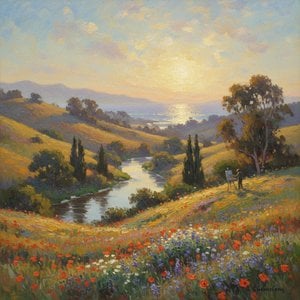
This influence wasn't simply imitation; Rose synthesized Monet’s techniques with his own sensibilities. While he shared the French master’s fascination with light, he applied it to distinctly Californian subjects – rolling hills dotted with poppies, sun-dappled oak groves, and tranquil waterways reflecting the expansive sky. He returned to France periodically, but California increasingly became his muse, a landscape he felt compelled to interpret through an Impressionistic lens.
A Distinctly Californian Palette
Rose’s artistic style is characterized by a vibrant color palette and loose brushwork. Unlike some of his contemporaries who favored muted tones, Rose embraced bold, saturated hues, mirroring the intensity of the California sunlight. His canvases shimmer with warmth, capturing the golden glow that bathes the state's landscapes. The visible brushstrokes aren’t haphazard; they are deliberate marks that create texture and convey a sense of movement, imbuing his paintings with life and energy.
His subject matter often centered on the natural beauty surrounding him: scenes from Pasadena, Carmel, and Monterey frequently appear in his oeuvre. He also explored still lifes, depicting fruit and everyday objects with the same attention to light and color that defined his landscapes. However, it was his depictions of California’s unique flora – particularly the vibrant poppy fields – that truly captured the public imagination.
Legacy and Historical Significance
Guy Orlando Rose played a crucial role in establishing the California School of Impressionism as a distinct artistic movement. He helped define a uniquely Californian approach to Impressionism, blending European techniques with local subject matter. While he faced personal challenges – including health issues stemming from an old injury and the use of lead-based paints – his dedication to his craft never wavered.
Though perhaps not as widely recognized today as some of his contemporaries, Rose’s paintings are increasingly valued for their beauty, technical skill, and contribution to American art history. His work offers a glimpse into a specific time and place, capturing the essence of California's landscape during a period of rapid change and growth. He left behind a legacy of luminous landscapes that continue to captivate viewers, solidifying his position as an important figure in the development of American Impressionism. He passed away in 1925, leaving behind a body of work that continues to inspire and delight.
Key Characteristics of Rose’s Work
- Plein Air Painting: A commitment to working outdoors directly from nature, capturing the immediacy of light and atmosphere.
- Vibrant Color Palette: Utilizing bright, saturated colors to reflect the intensity of Californian sunlight.
- Loose Brushwork: Employing visible brushstrokes to create texture and convey movement.
- California Landscapes: Focusing on scenes unique to California – poppy fields, oak groves, coastal views.
Questions & Answers
Can I study Guy Orlando Rose's use of color across all works?
The color profile of Guy Orlando Rose's work is shown on the artist's Palette Genome page.
Where is Guy Orlando Rose from?
Guy Orlando Rose was born in United States of America.
How do I find works by Guy Orlando Rose in a specific palette?
To find works by Guy Orlando Rose in a specific palette, use the artist's By Palettes page.