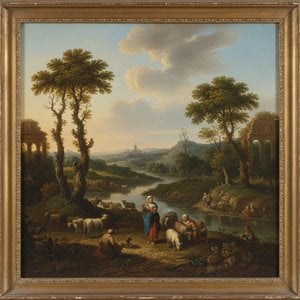
Govert Dircksz Camphuysen: The Quiet Master of Dutch Landscapes
Govert Dircksz Camphuysen, a name perhaps less familiar than those of Rembrandt or Vermeer, nevertheless stands as a significant figure in the Golden Age of Dutch painting. Born in Dokkum around 1624 and tragically dying in Amsterdam in 1672, Camphuysen’s legacy rests primarily on his serene and deeply evocative landscapes – scenes of rural life imbued with an almost palpable sense of tranquility and understated beauty. His work offers a poignant glimpse into the lives of farmers and laborers, capturing not grand narratives but rather the quiet rhythms of daily existence, bathed in the soft glow of moonlight or the muted hues of dawn.
Camphuysen’s artistic journey began within a family steeped in artistic tradition. His father, Dirck Rafaelsz Camphuysen, was himself a painter and poet, and his brother, Rafael Dircksz Camphuysen, followed in their footsteps. This familial connection undoubtedly provided him with an early foundation in the visual arts, though it’s important to note that Camphuysen developed a distinctly individual style, one characterized by a remarkable sensitivity to light and atmosphere. Early influences are believed to have included Paul Potter, whose masterful use of atmospheric perspective and luminous color palettes clearly resonated with Camphuysen's approach. However, unlike Potter’s dynamic compositions, Camphuysen favored a more restrained and contemplative aesthetic, focusing on the subtle nuances of his subjects.
Camphuysen’s oeuvre is remarkably small – estimates suggest he produced around 60-80 paintings throughout his career. This scarcity contributes to the enduring fascination with his work; each painting feels precious, a carefully considered meditation on the beauty of the Dutch countryside. His most celebrated subjects are undoubtedly his depictions of farm interiors and stables, often illuminated by the soft light of dawn or dusk. These scenes are populated not by heroic figures but by ordinary people – farmers tending their livestock, milkmaids performing their daily tasks, children playing in the fields. There’s a remarkable honesty to these portrayals; Camphuysen avoids sentimentality, presenting his subjects with a quiet dignity and respect.
A key element of Camphuysen's style is his masterful manipulation of light. He was particularly adept at capturing the ethereal quality of moonlight, creating scenes that seem to shimmer with an otherworldly glow. These “moonlight paintings,” as they’re often referred to, are among his most captivating works – images of solitary figures or small groups bathed in the silvery radiance of the night sky. The use of cool blues and violets, combined with subtle gradations of light and shadow, evokes a sense of peace and introspection. His landscapes also frequently feature a hazy atmosphere, creating a dreamlike quality that further enhances their contemplative mood.
Despite his undeniable talent, Camphuysen’s career was marked by periods of hardship and exile. Following the death of his father, he moved to Amsterdam with his family, where he faced financial difficulties and ultimately lost his position as a church minister due to his adherence to Arminian beliefs. This led to his expulsion from the city and a period of relative obscurity. However, Camphuysen persevered, continuing to paint in his spare time, and eventually regained some recognition for his work. His paintings are now held in prestigious collections around the world, including the Hermitage Museum in St. Petersburg and the Dulwich Gallery in London, testament to their enduring artistic merit.
The Legacy of a Quiet Observer
Govert Dircksz Camphuysen’s contribution to Dutch painting lies not in grand pronouncements or dramatic narratives but rather in his ability to capture the quiet beauty of everyday life. He was a keen observer, a master of light and atmosphere, and a painter who possessed an extraordinary sensitivity to the human condition. While he may not be as widely celebrated as some of his contemporaries, Camphuysen’s work continues to resonate with viewers today, offering a poignant reminder of the simple pleasures and enduring values of rural life.
His influence can also be seen in later generations of Dutch landscape painters, particularly those who sought to capture the subtle nuances of light and atmosphere. The legacy of Camphuysen is one of understated elegance, quiet contemplation, and a profound appreciation for the beauty of the natural world – a legacy that continues to inspire artists and viewers alike.