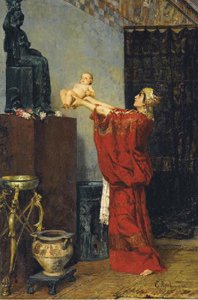
A Life Painted in Drama: The World of Georges Antoine Rochegrosse
Georges Antoine Rochegrosse, born in Versailles in 1859, was an artist whose canvases throbbed with a dramatic intensity that captivated late 19th and early 20th-century France. His life, marked by both personal upheaval and artistic triumph, unfolded against a backdrop of shifting aesthetic currents – from the academic rigor of his training to the burgeoning allure of Symbolism and, ultimately, the exotic embrace of Orientalism. Abandoned by his father in childhood, Rochegrosse found an unexpected paternal figure in Théodore de Banville, his mother’s second husband and a celebrated poet. This connection proved pivotal, immersing the young artist in a world of literary sophistication and introducing him to the vibrant artistic circles of Paris. It was a formative influence that would shape not only his sensibility but also provide invaluable subject matter for future works.From Historical Epic to Wagnerian Dreams
Rochegrosse’s formal education began with Alfred Dehodencq, followed by studies at the prestigious Académie Julian and École des Beaux-Arts under Jules Joseph Lefebvre and Gustave Clarence Rodolphe Boulanger. These masters instilled in him a mastery of technique and a dedication to historical accuracy, qualities that would initially define his artistic output. His early Salon submissions were ambitious historical scenes, often depicting moments of intense violence and emotional turmoil – works like Vitellius Dragged Through the Streets of Rome by the Populace (1882) and The Death of Caesar. These paintings weren’t merely recreations of past events; they were visceral experiences, rendered with a theatrical flair that immediately garnered attention. Recognition came swiftly with Andromaque (1883), which earned him the coveted Prix du Salon, solidifying his position within the Parisian art world. However, Rochegrosse was not content to remain solely within the confines of academic tradition. A shift began to occur in his work, influenced by the rising tide of Symbolism and a fascination with Richard Wagner’s operatic mythology. This evolution culminated in The Knight of the Flowers (1892), a large-scale painting inspired by Wagnerian themes that showcased a newfound emphasis on atmosphere, emotion, and evocative imagery—a departure from his earlier, more literal depictions.Algeria’s Embrace: The Rise of an Orientalist Master
The most significant turning point in Rochegrosse's career arrived with his first journey to North Africa in 1894. Initially undertaken as research for illustrating Gustave Flaubert’s Salammbô, Algeria quickly captivated him, becoming not just a source of artistic inspiration but a new home. He established a studio in El Biar, a picturesque village near Algiers, and immersed himself in the culture, light, and landscapes of the region. This immersion profoundly altered his artistic trajectory, leading him to embrace Orientalism with an authenticity that distinguished him from many of his contemporaries. His wife, Marie Leblond, became both muse and collaborator during this period, frequently posing for his paintings and contributing her own artistic talents – most notably in the creation of the elaborate Zaïmph veil inspired by Flaubert’s novel. Works like The Death of the Emperor Geta (1899) demonstrate a continued mastery of dramatic composition, now infused with the exotic allure and vibrant colors of North Africa. He became a prominent figure in French Orientalist painting, regularly exhibiting at dedicated salons and earning accolades for his evocative depictions of Algerian life.Legacy and Enduring Appeal
Throughout his career, Rochegrosse received numerous honors, including a third-class medal at the Salon in 1882, election as an Officer of the Legion of Honour in 1892, and the Médaille d’Honneur in 1906. He also dedicated himself to education, serving as a professor at the Algiers School of Fine Arts, nurturing a new generation of Algerian artists. His paintings are now held in esteemed collections worldwide, including the Musée d’Orsay and the Musée de Picardie, testament to his enduring artistic significance. Rochegrosse's legacy lies not only in his technical skill and dramatic flair but also in his ability to synthesize diverse influences – academic training, Symbolist sensibilities, and a deep engagement with North African culture – into a unique and compelling visual language. He was an artist who dared to explore the darker aspects of human experience while simultaneously celebrating beauty, sensuality, and the exotic allure of distant lands. His work continues to resonate today, offering viewers a glimpse into a world painted in drama, passion, and unforgettable detail.Key Works & Recognition
- Influences: Jules Joseph Lefebvre, Gustave Clarence Rodolphe Boulanger, Théodore de Banville.
- Notable Works: Vitellius Dragged Through the Streets of Rome by the Populace, Andromaque, The Knight of the Flowers, The Death of the Emperor Geta.
- Museum Holdings: Musée d’Orsay, Musée de Picardie, Musée des Beaux-Arts de Rouen.
- Illustrations: Works for Gustave Flaubert's Salammbô, Victor Hugo's Les Misérables, and Charles Baudelaire's Les Fleurs du Mal.
Questions & Answers
Where is Georges Antoine Rochegrosse from?
Georges Antoine Rochegrosse was born in France.
Is there a 3D virtual tour of Georges Antoine Rochegrosse's works?
Georges Antoine Rochegrosse's artworks can be seen in a 3D gallery on the artist's 3D Museum page.
How can I see every artwork made by Georges Antoine Rochegrosse?
Every work by Georges Antoine Rochegrosse on this website can be browsed from the artist's All Artworks page.
What are the birth city and country of Georges Antoine Rochegrosse?
Georges Antoine Rochegrosse was born in Versailles, in France.
What are the birthplace and birth year of Georges Antoine Rochegrosse?
Georges Antoine Rochegrosse was born in Versailles in 1859.
Can I browse Georges Antoine Rochegrosse's works by movement?
The movements Georges Antoine Rochegrosse worked in can be seen on the artist's All Movements page, which groups the artworks by movement.
How many artworks by Georges Antoine Rochegrosse are available to browse?
You can browse 74 artworks by Georges Antoine Rochegrosse on the All Artworks page.