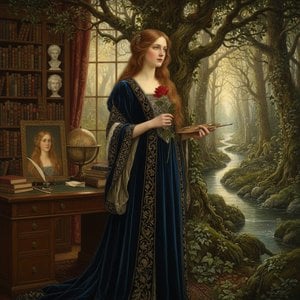
The Ethereal Vision of Frederick Cayley Robinson
In the quiet corners of British art history, few names evoke as much a sense of dreamlike serenity as Frederick Cayly Robinson. Born in Brentford in 1862, Robinson emerged as a painter of profound sensitivity, a master of light and color who could transform a canvas into a window toward a more spiritual realm. His work does not merely depict scenes; it captures atmospheres, often hovering between the tangible world and the realm of myth and memory. Through his mastery of tempera and oil, he developed a luminous style that felt both ancient and strikingly modern, bridging the gap between the detailed traditions of the Pre-Raphaelites and the atmospheric explorations of early twentieth-century symbolism.
Robinson’s artistic journey was shaped by a rigorous yet expansive education. After his initial training at St John’s Wood Academy and the Royal Academy Schools, he sought the transformative air of Paris, studying at the Académie Julian between 1890 and 1892. It was in France that his vision began to coalesce, heavily influenced by the monumental and serene decorative style of Pierre Puvis de Chavannes. This exposure to French muralism instilled in him a lifelong fascination with large-scale composition and the use of flat, rhythmic planes of color. As a member of prestigious groups such as the Society of Painters in Tempera and the New English Art Club, he became a vital part of a movement that sought to revitalize British painting through experimentation with medium and light.
Symbolism, Dreams, and the Mastery of Light
The true magic of Robinson’s oeuvre lies in its ability to evoke the subconscious. His paintings often function as visual poems, where the boundaries between reality and fantasy are beautifully blurred. In works such as The Blue Bird Dreamships, one finds a breathtakingly ethereal landscape where sleeping figures and floating vessels drift through a sky of soft, glowing hues. This dreamlike quality is not merely decorative; it is deeply rooted in his interest in symbolism and the subtle undertones of occultism that permeated much of the era's intellectual discourse. He possessed a unique ability to use light not just as a tool for visibility, but as a medium for emotion, casting a soft, nostalgic glow over scenes of childhood wonder or quiet contemplation.
His technical prowess allowed him to navigate various subjects with ease, from the intimate to the monumental:
- The Muralist: His most significant achievement remains the Acts of Mercy murals for Middlesex Hospital. Completed between 1915 and 1920, these panels utilize the tempera medium to create a sense of timelessness, depicting biblical narratives with a serene, healing luminosity.
- The Illustrator and Designer: Robinson’s talent extended into theatrical design and illustration, where his ability to create evocative, atmospheric worlds found a natural home.
- The Impressionist Influence: In works like Female Nude In A Garden, he demonstrated an ability to blend symbolic depth with the soft textures and light-play characteristic of Impressionism, creating compositions that feel both grounded in nature and elevated by spirit.
A Lasting Legacy in British Art
Though Robinson remained somewhat underappreciated by the mainstream critics during his lifetime, his historical significance has grown as modern eyes rediscover the value of his quiet, contemplative beauty. He stands as a pivotal figure who helped transition British art from the heavy narratives of the Victorian era into the more fluid, psychological landscapes of the twentieth century. His work serves as a bridge between the meticulous detail of the past and the emotive abstraction of the future.
Today, when we look upon a Robinson painting, we are invited to slow our pace. Whether it is the nostalgic charm of Maeterlinck's 'The Bluebird' or the profound stillness of his hospital murals, his art remains a sanctuary for the soul. He leaves behind a legacy defined by luminosity, tranquility, and an enduring ability to capture the fleeting, beautiful moments of the human dreamscape.
Questions & Answers
Where is Frederick Cayley Robinson from?
Frederick Cayley Robinson was born in United Kingdom.
How popular are Frederick Cayley Robinson's artworks?
Statistics about Frederick Cayley Robinson's works are available on the artist's Stats page.
How many artworks by Frederick Cayley Robinson are available to browse?
You can browse 66 artworks by Frederick Cayley Robinson on the All Artworks page.