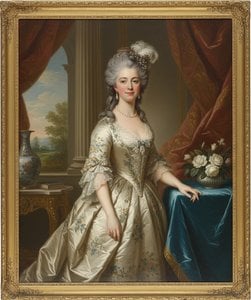
Francis Cotes: A Master of Pastel and Subtle Charm
Born in London in 1726, Francis Cotes (1726–1770) stands as a pivotal figure in the development of English art during the Georgian era. More than just a portrait painter, he was a true innovator, particularly recognized for his pioneering work with pastel and crayon – mediums that he pushed to their expressive limits. His legacy lies not only in the beauty of his finished works but also in his meticulous approach to technique and his profound influence on subsequent generations of artists.
Cotes’s early artistic training began under the tutelage of George Knapton, a respected portrait painter of the time. This foundation provided him with essential skills, yet Cotes quickly sought to forge his own distinctive style. A keen observer and student of Rosalba Carriera, the celebrated Venetian pastelist, he was deeply influenced by her delicate handling of color and her ability to capture fleeting expressions. He embraced pastel as his primary medium, experimenting with its unique qualities – its luminosity, its capacity for subtle gradations, and its suitability for rendering soft textures. Interestingly, his apprenticeship also involved a practical understanding of chemistry, knowledge that proved invaluable in formulating his own pastels, ensuring consistent color and tone.
Cotes’s career blossomed during the 1760s, a period marked by significant stylistic shifts in English portraiture. He developed a distinctive technique characterized by thinly applied paint—often mimicking the appearance of pastel—creating an ethereal quality that belied his use of oil. This approach earned him comparisons to Allan Ramsay and Sir Joshua Reynolds, both masters of their time, though Cotes’s style possessed a unique charm and intimacy. His portraits were renowned for their clarity, warmth, and remarkable attention to detail, particularly in the rendering of costume – a skill often outsourced to the specialist drapery painter Peter Toms after 1746, ensuring an accurate representation of fashion trends.
The Royal Academy and Artistic Circles
Beyond his individual artistic achievements, Cotes played a crucial role in shaping the cultural landscape of London. He was a founding member of the Society of Artists of Great Britain (later the Royal Academy) in 1768, demonstrating his commitment to establishing a formal institution for artists. His election as one of the first members of the Royal Academy in 1769, though tragically occurring just two years before his death, underscored his standing within the artistic community. He was known for his convivial nature and active participation in social gatherings, fostering connections with prominent figures of the era.
Cotes’s influence extended beyond his own studio. He mentored John Russell, who meticulously documented Cotes' techniques in “The Elements of Painting with Crayon,” providing a valuable insight into the artist’s methods and philosophies. This legacy ensured that Cotes’s approach to pastel remained relevant long after his death.
Notable Works and Artistic Style
Several of Cotes’s portraits stand as testaments to his skill and artistry. “Lieutenant Colonel Francis Smith” (1763), now housed at the National Gallery, exemplifies his neoclassical style – a formal depiction of rank and military status rendered with meticulous detail and dramatic lighting. “Francis Burdett of Foremarke Hall” (1764) showcases his mastery of pastel technique, capturing the elegance and refinement of Georgian society. These works, along with numerous other portraits, reveal Cotes’s ability to imbue his subjects with personality and character through subtle gestures and expressions.
Throughout his career, Cotes continued to experiment with crayon, pushing its boundaries as a medium. While he ultimately embraced oil painting for larger-scale works, he never abandoned crayon entirely, recognizing its unique qualities for capturing delicate details and nuanced effects. His work reflects a constant striving for innovation and a deep appreciation for the expressive potential of color.
A Tragic End and Lasting Legacy
Francis Cotes’s life was tragically cut short in 1770 at the age of 44, succumbing to illness in Richmond. Despite his untimely death, his impact on English art remains profound. He helped establish pastel as a respected medium, influenced countless artists, and left behind a body of work that continues to captivate viewers with its charm, elegance, and technical brilliance. His contributions to the Royal Academy and his dedication to artistic excellence cemented his place as one of the most important figures in Georgian portraiture.
Further exploration into Cotes’s life and work can be found at Art UK, where a comprehensive biography and image gallery are available. His portraits, including “Lieutenant Colonel Francis Smith” and “Francis Burdett of Foremarke Hall,” can also be viewed at the National Gallery.
Questions & Answers
What are the birthplace and birth year of Francis Cotes?
Francis Cotes was born in London in 1726.
What are the birth city and country of Francis Cotes?
Francis Cotes was born in London, in United Kingdom.
Where is Francis Cotes from?
Francis Cotes was born in United Kingdom.
Which artworks by Francis Cotes are the most viewed?
Statistics about Francis Cotes's works are available on the artist's Stats page.
Can I explore Francis Cotes's works by keyword?
The By Keywords page of Francis Cotes groups the artist's artworks by their keywords.
Where are Francis Cotes's artworks grouped by palette?
The By Palettes page groups Francis Cotes's artworks by their color palettes.
Where can I see Francis Cotes's artworks in chronological order?
A timeline of Francis Cotes's works exists: the artist's Artwork Timeline page orders the artworks by creation date.