Early Life and Circumstances
- Born: December 19, 1804, Gloucester, Massachusetts
- Died: August 14, 1865, Gloucester, Massachusetts
- Full Name: Nathaniel Rogers Lane (legally changed to Fitz Henry Lane in 1832)
- Movement: Luminism
Artistic Development and Training
- Lithography Experience: Worked as a lithographer at Pendleton’s Lithography Shop in Boston from 1832 to 1847.
- Early Works: Watercolor "Burning of the Packet Ship 'Boston'" demonstrates developing skill but less refined style than later works.
Style and Major Works: The Luminist Master
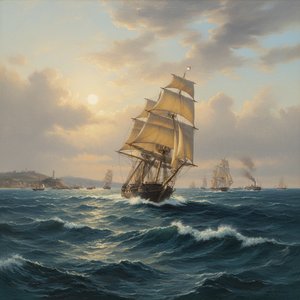
Lane is recognized as a leading figure in the Luminist movement, characterized by its emphasis on capturing atmospheric effects, particularly light reflecting on water. His paintings are known for their clarity, precision, and serene depiction of coastal scenes.- Key Characteristics of Lane's Style:
- Atmospheric Perspective: Masterful use of aerial perspective to create a sense of depth and distance.
- Detailed Observation: Meticulous attention to detail in depicting ships, buildings, and landscapes.
- Luminous Light Effects: Capturing the subtle nuances of light and its reflection on water with remarkable accuracy.
- Notable Works:
- "Entrance to Somes Sound from Southwest Harbor" (1852) – exemplifies his ability to capture the tranquility of coastal landscapes.
- "The Fort and Ten Pound Island, Gloucester, Massachusetts" (1847) - showcases a detailed depiction of local landmarks.
- “Lumber Schooners at Evening on Penobscot Bay” (1860) – demonstrates his skill in portraying dramatic lighting conditions.
- "Camden Mountains from the South Entrance to the Harbor" (1859) - captures a picturesque coastal scene with striking clarity.
- “Merchant Brig under Reefed Topsails” (1863)
- “Light House at Camden, Maine” (1851)
- “The Westen Shore with Norman's Woe” (1862)
Legacy and Historical Significance
Fitz Henry Lane’s work gained recognition during his lifetime, though his reputation has grown significantly in the 20th and 21st centuries. He is now considered one of the most important American Luminist painters, celebrated for his unique ability to capture the beauty and tranquility of New England's coastal landscapes. Lane’s paintings offer a valuable historical record of maritime life in 19th-century Gloucester and other coastal communities. His meticulous attention to detail and masterful use of light continue to inspire artists and captivate audiences today, solidifying his place as a significant figure in American art history.Questions & Answers
Can I explore Fitz Henry Lane's works by keyword?
To find works by Fitz Henry Lane on a specific theme, use the artist's By Keywords page, which groups the artworks by keyword.
How many artworks by Fitz Henry Lane are available to browse?
You can browse 95 artworks by Fitz Henry Lane on the All Artworks page.
Where is Fitz Henry Lane from?
Fitz Henry Lane was born in United Kingdom.