Menu
FREE ART CONSULTATION

Quick Facts

  • Works on APS: 6
  • Copyright status: Under copyright
  • Also known as:
    • Victor Alexandre Firmin Gautier
    • Firmin Gautier
  • Top 3 works:
    • La Sainte Famille
    • Sainte Famille
    • Tête de femme Ste Madeleine
  • Top-ranked work: La Sainte Famille

Art Quiz

There is only one correct answer for each question.

Question 1:
What artistic movement is Gautier Firmin primarily associated with?
Question 2:
Firmin's paintings often depict:
Question 3:
Which technique is Firmin known for utilizing in his artwork?
Question 4:
Firmin's artistic style emphasizes:
Question 5:
Where is Gautier Firmin originally from?

A Life Immersed in Light and Symbolism: The World of Gautier Firmin

Gautier Firmin, a French painter born in Grenoble in 1838, lived a life deeply intertwined with the artistic currents of his time. While biographical details remain somewhat elusive, piecing together fragments from historical records and art databases reveals an artist dedicated to capturing not merely what he saw, but the very essence of emotion and spirituality within serene landscapes and intimate portraits. Firmin’s journey began with foundational studies at the municipal school of drawing in Grenoble, under the tutelage of Théodore Ravanat and Félix Cottavoz—artists who instilled a respect for classical techniques while simultaneously fostering an environment open to emerging artistic sensibilities. Crucially, financial support from both the municipality and the Isère general council enabled Firmin to pursue further training at the prestigious École des Beaux-Arts in Paris, a pivotal step that would shape his future trajectory. His family background, with a father working as a menuisier and a grandfather as a chapelier, suggests an upbringing rooted in craftsmanship—a sensibility that likely informed his meticulous approach to painting. A marriage record from 1873 reveals Firmin’s established status as an artist painter and even a member of the Grenoble municipal council, hinting at a degree of civic engagement alongside his artistic pursuits.

The Parisian Influence and Developing Style

Paris in the mid-19th century was a crucible of artistic innovation. While Firmin didn’t immediately align himself with the radical movements like Impressionism that were beginning to take hold, he absorbed the prevailing atmosphere—a fascination with light, color, and psychological depth. His early works demonstrate a clear mastery of academic painting techniques, evident in precise draftsmanship and realistic depictions of form. However, as his career progressed, Firmin began to move beyond mere representation, imbuing his canvases with a subtle symbolism that hinted at deeper emotional and spiritual concerns. This shift is particularly noticeable in his portraits, which transcend the purely physical likenesses to capture the inner lives of his subjects. He wasn’t simply painting faces; he was attempting to portray souls. The influence of artists like Aimé Irvoy, who served as a witness at Firmin's marriage, suggests a network of artistic exchange and collaboration that further refined his aesthetic vision.

Themes of Faith and Intimacy in His Oeuvre

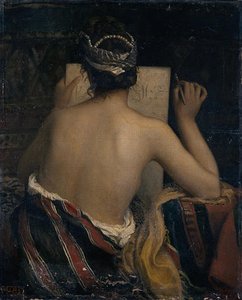
Firmin’s paintings frequently explore themes of faith, family, and the human condition. Works like “La Sainte Famille” and “Sainte Famille” demonstrate a reverence for religious iconography, though rendered with a distinctly personal touch—a quiet intimacy that sets them apart from more grandiose depictions. His portraits, often featuring women, are characterized by a gentle sensitivity and an almost ethereal quality. The painting "Tête de femme Ste Madeleine" exemplifies this approach; the subject’s gaze is introspective, inviting contemplation rather than demanding attention. Firmin's landscapes, while serene on the surface, often contain subtle symbolic elements—a solitary tree representing resilience, a winding path suggesting life’s journey, or a distant horizon evoking hope and transcendence. He wasn’t interested in bombastic displays of emotion; instead, he sought to create works that resonated with quiet contemplation and spiritual depth.

Legacy and Historical Context

Firmin Gautier's untimely death in 1877 at the age of 39 marked a poignant end to a promising career. While not widely celebrated during his lifetime, his work has experienced renewed appreciation in recent years as scholars and collectors recognize the unique qualities of his artistic vision. His paintings offer a fascinating glimpse into the transitional period between academic realism and the emerging modern movements—a time when artists were grappling with new ways of representing the world around them. Firmin’s emphasis on symbolism, psychological depth, and spiritual themes places him within a broader context of late 19th-century French art that valued introspection and emotional resonance. His work serves as a reminder that artistic innovation isn't always about radical departures; sometimes, it lies in subtly shifting perspectives and imbuing traditional forms with new meaning. His paintings continue to captivate viewers with their evocative power and enduring beauty.