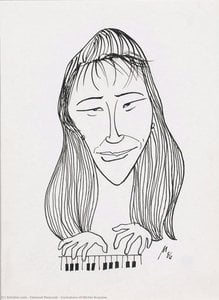
The Soul Behind the Line: The Artistic Legacy of Edmund Mańczak
In the storied annals of Polish art, few figures possess the ability to bridge the gap between profound psychological depth and the playful wit of satire as gracefully as Edmund Mańchik. Born in the vibrant, culturally rich atmosphere of Warsaw in 1917, Mańczak emerged from a period of immense historical transition, carrying with him the echoes of European avant-garde movements. His early years were shaped by the intellectual currents of Surrealism and Cubism, which provided him with a sophisticated visual vocabulary long before he established his own singular voice. This foundation allowed him to move beyond mere imitation, seeking instead to capture the very essence of his subjects through a lens that was both observant and deeply empathetic.
Mańczak’s journey as an artist was one of continuous evolution and academic rigor. After honing his craft at the Poznań State Art School, he refined his technical prowess at the prestigious Warsaw Academy of Fine Arts. It was within these hallowed halls that Mańczak transitioned from a student of diverse styles—ranging from the raw energy of Expressionism to the structured precision of Constructivism—to a master educator. During his tenure as a professor at the Academy between 1958 and 1967, he did more than just teach technique; he nurtured a generation of artists, instilling in them a respect for the meticulous observation of the human condition that would become his own hallmark.
Mastery of Medium and Character
While many artists seek the grandeur of oil on canvas, Mańczak found his greatest triumphs in the intimate and tactile realms of pencil, ink, and cardboard. There is a remarkable intimacy in his choice of materials, which allowed him to manipulate texture and tone with surgical precision. His work often eschews the distraction of color to focus entirely on the interplay of light and shadow, creating a monochromatic world where every stroke of the pen serves a narrative purpose. This technical mastery was most evident in his celebrated caricatures, where he achieved a rare feat: capturing the unmistakable likeness of a person while simultaneously revealing their inner spirit.
His portraits were never mere anatomical studies; they were psychological explorations. When rendering figures such as Krzysztof Jabłoński or Tatiana Pikajzen, Mańczak utilized subtle gestures and fleeting expressions to convey deeper truths about their characters. His ability to balance the exaggerated features of caricature with a profound sense of dignity is what elevates his work from simple humor to high art. Through his skilled use of line, he could evoke laughter through a clever exaggeration or silence through a poignant, shadowed gaze.
A Lasting Impression on Polish Art
The historical significance of Edmund Mańczak lies in his ability to humanize the artistic process. In an era where art could often become overly political or abstractly detached, Mańczak remained rooted in a humanist perspective. His oeuvre serves as a vital record of the personalities and social textures of mid-20th-century Poland, preserved through the sharp, witty, and compassionate eyes of a master draughtsman.
To reflect on his life's work is to witness a lifelong dialogue between humor and heartache, between the precision of the academy and the freedom of the satirist. His legacy continues to resonate through:
- Technical Innovation: The seamless integration of avant-garde influences into the traditional medium of drawing.
- Psychological Depth: A unique ability to use caricature as a tool for character study rather than mere mockery.
- Educational Impact: His profound influence on the Warsaw Academy of Fine Arts and the subsequent generations of Polish artists.