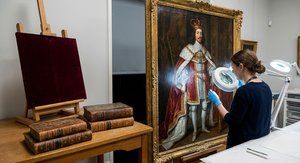
Daniel Mijtens: The English Court’s Naturalist
Daniel Mijtens (c. 1590 – 1647/48), often known as Daniel Mytens the Elder, stands as a pivotal figure in the transition of portraiture from the formality of earlier Dutch styles to the more approachable and naturalistic depictions favored by the English court during the Stuart period. Born in Delft, Netherlands, into a family deeply rooted in artistic tradition – his uncle was the esteemed Aert Mijtens, and he was related to Isaac Mijtens – Mijtens’s early training likely occurred within the studio of Michiel Jansz van Mierevelt in The Hague. This formative experience instilled in him a foundational understanding of composition and technique, which he would later adapt and refine during his prolific career, particularly in England. His initial period in the Netherlands remains somewhat obscure, with few known works from this early phase, suggesting a deliberate shift in artistic direction as he embarked on a new chapter in his life.A Move to London and Royal Patronage
By 1618, Mijtens had established himself in London, quickly gaining recognition through his commissions for Thomas Howard, the 14th Earl of Arundel, a leading art collector and connoisseur. This initial patronage proved crucial, providing him with access to influential circles and establishing a reputation as a skilled portraitist. His early works for the Earl showcased a burgeoning talent – portraits of Arundel himself and his Countess, Alethea Talbot – demonstrating an emerging ability to capture likenesses with subtle detail and a nascent sense of psychological depth. However, it was his subsequent commissions for King James I and Prince Charles that truly cemented his position within the English court. The scale of these projects—including multiple iterations of portraits of the royal family—necessitated assistance from a workshop, hinting at the considerable demand for his services and the evolving nature of artistic production during this period.The Hamilton Portraits: A Masterclass in Naturalism
Among Mijtens’s most celebrated works are the portraits of James Hamilton, later 1st Duke of Hamilton. These paintings, particularly those depicting a young Hamilton at seventeen in 1623 and again in 1629, represent a significant departure from the stiff formality typical of earlier court portraits. Mijtens masterfully captured the subject’s youthful vitality and character, imbuing the images with an unprecedented sense of realism and immediacy. The subtle nuances of expression, the play of light and shadow, and the attention to detail in the rendering of clothing and accessories all contribute to a remarkably lifelike portrayal. These portraits are considered cornerstones of Mijtens's legacy, demonstrating his innovative approach to portraiture and influencing subsequent artists like Abraham van Blyenberch. The meticulous duplication of this particular portrait highlights the scale of his work and the importance placed on creating multiple versions for various patrons.Influence and Legacy
Mijtens’s arrival in England coincided with a period of artistic exchange, and he actively sought to expand his knowledge and refine his style. His visits to the Netherlands in 1626 and 1630 were likely undertaken to study the latest developments in painting, particularly the works of Peter Paul Rubens and Anthony van Dyck – artists whose dynamic compositions and masterful use of light profoundly impacted Mijtens’s technique. He introduced a new naturalism into the English court portrait, moving away from the idealized representations favored by some of his predecessors. However, his career was ultimately overshadowed by the arrival of Anthony van Dyck in 1632, who quickly surpassed him as the leading court portraitist due to his superior technical skill and refined aesthetic sensibilities. Despite this decline in prominence, Mijtens’s contributions to English art remain significant, shaping the trajectory of portraiture and leaving behind a body of work that continues to fascinate and inspire. He ultimately returned to the Netherlands, dedicating himself primarily to art dealing before his death in 1648.Notable Works
- Daniel Mijtens - Charles I (1600–1649), King of England (Metropolitan Museum of Art) – A prime example of his royal portraiture, showcasing the formality and grandeur expected of such depictions.
- Duke of Hamilton – Demonstrates his ability to capture youthful vitality and character with remarkable realism.
- Charles I, King of England - A key portrait reflecting the evolving style of courtly representation during the Stuart era.
Questions & Answers
Is there a timeline of Daniël Mijtens's works?
The artist's Artwork Timeline page presents Daniël Mijtens's works ordered by date, year by year.
What are the birthplace and birth year of Daniël Mijtens?
Daniël Mijtens was born in Delft in 1590.
What other names is Daniël Mijtens known by?
Daniël Mijtens appears under the alternate names Daniel Mytens the Elder, Daniël Mijtens (I), Daniel Mytens, Daniel Mittens, Daniel, I. Martensz. Mijtens.