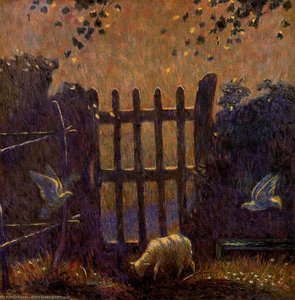
Benvenuto Benvenuti: A Tuscan Visionary of Light and Color
Benvenuto Benvenuti (1881-1959) stands as a significant, yet often underappreciated, figure in the late 19th and early 20th century Italian art world. Born in Livorno, Italy, he dedicated his life to capturing the essence of Tuscany’s landscapes – not merely depicting them, but imbuing them with an almost palpable sense of light, atmosphere, and emotion. His journey as an artist was shaped by a confluence of influences, from the early Macchiaioli movement to the groundbreaking techniques of Divisionism, ultimately forging a unique style characterized by vibrant color palettes, meticulous detail, and a profound sensitivity to the natural world. Benvenuti’s artistic education began under Lorenzo Cecchi at the School of Arts and Crafts in Livorno, providing him with a foundational understanding of traditional painting methods. However, it was his encounter with Adolfo Tommasi, a leading Macchiaioli landscape painter, that truly ignited his passion for capturing fleeting moments and atmospheric effects. The Macchiaioli’s emphasis on broken color and direct observation profoundly impacted Benvenuti's approach to composition and technique. He quickly developed an eye for the subtle shifts in light and shadow, striving to represent not just what he saw, but how it *felt*. This early influence is evident in his later works, particularly those depicting the rolling hills and sun-drenched fields of Tuscany. A pivotal moment in Benvenuti’s artistic development occurred in 1903 with his meeting with Vittore Grubicy, a key theorist and practitioner of Divisionism – a technique that sought to break down forms into their constituent colors and apply them separately to the canvas. Grubicy's influence was transformative; he encouraged Benvenuti to experiment with pointillist methods, meticulously layering tiny dots of color to create luminous effects and an illusion of depth. This experimentation led to a period of intense artistic exploration, culminating in his 1906 exhibition of “Luminous Sensations” at the National Fine Arts Show in Milan – a landmark event that showcased his evolving style. The triptych demonstrated his mastery of this technique, creating a shimmering, almost ethereal quality within the landscapes. Throughout the early decades of the 20th century, Benvenuti’s artistic circle expanded, bringing him into contact with other prominent Italian artists such as Lloyd, Fattori, Signorini, Pellizza da Volpedo, and Morbelli. He participated in several important exhibitions, including the Italian Divisionist Exposition at the Grubicy Gallery in Paris (1907) and the Salon d’Automme in Paris (1909), alongside fellow Tuscan artists. These collaborations exposed him to new ideas and perspectives, further refining his artistic vision. His time in Milan proved particularly fruitful, fostering a close relationship with Grubicy and allowing him to deepen his understanding of Divisionist principles. The outbreak of World War I brought disruption to Benvenuti’s life, resulting in a brief imprisonment in Germany. Following the war, he returned to Livorno and continued to exhibit his work, forming part of the Gruppo Labronico – an artistic collective that played a vital role in promoting contemporary art in the region. The 1920s saw Benvenuti diversifying his creative pursuits, venturing into graphic design and lithography for journals and posters, demonstrating his versatility as an artist. Tragically, a leg ailment led to amputation in 1932, significantly impacting his ability to paint. Despite these challenges, Benvenuti remained dedicated to his art until his death in 1959. His later works, created during the war years and beyond, are characterized by a heightened sense of introspection and a focus on capturing the subtle nuances of light and color. The Galleria Scopinich’s 1935 exhibition, which lauded his “L'Idea e la Luce,” highlighted his deep respect for the artistic principles espoused by Grubicy and Conti – two figures who profoundly shaped his artistic journey. Benvenuti’s legacy lies not only in his stunning landscapes but also in his pioneering exploration of Divisionist techniques and his unwavering commitment to capturing the beauty and spirit of Tuscany. His work continues to resonate with viewers today, offering a glimpse into a vibrant era of Italian art history.Key Works & Notable Characteristics
Benvenuti’s oeuvre is characterized by several recurring themes and stylistic elements:- Landscape Painting: The vast majority of his works depict the Tuscan countryside – rolling hills, vineyards, olive groves, and sun-drenched fields. These landscapes are rarely static; they are infused with a sense of movement and atmosphere, reflecting the fleeting effects of light and weather.
- Divisionism & Pointillism: Benvenuti’s masterful application of Divisionist techniques is evident in his use of small, precisely placed dots of color to create luminous effects. He skillfully manipulated these colors to evoke a sense of depth, atmosphere, and emotional resonance.
- Color Palette: His paintings are renowned for their vibrant and harmonious color palettes – dominated by warm yellows, oranges, reds, and blues, reflecting the natural light and hues of Tuscany.
- Detailed Observation: Benvenuti’s meticulous attention to detail is another hallmark of his work. He carefully rendered every element of his landscapes – from individual leaves and flowers to the texture of stone walls and weathered fences.
Connections & Influences
Benvenuti's artistic development was shaped by a network of influential figures:- Adolfo Tommasi: The Macchiaioli painter served as an early mentor, instilling in Benvenuti a passion for capturing fleeting moments and atmospheric effects.
- Vittore Grubicy: Grubicy’s teachings on Divisionism were instrumental in shaping Benvenuti's technique and artistic vision. He considered Grubicy his “perfect master.”
- Plinio Nomellini & Lloyd: Fellow Tuscan artists with whom he shared exhibitions and artistic ideas, contributing to the vibrant art scene of Tuscany.
Legacy & Significance
Benvenuti’s contribution to Italian landscape painting is significant. He was a key figure in the Divisionist movement, pushing the boundaries of color theory and technique. His work exemplifies the beauty and spirit of Tuscany, capturing its light, atmosphere, and timeless charm. While not as widely celebrated as some of his contemporaries, Benvenuti's dedication to his craft and his innovative approach to painting ensure that his legacy continues to inspire artists and art lovers alike.Questions & Answers
In which historical period did Benvenuto Benvenuti work?
Benvenuto Benvenuti worked in the Modern period. The period situates the artist's activity in history.
Can I browse Benvenuto Benvenuti's works by color palette?
To find works by Benvenuto Benvenuti in a specific palette, use the artist's By Palettes page.
What are the birthplace and birth year of Benvenuto Benvenuti?
Benvenuto Benvenuti was born in Milan in 1881.