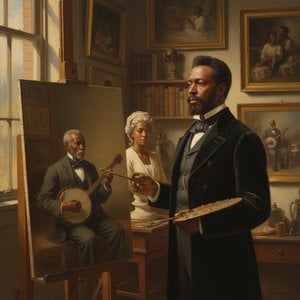
Benny Andrews: Life & Legacy
Early Life and Education
- Born: November 13, 1930, in Plainview, Georgia.
- Andrews grew up in a large family of ten children. His mother, Viola, instilled the importance of education, religion, and freedom of expression.
- Early Influences: His father, George Andrews, was a self-taught artist known locally as the “Dot Man,” who sparked Benny’s initial interest in art.
- He attended Fort Valley College on a two-year scholarship but left due to financial constraints and academic struggles.
- Andrews served in the U.S. Air Force from 1950 before pursuing formal artistic training.
Artistic Development & Career
- Andrews received his BFA from the School of the Art Institute of Chicago.
- He held his first solo exhibition in New York City in 1962, marking a significant step in his career.
- From 1968 to 1997, Andrews dedicated himself to teaching at Queens College, City University of New York.
- Prison Arts Program: He founded and directed a groundbreaking prison arts program that became a national model for rehabilitation through artistic expression.
- His work evolved into an expressive style characterized by bold colors and forms used to convey powerful emotions and social commentary.
Themes & Influences
- Key Themes: Andrews’ art frequently addressed themes of suffering, injustice, racial inequality, and the African American experience.
- His work often served as a visual protest against social and political issues of his time.
- He drew inspiration from personal experiences, observations of everyday life, and historical events.
- Artistic Influences: While developing his unique style, Andrews was influenced by various artistic movements, including Expressionism and Social Realism.
Notable Works
- Confrontation 2 (John Lewis Series): A powerful painting reflecting on the Civil Rights Movement and the struggles for equality.
- No More Games: A work that confronts issues of social injustice and inequality with raw emotion.
- Death of the Crow (1965): An early example of his expressive style, rendered in black and white oil on canvas.
Legacy & Historical Significance
- Benny Andrews’ work is featured in museum collections such as the Museum Collection Hugo Fischer (Bühl, Germany) and the Ogden Museum of Southern Art in New Orleans.
- Impact on Arts Education: His prison arts program demonstrated the transformative power of art for individuals facing incarceration.
- Andrews’ artistic contributions helped to raise awareness about social issues and promote dialogue around race, inequality, and justice.
- He passed away on November 10, 2006, leaving behind a lasting legacy as an artist, educator, and advocate for social change.
Questions & Answers
Where are Benny Andrews's artworks organized by color?
The Spectral Index page organizes Benny Andrews's artworks by color.
Where can I see Benny Andrews's artworks in chronological order?
A timeline of Benny Andrews's works exists: the artist's Artwork Timeline page orders the artworks by creation date.
How can I see every artwork made by Benny Andrews?
Every work by Benny Andrews on this website can be browsed from the artist's All Artworks page.