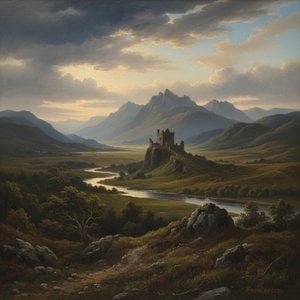
Alexander Nasmyth: A Scottish Pioneer of Landscape Painting
- Born: Edinburgh, United Kingdom (1758)
- Died: 1840
Alexander Nasmyth was a pivotal figure in Scottish art history, renowned as both a portraitist and, more significantly, a landscape painter. He is often credited with being the "father of Scottish landscape painting," bridging the gap between traditional portraiture and the burgeoning Romantic movement's focus on natural scenery.
Early Life and Training
- Apprenticed to a coachbuilder before pursuing art.
- Studied at the Royal High School and Trustees’ Academy in Edinburgh.
- Worked as an assistant to Allan Ramsay, a prominent portrait painter, in London (1774-1778). This experience provided valuable technical training and exposure to contemporary artistic trends.
- Returned to Edinburgh in 1778 and established himself as a portraitist.
- Travelled to Italy (1782-1784) with financial support from Patrick Miller of Dalswinton, where he deepened his understanding of landscape painting by studying Italian masters and copying works, notably those by Claude Lorrain.
Artistic Development and Key Works
- Initially painted portraits in the style of Ramsay but gradually shifted towards conversation pieces with outdoor settings.
- His portrait of Robert Burns (1787) is a notable work from his early career, showcasing his skill in capturing character and likeness.
- Around 1792, Nasmyth abandoned portraiture entirely to focus on landscape painting, influenced by political events and shifting artistic preferences.
- Developed a distinctive style characterized by detailed observation of natural features and architectural elements. His landscapes are all depictions of actual places.
- He also designed scenery for theatres and painted panoramas, demonstrating his versatility as an artist.
- Notable works include: View of Edinburgh from the West (1822-6), A View Of Edinburgh From The Dean, Pass Of The Cows, Highlands, and various depictions of Scottish lochs and castles.
Engineering Interests and Innovations
- Nasmyth possessed a keen interest in engineering and proposed several innovative ideas, though he never patented them.
- He was involved in the improvement and beautification of estates for members of the Scottish nobility.
- Designed notable structures such as the circular temple covering St Bernard's Well (1789) and bridges at Almondell and Tongland.
- Participated in a historic trial of Patrick Miller’s steamship on Dalswinton Loch in 1788, demonstrating his forward-thinking perspective.
Legacy and Influence
- Established a drawing school in Edinburgh that profoundly influenced a generation of artists, including David Wilkie, David Roberts, Clarkson Stanfield, John Thomson of Duddingston, and even the young John James Ruskin (father of John Ruskin).
- His emphasis on drawing from nature directly had a lasting impact on artistic training.
- Six of his daughters also became notable artists, contributing to a family legacy in the arts.
- Nasmyth's work helped establish landscape painting as a respected genre in Scotland and paved the way for later generations of Scottish landscape artists.
Questions & Answers
Where can I see the color profile of Alexander Nasmyth's work?
The color profile of Alexander Nasmyth's work is shown on the artist's Palette Genome page.
Is there a complete list of Alexander Nasmyth's artworks?
Every work by Alexander Nasmyth on this website can be browsed from the artist's All Artworks page.
How do I find works by Alexander Nasmyth in a specific palette?
Alexander Nasmyth's works can be browsed by color palette on the artist's By Palettes page.