Aert van der Neer: Master of Moonlight and Winter Landscapes
Aert van der Neer (c. 1603 – 9 November 1677) stands as a singular figure in Dutch Golden Age landscape painting, celebrated for his hauntingly beautiful depictions of nocturnal scenes bathed in ethereal moonlight and the crisp stillness of winter landscapes—particularly those overlooking canals and rivers. Unlike many of his contemporaries who favored grand vistas or idealized pastoral views, van der Neer focused on capturing subtle atmospheric effects and intimate moments within nature, establishing him as a pioneer of psychological realism within genre painting. His ability to evoke the biting chill of a frozen canal or the silvered glow of a midnight sky allows the viewer to step directly into the quietude of the seventeenth-century Netherlands.
Early Life and Artistic Foundations
Information regarding van der Neer’s formative years remains shrouded in the mists of history, yet his artistic essence is deeply rooted in the Dutch soil. While biographical accounts suggest he was born in Gorinchem around 1604, his true lineage is found in the brushstrokes of his contemporaries. His artistic education likely stemmed from exposure to influential painters like Rafael and Jochem Govertsz Camphuysen, whose stylistic sensibilities undoubtedly impacted his own burgeoning talent. This connection to a prominent artistic family fostered an environment conducive to honing skills and exploring innovative approaches to visual representation. Through this early immersion, he began to develop a unique eye for the interplay between light and shadow, a trait that would become his lifelong signature.
The Language of Moonlight and Technique
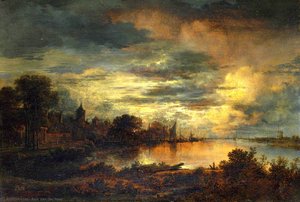
Van der Neer's distinctive style is immediately recognizable by his masterful manipulation of light—specifically moonlight—and its delicate interplay with firelight. He eschewed dramatic, sweeping compositions in favor of understated landscapes populated by figures engaged in the rhythmic activities of everyday life. In his works, one might find:
- Skaters gliding gracefully across frozen waterways during the height of winter.
- Kolf players pursuing their shots amidst soft snowdrifts.
- Fishermen patiently awaiting their catch under the watchful eye of a rising moon.
- Horse-drawn sleighs navigating the quiet, icy paths of a sleeping town.
His technique involved a meticulous layering of glazes to achieve remarkable tonal gradations and a delicate rendering of textures. This method allowed him to capture the ephemeral beauty of a sunset or the silvered, translucent quality of moonlight reflecting off ice. By focusing on these subtle atmospheric effects, he transformed simple landscapes into profound meditations on time and tranquility.
Legacy and Historical Significance
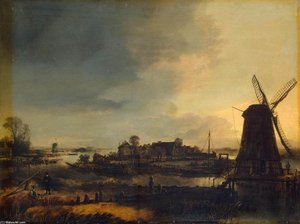
The historical significance of Aert van der Neer lies in his ability to elevate the "small" landscape into a realm of high emotional resonance. While other masters sought the monumental, van der Neer found greatness in the fleeting and the quiet. His works, such as the breathtaking
Landscape at Sunset or his lively winter scenes near Dutch towns, serve as timeless glimpses into seventeenth-century life. He remains a cornerstone of the Dutch Golden Age, remembered not just for his technical prowess, but for his ability to capture the very soul of the nocturnal world. His influence persists in the way we perceive the beauty of the night, reminding us that even in the darkest hours, there is a profound and luminous grace to be found in the natural world.