--- title: Winslow Homer - Wikipedia author: Authority control databases url: https://en.wikipedia.org/wiki/Winslow_Homer hostname: wikipedia.org sitename: Wikimedia Foundation, Inc. date: 2003-09-07 --- # Winslow Homer | Winslow Homer | | |---|---| ...
Before he was a painter of the Atlantic's fury, Winslow Homer understood the exacting demands of the line. His early years were spent in the rhythmic, repetitive labor of a Boston lithography studio, working under J.H. Bufford. This period was less an artistic awakening and and more a professional apprenticeship, a treadmill experience of preparing sheet music covers and commercial prints. Yet, there is a direct lineage between the precision required to etch a stone and the decisive brushstrokes found in his later oils.
This discipline finds an echo in the work of Adolf Menzel, another artist who began his career navigating the mechanical rigors of lithography. Just as Menzel translated the industrial pulse of Berlin into fine art, Homer utilized his commercial training to ground his subjects in a tangible reality. The ability to observe a detail and render it with structural integrity is a skill born not of inspiration alone, but of the steady, unglamorous work of the printmaker. For Homer, the transition from the lithographic stone to the canvas was not a rejection of his past, but an expansion of it.
The Unvarnished Truth: Civil War Realism and the Rejection of Romanticism
Realism was an artistic movement that emerged in France in the 1840s. Realists rejected Romanticism, which had dominated French literature and art since the early 19th century. The artist Gustave Courbet, the original proponent of Realism, sought to ...
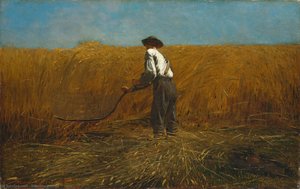
The American landscape in the 1860s was fractured by conflict, and Homer stood at the center of this upheaval. Serving as a special artist for Harper’s Weekly, he moved through the battlefields of Virginia, documenting the physical toll of war. His work from this era, such as Prisoners from the Front, eschewed the grand, heroic narratives favored by traditional history painting. Instead, he focused on the heavy, somber reality of the soldier’s experience—the fatigue, the uncertainty, and the quiet aftermath of violence.
This commitment to truth mirrors the broader movement of Realism that emerged in France during the 1840s. Gustave Courbet famously rejected the idealized subjects of Romanticism, choosing instead to depict the grit of contemporary life with an almost confrontational accuracy. While Homer’s subject was the American Civil War and Courbet’s was the French peasantry, both artists shared a refusal to look away from the difficult aspects of existence. They sought to capture the world as it appeared to the eye, stripped of sentimental embellishment, focusing instead on the weight of human experience in a changing nation.
The Weight of the Tide: Marine Subjects and the Legacy of the Barbizon School
--- title: Winslow Homer: Crosscurrents - The Metropolitan Museum of Art url: https://www.metmuseum.org/exhibitions/winslow-homer/visiting-guide hostname: metmuseum.org description: The Met presents over 5,000 years of art from around the world for e...
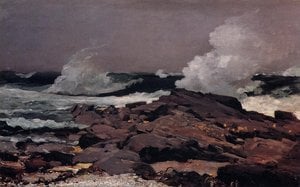
As the smoke of war cleared, Homer’s gaze turned toward the sea, finding a profound language in the movement of water and light. His travels to England and his time in the fishing community of Cullercoats allowed him to observe the strenuous lives of those tied to the ocean. In these works, the sea is not merely a backdrop but a powerful, often indifferent force. Whether capturing the optimistic energy of Breezing Up (A Fair Wind) or the more harrowing tension of maritime rescues, Homer mastered the ability to render the density and translucency of the Atlantic.
This fascination with the natural world and its atmospheric qualities draws a parallel to the Barbizon School painters in France. During his 1866 stay in Paris, Homer was exposed to the techniques of artists who sought to find spiritual depth within the landscape. Much like the Barbizon masters, Homer utilized outdoor lighting and a more direct approach to nature to move away from the polished artifice of previous generations. He took these European influences and applied them to the rugged coastlines of New England and Gloucester, creating a uniquely American maritime vocabulary that respected both the light of the sky and the weight of the wave.
Prouts Neck and the Quietude of Place: Finding Solace in Rugged Landscapes
--- title: Homer at Home and Abroad author: Madeline Bilis url: https://www.mfa.org/article/2025/homer-at-home-and-abroad hostname: mfa.org description: As a lifelong New Englander, Winslow Homer seems to have been born with an appreciation for the s...
In his later years, Homer sought the solitude of Prouts Neck, Maine, a peninsula that became both his studio and his sanctuary. Here, the vastness of Saco Bay provided a canvas for his most introspective works. The landscape was not a place of escape, but a site of intense observation, where the interplay of jagged rocks and blue-green swells reflected a lifelong preoccupation with mortality and endurance. His work in Maine, particularly his watercolors, captured the daily rhythms of coastal life with a quiet, profound dignity.
This reverence for a specific, lived-in landscape finds a historical echo in the works of the Hudson River School, though Homer’s approach was far more restrained. While earlier American painters sought to capture the sublime and untamed grandeur of the frontier to inspire national pride, Homer focused on the intimate and the elemental. He did not need the vastness of the West to find the epic; he found it in the tide pools and the weathered wood of a pier. His Maine was not a romanticized myth, but a tangible, breathing reality.
The Permanence of Pigment: Technical Mastery in a Transient World
To look at a Homer painting is to encounter the physical presence of paint itself. He understood the medium’s ability to hold weight and density, particularly in his oil works, where the texture of the brushstroke contributes to the subject's gravity. Conversely, his prolific watercolor oeuvre demonstrates a mastery of fluidity, allowing him to capture the fleeting light of a summer afternoon or the spray of a breaking wave. This technical versatility ensured that his observations remained anchored in the physical world.
This dedication to the integrity of materials reminds us of the enduring value of the handmade. In an age where digital reproduction can feel ephemeral, the visible hand of the artist provides a necessary connection to the past. At ArtsDot.com, we honor this tradition through our commitment to hand-painted oil reproductions on 100% cotton canvas. Our artists, trained in the rigorous standards of fine arts academies, utilize the same principles of layering and glazing that allowed Homer to achieve such depth. Whether it is a custom portrait or a reproduction of a maritime classic, we believe that the soul of a painting resides in the deliberate, physical application of pigment—a way to bring the enduring strength of the Old Masters into the modern home.
Explore 10 defining masterpieces of Romantic Realism! Discover Courbet, Millet & Daumier's powerful paintings—capturing emotion and social realities. Find museum-quality reproductions for your home at ArtsDot.com.
Immerse yourself in the raw power of American Realism with our curated guide to the top 25 Winslow Homer artworks. From dramatic seascapes to iconic landscapes, explore the stories behind these timeless masterpieces and find museum-quality reproductions on ArtsDot.com.
An expert guide for art collectors exploring the chemistry and artistry of oil, acrylic, tempera, and watercolor. Discover how medium specificity and material integrity define the longevity and value of fine art masterpieces.




 Realism (art movement)


