


The Prelude to Light: From Romantic Drama to Impressionist Radiance
 Landscape with Cattle at Limousin
The Drama of the Pastoral: Capturing Movement in Dupre's Landscape To stand before Jules Dupré’s Landscape with Cattle at Limousin is to be enveloped by a moment suspended between tranquility and impending drama. This magnificent oil on canvas, datin...
To wander through the history of French landscape painting is to witness a profound awakening, a slow transition from the heavy, dramatic shadows of the past toward a world bathed in pure, unadultered light. Before the Impressionists broke the boundaries of tradition, the canvas was often a stage for tension and monumental emotion. We see this beautifully articulated in the works of Jules Dupré, whose 1837 masterpiece, Landscape with Cattle at Limousin, captures a moment suspended between pastoral tranquility and an impending storm. There is a palpable weight to the atmosphere in these earlier works; the sky refuses to settle into mere placidity, instead pressing down with dark, ominous cloud formations that contrast against brilliant, fleeting highlights.
This era of Romanticism laid the essential groundwork for what was to come. While artists like Dupré and even the later Eugène Delacroix utilized expressive brushwork and a sensitivity to atmosphere, their focus remained often on the dramatic or the monumental. In Delacroix’s Landscape near Ante, we find a serene escape, yet it is a scene anchored by the structured weight of cypress trees and rolling hills that still respect the traditional boundaries of form. It was a period of transition, where the heavy glazes of the old masters began to thin, allowing an underlying luminosity to emerge, foreshadowing the radical rebellion that would soon transform the very way we perceive the natural world.
The Breath of the Earth: Pissarro and the Soul of the French Landscape
 Mastering Light: The 25 Best Artworks by Impressionist Legend Camille Pissarro
Introduction Imagine standing before a canvas where the air itself feels alive, vibrating with the soft hum of a French countryside morning or the rhythmic pulse of a bustling street corner. To step into the world of Camille Pissarro is to abandon th...
As the 19th century progressed, a new generation of observers emerged, led by the steady, guiding spirit of Camille Pissarro. To step into Pissario’s world is to abandon the rigid lines of tradition and embrace the beautiful, fleeting chaos of light. He did not merely paint landscapes; he captured the breathing pulse of the earth itself. For Pissarro, there was profound dignity in the mundane—a dirt road, a quiet orchard, or a cluster of trees were not just subjects, but electric windows into the soul of the countryside. His approach was revolutionary because it embraced en plein air painting, working directly under the open sky to catch the soft hum of a French morning.
Pissarro’s mastery lay in his ability to make the air itself feel alive, vibrating with the rhythmic pulse of nature. Unlike the dramatic tensions found in the works of the Barbizon School, Pissarro sought the subtle nuances of the everyday. His palette breathed with color and movement, moving away from the dark, academic corridors toward a luminous, textured mastery. Through his eyes, we learn that the true essence of a landscape is not found in its grandest peaks, but in the way light dances upon a simple field, reminding us that even the most quiet moment is imbued with a profound, shimmering vitality.
Chasing the Ephemeral: The Dance of Atmosphere and Sunlight
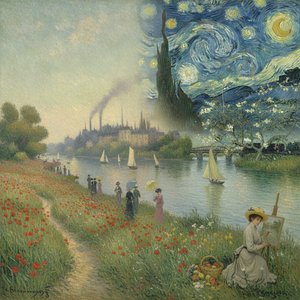 10 Iconic Impressionist Landscapes That Changed Art Forever
Introduction To step into the world of Impressionist landscapes is to abandon the rigid boundaries of reality and embrace the fleeting dance of light and atmosphere. Imagine standing on the banks of the Seine or amidst a sun-drenched meadow in Givern...
The heart of the Impressionist movement lies in its pursuit of the ephemeral—that breathless, fleeting moment before the light shifts and the shadows lengthen. This was a radical departure from photographic precision; instead, artists like Monet and Renoir sought to capture an impression, a sensory memory of a scene. Imagine standing on the banks of the Seine or amidst a sun-drenched meadow in Giverny, where the horizon vibrates with color and the air feels heavy with moisture. This movement was a rebellion against the somber dictates of the Académie des Beaux-Arts, trading muted earth tones for a vibrant, broken palette that mimicked the flickering movement of leaves and the shimmer of water.
This dance of light and shadow requires a unique technical mastery. It is seen in the way an artist uses visible, energetic brushstrokes to create texture and depth, much like the thick impasto found in the works of Paul Gauguin. While Gauguin eventually pushed toward the more symbolic and exotic landscapes of Martinique, his roots remained deeply connected to this fascination with light and vitality. The Impressionist technique allows the viewer to experience the landscape not as a static image, of a finished object, but as a living, changing entity. It is an invitation to witness the transient nature of time, captured through the interplay of color and the soft, hazy warmth of a summer afternoon.
Beyond the Horizon: Capturing the Pastoral Peace of the Barbizon Influence
 alexandre defaux
Alexandre Defaux: A Painter of French Pastoral Life Born in Cergy, France, in 1826, Alexandre Defaux emerged as a significant figure within the Barbizon School of landscape painting – a movement that profoundly shifted the course of French art. While...
Before the Impressionist revolution fully took hold, the Barbizon School provided a vital bridge, emphasizing a deep, personal response to the rural landscapes of France. Artists such as Alexandre Defaux brought a serene glimpse into the daily rhythms of farming communities, capturing an era of quiet beauty before the rapid onset of industrialization. Their work was characterized by a remarkable sensitivity to detail—the texture of weathered farmhouses, the rustle of foliage, and the hardworking individuals who shaped the land. This movement prioritized the immediate effects of light and atmosphere, creating a sense of peace that felt both realistic and deeply emotive.
This pastoral tradition also found echoes in the works of others, such as Edgar Degas, who, in At the Races in the Countryside, utilized a style influenced by photography to create a sense of a spontaneous snapshot. Even when depicting social scenes, the connection to the landscape remains central. There is a shared lineage between the quiet, earthy tones of Defaux and the more vibrant, sun-drenched meadows of later Impressionism. Together, these artists created a tapestry of French rural life, moving from the structured realism of the early 19th century toward a more liberated, sensory experience of the natural world.
A Sensory Journey: How Impressionism Invites Us to Slow Down and Observe
 Martinique Landscape
Captivating Subject and Lush Landscape Immerse yourself in the vibrant beauty of a tropical paradise captured through the masterful brushwork of Paul Gauguin. This evocative scene depicts the lush, mountainous terrain of Martinique, where the natural...
In our modern era of digital perfection and static, high-speed imagery, the textured depth of an Impressionist canvas offers a much-needed sanctuary. These works remind us of the beauty found in imperfection and the profound wonder hidden within the everyday. To engage with these paintings is to practice the art of slowing down. It is to observe the subtle nuances of a sunset, the way a shadow stretches across a meadow, or the way light filters through silvered leaves. The visible brushstrokes and deep tonal ranges serve as a tactile reminder of human perception and the raw emotion of seeing.
At ArtsDot.com, we believe that art should be a lasting memory, a window into these timeless moments of beauty. Whether it is a hand-painted reproduction that captures the thick, physical texture of an original or a custom commission that transforms a personal milestone into a masterpiece, our mission is to bring this luminous world into your home. We invite you to explore the enduring magic of the Impressionist spirit—a journey of light, color, and soul that continues to inspire and move us, decades after the final brushstroke was laid upon the canvas.


