Landscape with a River – A Reflection of Norfolk’s Soul John Crome, “Old Crome” as he was affectionately known by his contemporaries and son alike, stands as an enduring emblem of British landscape painting—a foundational figure within the celebrated...
The late eighteenth century arrived with a heavy weight of logic, an era where the Enlightenment sought to measure every mountain and categorize every star through the lens of scientific certainty. Yet, beneath this structured surface, a quiet rebellion was forming. This movement, known as Romanticism, did not seek to destroy reason but rather to supplement it with the unquantifiable truths of intuition and emotion. It was a shift from the objective to the subjective, where the artist’s primary duty moved from documenting the physical world to expressing the internal response to it.
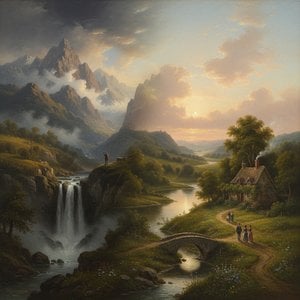
This transition finds a clear historical echo in the works of John Crome. While his contemporaries might have focused on the rigid geometry of a scene, Crome, through the Norwich School, embraced a more tactile and immediate approach. His work, such as Landscape with a River, demonstrates how the artist can move away from photographic realism to capture the very atmosphere of the East Anglian countryside. By utilizing thick impasto and a muted, luminous palette, he allowed the texture of the paint itself to convey the weight of the air and the movement of the water, proving that truth in art often resides in feeling rather than mere measurement.
The Internalized Landscape: Nature as a Reflection of the Soul
Early Life and Artistic Foundations Born on October 11, 1803, in the charming city of Middelburg, nestled within the Dutch province of Zeeland, Barend Cornelis Koekkoek entered a world already steeped in artistic tradition. His father, Johannes Herma...
To the Romantic painter, a forest was never merely a collection of trees, nor was a storm simply a meteorological event. The landscape became a psychological mirror, a vessel for the artist's deepest anxieties, joys, and spiritual yearnings. This era saw the elevation of the natural world to a sacred status, where the wildness of the earth served as a metaphor for the untamed reaches of the human psyche. The boundaries between the observer and the observed began to dissolve, leaving only a shared sense of existence.
We see this profound connection in the lineage of Barend Cornelis Koekkoek. Born into a family of Dutch painters, Koekkoek inherited a technical discipline that he eventually used to explore much more dramatic, emotive territories. His landscapes are not passive vistas; they are charged with an emotional resonance that seeks to capture the very breath of nature. Much like his predecessors, he understood that by focusing on the atmospheric effects of the Dutch and German countryside, he could invite the viewer into a state of contemplation, making the external scenery inseparable from the internal experience.
Atmospheric Truth: The Art of Light, Mist, and Shadow
The Romantic Visionary of the Neapolitan Coast Born in the historic city of Dresden on September 27, 1799, Carl Wilhelm Götzloff emerged from a modest background to become one of the most luminous voices of the Romantic era. The son of a town constab...
The mastery of atmosphere is perhaps the most enduring technical achievement of the Romantic period. Artists moved away from the clear, sharp outlines of Neoclassicism to embrace the blurred edges of mist, the heavy shroud of clouds, and the transformative power of light. This was not a lack of skill, but a deliberate choice to use light as a medium of mystery. Through subtle tonal gradations and layered oils, they created an illusion of depth that felt less like a window and more like a memory.
This pursuit of atmospheric nuance is evident in the work of Carl Wilhelm Götzloff. Trained under masters like Caspar David Friedrich, Götzloff learned the delicate art of capturing how light dissolves the edges of a distant shore or how mist clings to a mountain peak. His move to Naples allowed him to merge Northern European sensibilities with the vibrant, sun-drenched clarity of the Mediterranean. In his hands, the technique of layering paint became a way to capture the shimmering quality of sunlight, ensuring that the physical light on the canvas mirrored the spiritual light within the viewer.
Discover Richard Wilson (1713-1782), a pioneer of British landscape painting. Explore serene countryside scenes & idyllic views influenced by Gainsborough. View his masterpieces now!
There is a specific, haunting beauty found in decay—a fascination with the way time reclaims even the most formidable human structures. The Romantic movement often looked backward, finding meaning in the remnants of previous eras. The presence of ruins within a landscape functioned as a memento mori, reminding the observer of the transience of power and the inevitable triumph of nature over human ambition.
This meditation on mortality is captured with clarity in Richard Wilson’s landscapes. In his depictions of crumbling stone, the architecture acts as a central character in a narrative about the passage of years. The ruins provide a focal point for contemplation, grounding the vastness of the landscape in a sense of history and loss. It is a technique that connects the viewer to the weight of centuries, suggesting that while human endeavors may fade, the earth remains, enduring and indifferent.
Confronting the Infinite: Human Fragility within the Sublime
Introduction To step into the world of Romantic landscape painting is to surrender oneself to the sublime. It is an invitation to move beyond the mere observation of nature and instead experience its profound, often overwhelming, emotional power. Dur...
The concept of the "Sublime" sits at the very heart of this movement—that specific, overwhelming sensation where beauty meets terror. It is the feeling of standing on the edge of a precipice or witnessing a tempestuous sea, realizing one's own insignificance in the face of the infinite. This was not an art of comfort, but an art of awe, designed to provoke a sense of spiritual transcendence through the recognition of nature's untamable power.
This confrontation with the vastness is perhaps most famously explored in the works of Caspar David Friedrich. In pieces like Monk by the Sea, the human figure is often dwarfed by an immense, brooding horizon. The composition does not offer a sense of security; instead, it leaves the viewer suspended in a state of profound solitude. This use of scale serves to remind us of our smallness within the grandeur of the universe, yet paradoxically, it connects us to that very greatness through the shared experience of wonder.
Integrating Tradition: The Enduring Resonance of Modern Design
The continuity of these traditions is found in the physical weight an object carries within a room. In the eighteenth century, the placement of a large-scale landscape in a manor house was intended to command the architecture, dictating the movement and the quietude of the viewer. This relationship between scale and space remains a fundamental principle of composition. A large-scale multi-panel group set painting functions similarly, anchoring a room by establishing a presence that resists the fleeting nature of modern decor.
This presence is what distinguishes a curated environment from a decorated one. When a custom portrait is placed within a contemporary setting, it introduces a specific historical weight that challenges the anonymity of mass-produced objects. At ArtsDot.com, we assist collectors in selecting works that provide this gravity to their private and professional environments. By choosing reproductions that adhere to the technical standards of the Old Masters, one introduces a sense of historical continuity into a modern space, ensuring the room feels inhabited rather than merely occupied.
Discover John Crome (1768-1821), founder of the Norwich School! Explore his evocative Romantic landscapes, oil paintings & etchings inspired by Dutch Masters and Constable.
Carl Gustav Carus (1789-1869) was a German Romantic painter, physician & scientist. Explore his atmospheric landscapes, psychological themes, and influence on Darwin & Jung. Discover iconic works like …
Discover the profound emotional depth of Romantic landscape painting. Explore the philosophy of the Sublime and the mastery of legends like Turner and Friedrich. Enhance your collection with museum-grade, hand-painted oil reproductions from ArtsDot.com.
Explore the profound emotional depth of Romantic landscape painting. Discover how masters captured the sublime through light, shadow, and untamed nature, and learn to bring this timeless, atmospheric beauty into your collection with museum-quality fine art reproductions.
Explore the emotional power of Romantic landscape painting! Discover the sublime & picturesque aesthetics, key artists like Friedrich & Cole, and lasting influence on art history. Find your perfect piece at ArtsDot.



 Landscape with a River
 Barend Cornelis Koekkoek
 Carl Wilhelm Götzloff
 Richard Wilson
 10 Iconic Masterpieces That Defined Romantic Landscape Painting