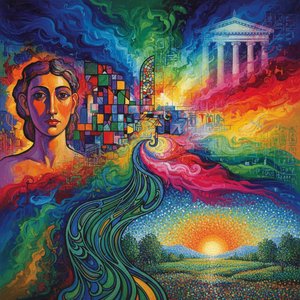
The Monodrama’s Inner Landscape: A Study in Musical Tension
To listen to Erwartung is to enter a space where the boundaries of the self begin to dissolve. Written by Arnold Schoenberg in 1909, this monodrama for soprano and orchestra does not rely on a traditional plot or a sequence of predictable events. Instead, it presents a singular, psychological state: a woman searching through a dark forest, lost in a fever of expectation and dread. The music does not move toward a resolution; it moves inward, tracing the jagged contours of a mind unravting.
This musical structure finds its historical echo in the way we perceive the depth of a portrait. Just as a painter uses light and shadow to suggest a figure that exists beyond the frame, Schoenberg uses sudden shifts in orchestration to suggest emotions that cannot be named. The tension is not found in a melody one can hum, but in the intervals between notes—the pauses where the silence feels heavy with what remains unsaid. It is a study of the moment before a realization, a musical embodiment of the threshold between consciousness and the subconscious.
Chromatic Dissonance: Schoenberg, Kandinsky, and the Abstraction of Feeling
Wassily Wassilyevich Kandinsky. A pioneer of abstract art and the Blue Rider movement. Explore his vibrant, spiritual compositions and revolutionary works today.
The departure from traditional tonality in Erwartung was not an isolated event but part of a broader movement toward abstraction that redefined the early twentieth century. Schoenberg, a composer who also practiced as an amateur painter, shared a profound intellectual bond with Wassily Kandinsky. For both men, the goal was to strip away the literal—the recognizable landscape or the predictable chord progression—to reveal a more fundamental truth. In music, this meant abandoning the comfort of a home key; in painting, it meant liberating color from the duty of describing objects.
Kandinsky’s work often sought to translate spiritual vibrations into visual form, much as Schoenberg translated psychological tremors into sound. When we look at an abstract composition, we are not looking for a depiction of a tree or a mountain, but for a resonance of spirit. The dissonance in Erwartung functions similarly to a sharp, unexpected stroke of pigment on a canvas. It disrupts the viewer's or listener's equilibrium, forcing an engagement with the raw energy of the work rather than its surface-level beauty.
The Fauvist Pulse: Saturated Color and Atonal Intensity
Explore Arnold Schoenberg's revolutionary music – atonality, twelve-tone technique & influence on 20th-century composers. Discover his legacy at the Schönberg Center.
While the German and Viennese schools focused heavily on the psychological depths of Expressionism, the movement found its initial, more outward pulse in the French Fauvists. This group utilized bold, saturated colors to convey emotion, prioritizing the intensity of the artist's vision over the accuracy of light and form. There is a shared DNA between the wild, uninhibited palette of a Fauvist landscape and the atonal intensity found in Schoenberg’s score.
The connection lies in the rejection of the decorative. The Fauvists used color not to please the eye with harmony, but to strike it with impact. Similarly, Schoenberg’s orchestration avoids the lush, comfortable textures of late Romanticism. Instead, he employs sudden bursts of brass and piercing woodwinds that mirror the way a bright, clashing color can disrupt a muted composition. Both approaches demand that the audience confront the work's intensity directly, without the safety net of traditional aesthetic comforts.
Reflections of the Unseen: The Self-Portrait as Musical Narrative
Schoenberg’s engagement with the visual arts was deeply personal, evidenced by his numerous self-portraits. These works were not mere exercises in likeness but attempts to capture the shifting identity of the creator. In a self-portrait, the artist confronts their own gaze, much like the soprano in Erwartung confronts her own fragmented memories and fears. The music acts as a mirror, reflecting a psyche that is constantly being reconstructed through sound.
This mirrors the way we approach the study of the Old Masters. When we examine a portrait by Rembrandt or Velázquez, we are looking for more than skin and bone; we are searching for the presence of the person behind the paint. Schoenberg applied this same rigor to his monodrama. He did not write a character; he wrote a state of being. The music becomes a vessel for an identity caught in the act of searching, making the performance an intimate encounter with the artist's own internal struggle.
The Architecture of Anxiety: Navigating the Shift from Romanticism to Expressionism
The transition from the maximalist Romantic era to the starker landscapes of Expressionism was marked by a profound sense of cultural anxiety. The years leading up to and following World War I brought a mounting discontent with the established order, a feeling that the old structures could no longer contain the complexities of the modern age. Erwartung sits at the heart of this shift, breaking away from the grand, sweeping narratives of the nineteenth century to explore the fractured, uncertain reality of the twentieth.
This architectural shift in art is visible in the movement from the balanced compositions of the Renaissance toward the more fragmented and unstable forms of the modern era. The stability of a classical landscape is replaced by the disorientation of an Expressionist forest. To appreciate this evolution, one must respect the tradition that preceded it while acknowledging the necessity of the break. Schoenberg did not destroy the past; he used its fragments to build something new, much like how we might use a traditional oil technique to render a modern, unsettling subject on canvas. At ArtsDot.com, we celebrate this continuity, offering hand-painted reproductions and custom commissions that honor the weight of history while embracing the spirit of individual expression.
Explore Arnold Schoenberg's revolutionary music – atonality, twelve-tone technique & influence on 20th-century composers. Discover his legacy at the Schönberg Center.
Explore the fascinating relationship between color & emotion in art history. Discover how master artists used vibrant hues to evoke feelings, cultural meanings, and psychological responses. A deep dive for classic art enthusiasts.
Explore the powerful world of Expressionism with ArtsDot. Discover key artists like Kirchner & Nolde, understand its emotional impact, and learn about this revolutionary art movement's lasting legacy. Handmade oil paintings available.
Journey through the soul of abstraction with our curated guide to the top 25 Wassily Kandinsky masterpieces. Explore the vibrant colors and spiritual forms that defined modern art. Find museum-quality reproductions and decor inspiration. Discover all masterpieces on ArtsDot.com.
Explore the captivating world of introspective art! Discover how artists across eras – from Rembrandt to Kahlo – used self-portraiture to reveal their inner worlds and emotional depths. A journey through art history & psychology.



 Wassily Wassilyevich Kandinsky
 Arnold Schoenberg
 Self-Portrait