Maritime history dates back thousands of years. The earliest watercraft used by humans were rafts, as they needed less sophisticated wood-working skills to make. The oldest archaeological survival of a prehistoric boat is a dugout canoe, the Pesse ca...
The history of maritime art is a fascinating evolution from functional documentation to pure aesthetic expression. For centuries, our relationship with the sea was defined by necessity, fear, and commerce. The earliest visual encounters were often practical—navigational charts, ship logs, and meticulous renderings of vessels used for trade and exploration. These works were not intended to stir the soul but to record the reality of a voyage, serving as vital records for those who navigated the unpredictable currents of global trade.
This era of documentation finds an echo in the ancient maritime history where watercraft like the Pesse canoe served as essential tools for survival and migration. Just as early humans relied on physical evidence of their journeys across strays, early maritime artists provided the visual evidence required to understand a growing world. Today, we see this same desire for connection in the way collectors seek out works that ground a modern space in historical truth.
Navigating the Golden Age: Dutch Maritime Power and the Legacy of the Ship Portrait
The maritime fur trade (historically called the North West trade), a ship-based fur trade system, focused largely on acquiring furs of sea otters and other animals from the Indigenous peoples of the Pacific Northwest Coast and Alaska Natives. Entrepr...
During the 17th-century Dutch Golden Age, the ship portrait emerged as a powerful genre, reflecting the burgeoning maritime power of cities like Hamburg and Amsterdam. Artists such as Ludolf Backhuysen did not merely paint water; they were chroniclers of an era, capturing the grandeur of naval strength and the intrepid spirit of exploration. These paintings functioned almost as news reports, documenting the vessels that drove the global economy through trade routes spanning from the North West fur trade to the markets of Qing China.
This period of intense maritime activity finds a parallel in the historical expansion of the Russian-American Company and the Hudson's Bay Company, where the physical presence of a ship was a symbol of economic sovereignty. The precision required to render these vessels mirrors the technical sophistication seen in the collections of the National Maritime Museum of Korea, where the Joseon Missional Ship stands as a testament to ancient craftsmanship. When we look at a well-executed ship portrait today, we are not just viewing a painting; we are observing a legacy of maritime dominance and the meticulous detail of an age defined by sail and wood.
Mapping the Infinite: The Shift from Cartographic Precision to Atmospheric Impressionism
Discover Daubigny’s "Seascape" (1867): A dramatic oil painting of a stormy ocean & sky in an impressionistic style. Explore this evocative artwork's beauty and historical significance.
As the centuries progressed, the focus shifted from the vessel to the very essence of the ocean itself. The transition toward Impressionism marked a revolutionary departure from the need for precise documentation. Artists began to move away from grand historical narratives toward the study of light, weather, and the transient effects of the atmosphere. This shift allowed the sea to be viewed not as a highway for commerce, and trade, but as a subject of profound sensory experience.
We see this transition in the works of masters like Charles-François Daubigny, whose 1867 seascape utilizes an impressionistic style to capture the drama of a stormy sky. This movement toward abstraction finds its historical antecedent in the development of cartography and hydrography, where the goal was once to map every coastline with absolute certainty. While the cartographer sought to define the boundaries of the known world, the Impressionist sought to dissolve them through light. For the modern collector, this provides a beautiful tension between the structured history of the sea and the fluid, emotional experience of its waves.
The Sublime Tide: Capturing Nature's Fury through the Lens of History
Captivating Seascape of Nature’s Fury Immerse yourself in the raw power and majestic beauty of this evocative seascape, masterfully capturing a tumultuous ocean scene during a fierce storm. The painting vividly portrays the relentless energy of natur...
There is an inherent drama in the churning surf and darkened clouds that speaks to the human spirit's resilience. The ocean has long been viewed as a dual force—a sanctuary of peace and a formidable display of power. This duality is perhaps most evident in works like Claude Monet’s Storm on the Cote de Belle-Ile, where the relentless energy of nature is captured through vigorous brushstrokes and textured impasto. Such works do not merely show a storm; they invite the viewer to feel the weight of the atmosphere.
This confrontation with the sublime echoes the historical reality of maritime life, where sailors faced the unpredictable power of the elements every day. The risks taken during the maritime fur trade or the early expeditions to the Alaska Peninsula were met with the same raw, uncontrollable forces depicted in these canvases. Whether it is the realistic tension in a Louis Ginnett seascape or the moody coastal scenes of Alfred Thompson Bracing, the subject remains the same: the awe-inspiring capacity of the natural world to overwhelm and inspire.
Beyond the Horizon: The Psychological Resonance of Modern Seascape Curation
The Allure of the Horizon: Finding Emotional Resonance in Seascape Art The Allure of the Horizon: A Comprehensive Exploration of Seascape Art Through History & Emotion The Genesis of Seascape: From Maritime Records to Artistic Expression For centurie...
To gaze upon the horizon is to engage in a silent dialogue with the infinite. For the discerning collector, seascape art offers far more than mere decoration; it provides a psychological anchor. In our increasingly hurried lives, the rhythmic movement of waves and the subtle interplay of light upon water possess a rare ability to soften the sharp edges of modern existence. Integrating these themes into a home or professional space establishes a sense of place and emotional depth, allowing the art to actively shape the atmosphere of the living space.
This search for tranquility finds its roots in the historical human need for reflection, much like the quiet contemplation found in Jozef Israëls’ Dreams, where a young girl rests by the sea under the setting sun. Just as that painting offered a moment of peace in 1860, a well-placed seascape today offers an escape from urban bustle. At ArtsDot.com, we believe that every piece of art is an opportunity for discovery, helping you find that perfect window to a distant coastal retreat and bringing the salt-kissed tranquility of the ocean into your most intimate spaces.
Explore Ludolf Backhuysen’s stunning maritime paintings! Master of realism & stormy seas, his Dutch Golden Age works depict ships, battles & coastal life.
Explore the captivating seascapes of Abraham Hulk Senior, a leading Anglo-Dutch marine painter of the 19th century. Discover his signature style, family legacy & collectable artworks at ArtsDot.
Discover the profound beauty of seascape art with our expert guide for collectors. Explore premium hand-painted maritime reproductions, from Impressionist light to classical masters, and learn how bespoke coastal commissions can transform luxury interiors with timeless elegance.
Explore the life & art of Charles-François Daubigny, a pivotal Barbizon School painter. Discover his innovative landscapes, mastery of light, and influence on Impressionism. High-quality reproductions available.



 Maritime fur trade
 Seascape
 Storm on the Cote de Belle-Ile
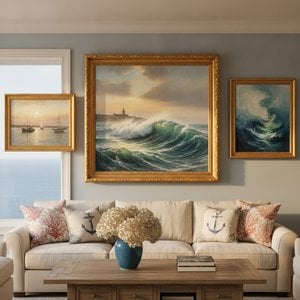 Bring the Ocean Home: Captivating Maritime Paintings to Transform Your Space with Timeless Elegance


