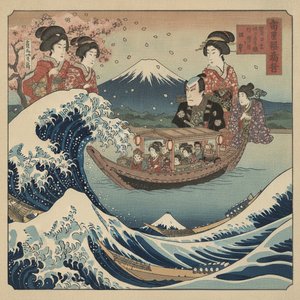
Ukiyo-e (Japanese: 浮世絵) is a genre of Japanese art that flourished from the 17th through 19th centuries. Its artists produced woodblock prints and paintings of such subjects as female beauties; kabuki actors and sumo wrestlers; scenes from history an...
To understand the heart of Japanese art from the 17th through the 19th centuries, one must first grasp the concept of ukiyo—the "floating world." This term, while originally rooted in Buddhist notions of the ephemeral and often sorrowful nature of existence, underwent a profound cultural transformation during the Edo period. As the Tokugawa shogunate brought unprecedented stability and economic growth to Japan, a new urban class emerged: the chōnin. These merchants, craftsmen, and workers, though positioned at the lower tiers of the formal social hierarchy, possessed the wealth to patronize a vibrant, hedonistic culture centered around the pleasure districts, Kabuki theaters, and teahouses.
The art of Ukiyo-e, or "pictures of the floating world," became the visual pulse of this era. It was an art form that celebrated the fleeting moment—the graceful curve of a courtesan’s neck, the dramatic tension of an actor's pose, and the rhythmic surge of a wave. These works were not merely decorative; they were windows into a society finding profound joy in the transient. Whether through the depiction of beautiful women, legendary warriors, or the quiet elegance of nature, Ukiyo-e captured a world in motion, immortalizing the very things that were destined to fade.
Technical Mastery: The Intricate Art and Alchemy of Woodblock Printing
Woodblock printing in Japan (木版画, mokuhanga) is a technique best known for its use in the ukiyo-e artistic genre, but it was also used for printing books in the same period. Invented in China during the Tang dynasty, woodblock printing was widely ado...
The creation of a masterpiece in the Ukiyo-e tradition was far from a solitary endeavor; it was a sophisticated industrial process requiring the seamless coordination of artist, carver, printer, and publisher. Unlike Western woodcuts that often utilized oil-based inks, the Japanese mokuhanga technique relied on water-based pigments. This distinction is vital to understanding the aesthetic soul of these prints. The use of water allowed for a breathtaking range of transparency, delicate glazes, and smooth gradations of color—effects known as bokashi—that are nearly impossible to achieve with heavier, opaque oils.
The labor involved was immense. A single complex print could require dozens, sometimes even hundreds, of separate hand-printings from different carved blocks. Each block corresponded to a specific color or tonal layer. For instance, the work of Chiura Obata in the early 20th century, while part of a later movement, demonstrates this enduring respect for the technique, where meticulous layering creates a sense of depth and luminosity. The precision required by the carver to translate an artist's fluid brushstroke into hard cherry wood is nothing short of miraculous. When these layers are perfectly aligned, the result is a harmonious balance of bold, decisive outlines and soft, atmospheric washes that breathe life into the paper.
Icons of the Edo Period: From Hokusai’s Landscapes to the Drama of Kabuki
Introduction To embark on a journey through the 25 most celebrated artworks of Katsushika Hokusai is to enter a world where ink blossoms into waves, mountains breathe with life, and everyday scenes resonate with profound beauty. These pieces aren’t m...
The pantheon of Ukiyo-e masters offers a diverse gallery of human experience and natural wonder. Perhaps no name resonates more powerfully than Katsushika Hokusai. His 1831 masterpiece, The Great Wave off Kanagawa, stands as a global icon of the movement. Within this print, we see the tension between the eternal—the stoic, snow-capped Mount Fuji—and the ephemeral—the claw-like foam of a crashing wave. Hokusai’s ability to infuse landscape with a sense of cosmic drama transformed the genre, moving it beyond urban portraiture into the realm of profound natural philosophy.
Beyond the landscapes, the genre thrived on the intimate and the theatrical. Artists like Okumura Toshinobu brought a subtle charm to the medium, focusing on the delicate details of everyday life and the romanticized allure of the Kabuki stage. His works offered a glimpse into the social fabric of Edo, capturing the energy of the streets and the intimacy of private moments. Similarly, the legendary Utagawa Kuniyoshi utilized the medium to explore the supernatural, creating haunting narratives where yurei (ghosts) emerge from waterfalls to confront brave samurai. This spectrum—from the serene beauty of a bird perched on a branch in Obata's work to the visceral terror of Kuniyoshi’s spectral encounters—illustrates the incredible breadth of the Ukiyo-e tradition.
Cultural Crossroads: How Japanese Prints Reshaped Western Modernism
Introduction Imagine walking through the neon-drenched streets of modern Tokyo, where every vibrant billboard and graphic anime frame carries a hidden DNA of the past. Long before the digital glow of our screens, there was Ukiyo-e —the art of the 'Fl...
As Japan began to emerge from its period of isolation during the late 19th century, a profound cultural exchange known as Japonisme swept through Europe. The arrival of Ukiyo-e prints in the hands of Western artists acted as a catalyst for a revolution in modern art. The masters of Impressionism and Post-Impressionism—including Claude Monet, Edgar Degas, and Vincent van Gogh—found in these Japanese prints a completely new visual vocabulary.
The "unconventional" perspectives of Ukiyo-e—the flattened planes of color, the bold use of negative space, and the asymmetrical compositions—challenged the long-standing Western obsession with linear perspective and chiaroscuro. Artists were inspired by the way Ukiyo-e artists could suggest depth through overlapping forms rather than shadows. This influence is visible in the graphic punch of modern design and the cinematic framing of contemporary animation. The legacy of these prints traveled across oceans, fundamentally rewiring the global aesthetic DNA and proving that the "floating world" was, in fact, a permanent fixture in the history of human creativity.
The Enduring Legacy: Ukiyo-e's Influence on Contemporary Visual Language
Introduction To step into the world of Ukiyo-e is to enter a realm of floating delights, where the ephemeral beauty of a passing moment is captured forever in ink and pigment. The term itself, translating to "pictures of the floating world," evokes t...
Today, the echoes of the Edo period are found in the most unexpected places, from the vibrant palettes of modern street art to the stylized aesthetics of Japanese manga and anime. The fundamental principles of Ukiyo-e—the celebration of line, the mastery of color, and the ability to find the sublime within the ordinary—continue to resonate. We see this influence in the way contemporary artists use bold outlines and flat colors to create high-impact imagery that commands attention in a crowded digital landscape.
The Ukiyo-e tradition serves as a meditative reminder of our own connection to the transient. In an age of rapid technological change, these prints invite us to pause and appreciate the beauty of the passing moment. Whether it is through a meticulously reconstructed oil reproduction of Hokusai's landscapes or a custom portrait that adopts the stylistic flair of the Utagawa school, the spirit of the floating world remains alive. It continues to inspire collectors and decorators alike to bring a sense of historical depth, technical excellence, and soulful elegance into the modern living space.
For professionals seeking to enhance corporate or hospitality environments with high-quality, museum-grade reproductions, ArtsDot.com offers an extensive catalog of hand-painted works. From large-format murals to custom multi-panel sets, we provide reliable, scalable art solutions for global procurement needs.
Journey through the floating world with our curated guide to 10 Ukiyo-e masterpieces. From Hokusai’s waves to Hiroshige’s landscapes, explore the stories behind these iconic Japanese woodblock prints. Find museum-quality reproductions for your decor at ArtsDot.com.
Explore the profound beauty of Japanese Ukiyo-e. From Hokusai's iconic waves to the elegance of the Edo period, discover the history and masters behind the 'Floating World' in this expert art-history guide for collectors and enthusiasts.
Journey through the 'Floating World' with our curated guide to 10 Ukiyo-e masterpieces. From Hokusai’s waves to Hiroshige’s landscapes, explore the stories behind these iconic woodblock prints. Find museum-quality reproductions for your decor at ArtsDot.com. Explore the full collection online.
Explore the profound beauty of Japanese Ukiyo-e. Discover the history, masters like Hokusai, and the enduring legacy of the 'Floating World' through an expert art-historical lens.
Journey through the soul of Japan with our curated guide to the 25 greatest works by Katsushika Hokusai. From The Great Wave to iconic ukiyo-e landscapes, explore the stories behind these timeless masterpieces and find museum-quality art reproductions on ArtsDot.com.



 Ukiyo-e
 Woodblock printing in Japan
 Hokusai's Masterpieces: 25 Iconic Prints & Paintings for Art Lovers | ArtsDot
 10 Iconic Ukiyo-e Masterpieces That Defined Japanese Woodblock Art
 10 Iconic Ukiyo-e Masterpieces That Defined Japanese Art