The Calligraphic Foundation: From Disciplined Script to Fluid Landscape Ink wash painting Ink wash painting (simplified Chinese: 水墨画; traditional Chinese: 水墨畫; pinyin: shuǐmòhuà) is a type of Chinese ink brush painting which uses washes of black ink,...
The history of ink wash painting does not begin with the depiction of a mountain or a river, but within the rhythmic, disciplined pulse of calligraphy. Long before the brush sought to render the texture of bark or the translucency of mist, it was used to trace the precise, structural characters of ancient courts. This movement evolved from a scholarly pursuit of calligraphic precision into a sophisticated visual language where the stroke is a temporal record of human intention meeting elemental flow. In the hands of a master, the transition from writing to painting is seamless; the same controlled pressure that forms a character can just as easily define the delicate vein of a leaf or the heavy, brooding weight of a storm cloud.
This lineage finds its roots in the Tang dynasty, where the movement overturned earlier, more realistic techniques in favor of something far more elusive: the spirit of the subject. As monks and court painters integrated fluid brushwork with a burgeoning spiritual consciousness, the simple act of writing transformed into a visual language capable of rendering the mist of a mountain or the delicate vein of a leaf with equal authority. This evolution reached new heights during the Song dynasty and eventually migrated to Japan in the 14th century via Zen Buddhist monks, establishing a tradition where the brushstroke is never merely a mark, but an expression of vitality.
Elemental Alchemy: The Interplay of Soot, Water, and Paper
The Genesis of the Stroke: Tracing the Historical Lineage of Ink Wash Painting To witness the first contact of a moistened brush against raw paper is to observe a primordial dance, one that has unfolded across centuries of East Asian history. The lin...
To witness the first contact of a moistened brush against raw paper is to observe a primordial dance. The transcendence of the artwork is inextricably linked to the tactile reality of its creation, a palette composed not of heavy pigments, but of elemental materials: soot, hair, and fiber. Sumi ink, often crafted from the precious residue of burnt pine or vegetable oils, possesses a depth that modern synthetics struggle to replicate. When this ink meets water on the surface of rice paper, a chemical and visual transformation occurs, creating a world of texture and atmosphere.
The artist’s mastery lies in manipulating these simple elements to achieve complex results. By adjusting the proportion of water to ink, the final image varies between light and dark, wet and dry, and thick and thin. This technique allows for a range of shades that can produce astonishing variations in tonality, from deep, saturated blacks to silvery grays. The materials themselves demand respect; the paper must be absorbent enough to capture the bleed of the ink yet resilient enough to hold the structural integrity of a sharp, angular stroke.
Monochrome Depth: The Technical Mastery of Tonality
Ink wash painting (simplified Chinese: 水墨画; traditional Chinese: 水墨畫; pinyin: shuǐmòhuà) is a type of Chinese ink brush painting which uses washes of black ink, such as that used in East Asian calligraphy, in different concentrations. It emerged duri...
In the realm of monochrome ink wash, what remains unpainted is often as significant as what is rendered in black. Achieving depth without color requires an intense focus on tonality and shading, achieved through varying the ink density. This is accomplished both by the differential grinding of the ink stick in water and by varying the ink load and pressure within a single brushstroke. A single stroke can produce a spectrum of tones, creating a sense of three-dimensional form through nothing more than light and shadow.
This technical precision allows for a unique approach to perspective. In many traditional landscapes, the style is impressionistic for distant objects—where mountains dissolve into hazy, indistinct shapes—yet becomes strikingly realistic for nearby elements. This creates a sense of immense scale; a painting spanning several meters can suggest a landscape of thousands of li. The interplay of dense ink and light washes creates a dynamic visual rhythm, providing the viewer with a sense of atmospheric depth that feels both physically present and spiritually distant.
The Architecture of Absence: Navigating the Active Void
The Enigmatic Brush of Tōensai Kanshi Tōensai Kanshi is a contemporary Japanese artist whose work embodies a profound connection to the traditions of *sumi-e* ink painting, yet simultaneously pushes beyond its established boundaries. Born in Japan (t...
Central to understanding this medium is the concept of ma—the active void. In Japanese aesthetics, emptiness is not simply the absence of something; it is an active, breathing participant in the composition. Unlike Western traditions that frequently view empty space as a vacuum to be filled with pigment and light, the mastery of ink wash treats the white expanse of the paper as a vital element. It is the silence between musical notes, the stillness between breaths.
By utilizing negative space, the artist invites the imagination to complete the landscape, allowing the mist to settle where no brush has traveled and the horizon to dissolve into infinity. This intentional minimalism serves a higher purpose: it strips away the superficial clutter of the material world to reveal an underlying spiritual truth. The void provides the necessary breathing room for the subject to exist, creating a sense of profound stillness and meditative calm that anchors the entire composition.
Works of bamboo painting, usually in ink, are a recognized genre of East Asian painting. In a work of bamboo painting in ink, a skilled artist and calligrapher will paint a bamboo stalk or group of stalks with leaves. The contrast between the foregro...
The subjects chosen for ink wash painting are rarely mere decorations; they carry immense symbolic weight. The "four gentlemen"—bamboo, plum blossom, chrysanthemum, and orchid—are frequently employed to represent virtues such as resilience, elegance, and humility. Bamboo, in particular, is a recognized genre of its own. A skilled artist uses the stalks and leaves to demonstrate mastery, yet the true goal is to suggest the essence of the plant: its ability to bend with the wind and storm without ever breaking.
This symbolism extends to larger landscapes, where mountains and rivers represent the eternal and the flowing. In works like those by the contemporary artist Tōensai Kanshi, these motifs are often reinterpreted through a more personal lens, incorporating abstract elements that suggest a nuanced, modern symbolism. Whether it is the "Three Friends of Winter"—bult comprising bamboo, pine, and plum blossoms—or the depiction of a solitary figure in a landscape, every element is chosen to reflect a state of mind or a moral ideal, turning the act of painting into an act of self-cultivation.
Modern Echoes: The Evolution of Sumi-e in Contemporary Practice
A Vision of Serene Solitude Ephemeral Shadows of Bamboo Amidst a Muted and Meditative Ink Wash Mist is a profound exploration of stillness and atmospheric depth. This new creation from the ArtsDot.com Studio reimagines the classic Sumi-e modern styl...
While rooted in ancient tradition, ink wash painting continues to evolve through the hands of contemporary practitioners. Modern artists are not merely replicating historical styles; they are deconstructing and rebuilding upon established conventions. We see this in the work of Laurent Garnier, whose 2026 creation, Ephemeral Shadows of Bamboo Amidst a Muted and Meditative Ink Wash Mist, reimagines the classic Sumi-e style with a fresh, contemporary perspective. Here, the dark charcoal bamboo stalks emerge from an ethereal fog, using a monochromatic palette of sepia and charcoal to evoke a quiet melancholy.
This evolution also finds resonance in the West. The fascination with ink wash painting influenced American modernists like Arthur Wesley Dow and his student Georgia O'Keeffe, helping to free them from purely "story-telling" approaches to art. Today, whether through the disciplined, meditative practice of Japanese masters or the experimental textures found in modern studio works, the power of the ink stroke remains undiminable. It continues to offer a way to capture the ephemeral essence of life, proving that true impact does not require scale or complexity, but an unerring truth found in the simplest of marks.
For those looking to bring this sense of profound stillness into their own collections, ArtsDot.com offers a curated selection of works that honor these traditions while embracing modern perspectives. From hand-painted oil reproductions that capture the physical texture of every brushstroke to unique, one-of-a-kind studio creations, we provide the means to connect with the enduring soul of ink and paper.
Discover the exclusive collection of Laurent Garnier at WahooArt. Experience master-style interpretations of modern Sumi-e ink wash art, celebrating flow and emptiness.
Discover Hakuin Ekaku (1686-1769), a pivotal Zen Buddhist monk & artist who revitalized the Rinzai school. Explore his calligraphy, koan paintings, and lasting influence on Japanese art & …
Journey through the soul of Japan with our curated guide to the top 25 Katsushika Hokusai masterpieces. From The Great Wave to iconic ukiyo-e prints, explore the stories behind these timeless woodblock legends. Find museum-quality reproductions on ArtsDot.com.
Embark on a sophisticated exploration of ink wash painting and Sumi-e. Uncover the profound historical lineages, Zen philosophies, and technical mastery behind this timeless medium in our authoritative guide for fine art enthusiasts.
Discover the serene beauty of Wabi-Sabi with our exquisite AI-enhanced ink-wash heritage art. We blend ancient Sumi-e traditions with modern innovation to create hand-painted oil reproductions that bring profound tranquility and timeless Zen elegance to your home collection.



 Mastering the Void: The Technical Depth and Historical Resonance of Ink Wash Painting
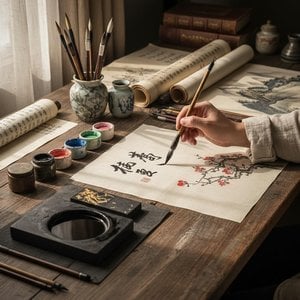 The Alchemy of Ink: Mastering the Timeless Beauty and Art History of Paper and Brush
 Ink wash painting
 Tōensai Kanshi
 Bamboo painting
 Ephemeral Shadows of Bamboo Amidst a Muted and Meditative Ink Wash Mist


