From Commissioned Glory to Gritty Reality: The Evolution of Industrial Subject Matter
The history of industrial painting began not with a desire to document hardship, but as an exercise in prestige. During the early stages of the Industrial Revolution, the landscape was often viewed through the lens of progress and prosperity. Wealthy industrialists frequently commissioned works that functioned as visual endorsements of their enterprises. These paintings were intended for company offices and boardrooms, presenting an idealized version of the factory or the mill. They focused on the sheer scale of production, often using exaggerated imagery to suggest a sense of unstoppable momentum. This era of romanticized industry finds a contemporary echo in the way we view modern corporate architecture. Just as the nineteenth-century mill owner sought to project strength through oil on canvas, today’s global corporations use sleek, glass-fronted headquarters to signal stability and transparency. The intent remains remarkably similar: using the built environment to communicate a specific identity. While the medium has shifted from heavy oils to architectural photography and digital rendering, the impulse to use industrial scale as a symbol of power persists.The Architecture of Smoke: Tracing the Lineage of the Urban Skyline
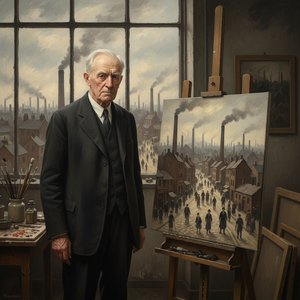
As the century progressed, the focus shifted from the singular factory to the collective weight of the city itself. The skyline became a dense forest of chimneys and structures that defined the boundaries of urban life. In towns like Bolton, the landscape was a thicket of cotton mills, foundries, and steelworks that crowded the horizon. This density created a new kind of visual language, one where the sky was rarely clear, often obscured by the constant output of coal-fired furnaces. We see this same structural density reflected in our modern metropolitan centers, though the materials have changed. Where once there were brick chimneys, we now have steel towers and cranes. The way an artist like Samuel Towers depicted the "forest of chimneys" from Queen's Park reminds us that the skyline is a living record of what a society values at any given moment. Today, as we navigate cities defined by retail hubs and distribution centers, we are still reading the same story of human organization written in stone and metal.Atmospheric Truths: Capturing Light and Haze in Mechanical Landscapes
Capturing the true essence of an industrial site requires more than just drawing a building; it requires capturing the air around it. For artists like L.S. Lowry, the atmosphere was central to the work. He utilized a palette that often leaned toward the drab, using grays and hazy whites to recreate the specific, heavy light of Manchester and Salford. This was not merely about color, but about the weight of the moisture and soot in the air. The goal was to find a certain effect on the canvas that a camera, in its literalness, could not achieve. This pursuit of atmospheric truth finds a parallel in the way we experience our current environments. We are still deeply affected by the "weather" of our urban spaces—the way smog, fog, or even the glare of streetlights alters our perception of reality. Just as Lowry sought to move beyond a simple photographic record to find a personal impression, modern observers look for the mood within the haze. The ability to see the subtle tonal relationships in a gray sky allows us to find beauty in what others might dismiss as bleakness.The Solitary Figure: Finding Humanity Amidst the Machinery
L.S. Lowry | Industrial Landscapes, Urban Scenes & Figures
Within these vast, mechanical landscapes, there is often a profound sense of isolation. In many of Lowry’s compositions, we encounter small, stick-like figures moving through the shadows of factories and tenements. These figures are not protagonists in a grand drama; they are participants in the quiet, repetitive rhythms of everyday life. Their presence highlights the tension between the massive, unyielding scale of industrial architecture and the fragile, transient nature of the individuals who inhabit it.
This sense of the individual within a larger system is a recurring theme in our modern social fabric. Whether we are walking through a crowded transit hub or sitting alone in a vast digital network, the feeling of being a small part of a much larger, impersonal machine remains. Art allows us to hold this contradiction—the coexistence of massive structural power and individual human experience—without needing to resolve it. It provides a space to acknowledge both the strength of the collective and the solitude of the person.
--- title: L.S. Lowry | Industrial Landscapes, Urban Scenes & Figures | Britannica author: Britannica Editors url: https://www.britannica.com/biography/L-S-Lowry hostname: britannica.com description: L.S. Lowry was an English painter noted for his in...