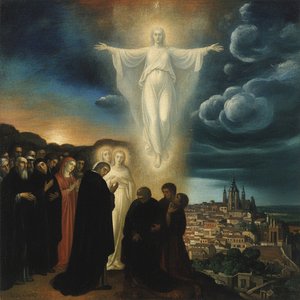
Introduction Step into a space where the boundaries between the earthly and the divine begin to blur. To explore religious art is not merely to study history; it is to embark on a journey through the deepest corridors of the human soul. For centuries...
To encounter sacred art is to engage with a visual vocabulary that transcends mere decoration, acting instead as a profound bridge between the earthly and the eternal. These works are not merely seen but read, much like a theological sentence where every detail serves as a deliberate syllable. For centuries, the canvas has functioned as a window, capturing moments of profound transcendence and quiet devotion. Whether through the dramatic interplay of light and shadow in a Baroque composition or the serene, symbolic stillness of an ancient icon, religious art seeks to give form to the formless.
The subject of the Holy Family became particularly prominent in the 1490s, offering a focal point for Christian iconography that emphasized intimacy and domestic piety. This period saw artists navigating the mysteries of faith, translating the intangible light of grace into something tangible. These paintings were never intended as mere ornaments; they were vessels for storytelling and tools for meditation, reflecting the collective hopes of entire civilizations. By studying these works, we do not simply observe history; we witness the profound whispers of the human spirit.
Northern Precision: Dürer and the Sanctity of the Everyday
A Portrait of Domestic Devotion: Albrecht Dürer’s Holy Family Albrecht Dürer's Holy Family stands as a profoundly intimate and remarkably prescient depiction of the Christian narrative, born from the heart of the German Renaissance. Painted during a ...
In the heart of the German Renaissance, Albrecht Dürer brought a revolutionary commitment to observing the world with startling realism. His approach to the Holy Family was characterized by a deep humanism, where the sacred was found within the textures of the mundane. In his Holy Family, one finds a darkened room that suggests both privacy and contemplation, presenting Mary, Joseph, and the infant Jesus with an almost unsettling accuracy. Dürer’s technical brilliance is evident in his use of oil paints, employing layering and glazing to achieve a sense of depth and luminosity that draws the viewer into the scene.
Dürer’s mastery extended far beyond color; he utilized meticulous cross-hatching—a technique perfected in his woodcuts—within darker areas to add incredible texture and visual complexity. This method foreshadowed later developments in chiaroscuro by demonstrating how light interacts with physical surfaces. In other works, such as The Holy Family in a Hall, his command of line creates a monumental architecture that serves as a symbolic representation of divine space. Through the precise rendering of every fold in a garment or the texture of a beard, Dürer proved that art could be both beautiful and profoundly truthful to the natural world.
Flemish Shadows: The Enigmatic Workshops of the Netherlandish Tradition
The Enigmatic Master of the Holy Blood The identity of the “Master of the Holy Blood” remains one of art history’s most enduring mysteries, a shadowy figure whose workshops flourished in 15th-century Bruges. Active between approximately 1510 and 1520...
Moving toward the workshops of 15th-century Bruges, we encounter a different kind of devotion, one defined by mystery and meticulous detail. The "Master of the Holy Blood" remains one of art history’s most enduring enigmas, representing a collective of painters whose work blended Flemish realism with nascent Renaissance ideals. Their paintings, such as the Descent from the Cross, are notable for a dramatic use of light and shadow that creates a sense of profound sorrow and vulnerability. These artists borrowed heavily from earlier masters like Rogier van der Weyden, yet they introduced a more dynamic spatial arrangement and an emphasis on emotional expression.
Similarly, the "Master of Frankfurt" offers a glimpse into the intimate domesticity of the Northern Renaissance. This artist specialized in scenes that focused on quiet moments within meticulously rendered interiors, often featuring recognizable views of Frankfurt to anchor the spiritual narrative in a tangible reality. The palette favored by such workshops—rich, saturated reds, blues, and golds—was applied with a precision that highlighted the textures of skin and fabric. These works remind us that the sacred does not always require grand, sweeping narratives; often, it is found in the crowded, small spaces of a shared, holy moment.
Spiritual Intensity: El Greco and the Baroque Transformation
Subject and Composition This captivating masterpiece vividly depicts the sacred moment of the Holy Family, featuring Mary, Joseph, the infant Jesus, and two young children, likely saints or symbolic figures. Arranged in a harmonious triangular compos...
As the sixteenth century gave way to the seventeenth, the visual language of faith underwent a dramatic shift toward the theatrical and the emotionally charged. El Greco, a figure shaped by Byzantine iconography and Italian Renaissance masters, became a defining voice of this transformation. His 1601 work, The Holy Family with St. Anne and the Young St. John the Baptist, exemplifies the Mannerist style through its use of elongated figures and expressive brushwork. The composition is arranged in a harmonious triangle, drawing the eye toward the central focus: the tender infant Jesus held by Mary.
In El Greco’s hands, light becomes a tool for spiritual intensity. He employs bold, fluid lines and a palette of warm reds and earth tones to create a luminous effect that enhances the sacred atmosphere. This period also saw the rise of tenebrism, where intense contrasts between light and shadow were used to heighten the drama of the scene. The emotional tone in such Baroque works is often profound, capturing moments filled with hope, innocence, and divine grace, inviting the viewer into a narrative that feels both immediate and eternal.
A halo (from Ancient Greek ἅλως, hálōs, 'threshing floor, disk'), also called a nimbus, aureole, glory or gloriole (Latin: gloriola, lit. 'little glory'), is a crown of light rays, circle or disk of light that surrounds a person in works of art. The ...
To truly understand these works, one must learn to decode their iconography—the study of identifying and interpreting the content of images. Every element is imbued with symbolic meaning, from the direction of a gaze to the presence of specific objects. For instance, in some depictions of the Holy Family, the subtle inclusion of a basket of eggs can enhance themes of purity, new life, and resurrection. Even the use of a halo, or nimbus, serves as a codified language to indicate sacred figures, appearing as a circular glow or even flames in certain traditions.
These symbols act as a visual liturgy. The placement of a figure or the way light illuminates a face carries the weight of scripture. In the Byzantine and Orthodox traditions, this precision is particularly evident, where every detail is a deliberate syllable in a larger theological sentence. By recognizing these patterns—the protective gesture of a hand or the symbolic use of light—the viewer moves from being a passive observer to an active participant in a sacred dialogue.
Architectural Echoes: The Church as a Vessel for Art and Faith
A Sanctuary of Timeless Grace In the heart of Sopron, where the cobblestone streets whisper tales of centuries past, stands the Holy Spirit Church, a breathtaking testament to the enduring power of sacred architecture. To step within its walls is to ...
The setting for much of this art is the architecture itself, which serves as a silent narrator of devotion. In places like the Holy Spirit Church in Sopron, Hungary, the structure becomes a dialogue between different eras, blending medieval foundations with later elegance. Here, light and stone perform a silent dance, creating an atmosphere of profound stillness. The integration of sculptural elements and the use of natural light to accentuate sacred forms demonstrate how architecture provides the framework for spiritual aspiration.
This connection between space and art is also evident in the Sacred Art Museum of Funchal, where the museum’s very bones provide a backdrop for a collection that chronicles religious traditions. In such spaces, the interior functions as a living gallery, where altars adorned with intricate carvings and gilded details command attention. Whether through the strength of medieval arches or the ornate elegance of later periods, these architectural settings ensure that the art is not merely viewed, but experienced within a realm of historical gravity and aesthetic beauty.
At ArtsDot.com, we appreciate the profound depth found in these historical traditions. We invite you to explore our collection of hand-painted reproductions and custom commissions, where the techniques of the old masters are honored through meticulous craftsmanship.
Journey through the spiritual intensity of El Greco’s greatest works. From Mannerist drama to luminous colors, explore 25 iconic masterpieces and find museum-quality reproductions for your collection. Discover all masterpieces on ArtsDot.com.
Journey through the Northern Renaissance with our curated guide to the 25 greatest artworks by Albrecht Dürer. From iconic woodcuts to profound self-portraits, explore the mastery behind these timeless classics. Find museum-quality reproductions at ArtsDot.com. Explore the full collection online.
Journey through the spiritual intensity of El Greco's greatest works. From Mannerist mastery to dramatic light, explore 25 iconic paintings and find museum-quality reproductions for your collection. Discover all masterpieces on ArtsDot.com.



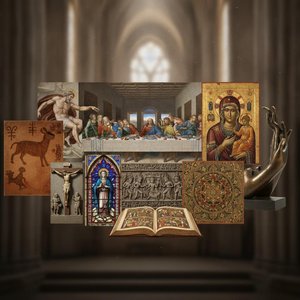 Divine Visions: Top 10 Masterpieces Exploring Religious Themes
 Holy Family
 Master Of The Holy Blood
 The Holy Family with St. Anne and the Young St. John the Baptist
 Halo (religious iconography)
 Holy Spirit Church