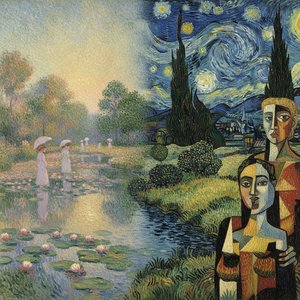
Explore Degas' meticulous 'Drapery Study,' a preparatory sketch for his ambitious 'Semiramis Building Babylon.' Witness the artist’s mastery of form & fabric folds.
Before a canvas receives its final layer of glaze, there exists the raw, unadorned truth of the initial mark. In the studios of the Old Masters, the preparatory sketch was never merely a blueprint; it was an investigation of form and weight. A single charcoal stroke could dictate the tension in a subject's shoulder or the heavy drape of a velvet sleeve. This early discipline taught us that the line is not a boundary, but a carrier of intent. When we look at these foundational studies, we see the artist’s first decision—a moment where thought begins to solidify into physical presence.
This fundamental reliance on the initial impulse remains the bedrock of all meaningful painting. Whether one is working with the precise anatomical rigor of a classical portrait or the looser, more experimental strokes of a modern landscape, the integrity of the mark determines the integrity of the work. A line that wavers without purpose lacks the conviction required to hold a viewer's gaze. To master the brush is to understand that every movement must be deliberate, even when it appears spontaneous.
Fluidity and Light: The Impressionist Influence of Berthe Morisot
As the nineteenth century progressed, the rigidity of the studio gave way to the light-drenched reality of the outdoors. Berthe Morisot, a central figure among the French Impressionists, moved away from the heavy, finished surfaces of her predecessors toward a method that embraced fluidity. Her brushwork often appeared translucent, with strokes that seemed to float across a prepared linen ground. By utilizing the thixotropic properties of lead white, she achieved a particular drag and pull, creating surfaces where paint was applied thinly at first, then built up with a rhythmic, visible energy.
Morisot’s technique reminds us that light is never static; it is a series of fleeting impressions. Her ability to layer colors without losing the clarity of the underlying strokes allowed her to capture the very essence of atmosphere. This approach finds its echo in our own contemporary appreciation for texture and movement. When we commission a hand-painted reproduction, we look for that same sense of life—the way a brushstroke catches the light and suggests a world in motion rather than a frozen, lifeless image.
The Kinetic Impulse: Abstract Expressionism and the Physicality of Paint
--- title: Gestural | Tate author: Eric de Chassey url: https://www.tate.org.uk/art/art-terms/g/gestural hostname: tate.org.uk description: Tate glossary definition for gestural: Term used to describe the application of paint in free sweeping gesture...
In the twentieth century, the line underwent a radical transformation, shedding its duty to represent objects and instead becoming an embodiment of the artist's physical state. The movement known as Abstract Expressionism, or action painting, brought the body into the very center of the composition. Artists like Jackson Pollock used sticks, dried brushes, or even direct pours from a can to trail paint across the canvas. Here, the gesture was no longer just an imitation of emotion; it was the emotion itself, recorded in the sweeping, frantic, or controlled paths of pigment.
This era proved that the artist's inner impulse could be read through the residue of their movements. As Willem de Kooning suggested, the act of painting allows for the accumulation of drama, pain, and love within a single mark. This kinetic energy creates a dialogue between the creator and the observer, where the viewer does not merely look at a scene but experiences the momentum of its creation. It is a profound reminder that art is a living process, an echo of a human moment captured in oil and pigment.
Texture as Language: The Emotional Resonance of Impasto
There is a specific language found in the thickness of paint, a tactile vocabulary known as impasto. When paint is applied with enough body to stand off the canvas, it creates shadows within the painting itself. This depth changes how we perceive volume and weight. A heavy, textured stroke can convey a sense of struggle or permanence, while a smoother, more blended area might suggest softness or decay. The physical topography of the surface becomes as important as the color palette.
This reliance on texture finds its roots in the classical tradition of building layers to create depth, yet it reaches its most expressive peak when the artist allows the medium to dictate its own form. In our studio, we see this daily; our artists use 100% cotton canvas and high-quality oils to ensure that every ridge and valley of a brushstroke remains preserved. This physical presence is what distinguishes a hand-painted work from a flat, digital print. The texture invites the eye to wander, finding meaning in the way the light hits each individual peak of pigment.
The Enduring Line: Maintaining Tradition in a Modern Context
While styles may shift from the meticulous precision of the Renaissance to the wild gestures of the modern era, the core principle remains unchanged: the brushstroke is an instrument of truth. We live in an age of rapid reproduction and digital perfection, where much of what we see is smoothed of all character. Yet, there remains a deep, instinctive pull toward the imperfect, the textured, and the human. We seek out the marks that show the hand of the maker, recognizing them as the only true way to convey lasting meaning.
At ArtsDot.com, we honor this continuity by bridging the gap between historical technique and modern living. Whether through a custom portrait that reimagines a personal memory in the style of Rembrandt or a large-scale mural that brings the grandeur of classical frescoes into a contemporary home, our focus remains on the integrity of the craft. We believe that the power of the brushstroke is not a relic of the past, but a vital, breathing element of the present, capable of transforming any space with its quiet, enduring strength.
Discover the exclusive collection of Noiret at WahooArt. Explore premium abstract reproductions featuring modern non-representational art and profound chromatic depth.
Discover the exclusive collection of Laurent Lefèvre at WahooArt. Experience breathtaking Abstract Expressionism defined by gestural movement and emotional spontaneity.
Explore the transformative era of Post-Impressionism. Discover how masters like Van Gogh moved beyond light to embrace emotion, structure, and vibrant color, redefining modern art history through expressive brushwork and symbolic depth.
Explore the profound history of iconic drawings. From Renaissance anatomical studies to modern expressive lines, discover how the humble sketch captures the soul of art history through an expert lens. Perfect for collectors and enthusiasts seeking deep artistic insight.
Discover the intersection of technology and tradition. Transform your photos into meticulous AI-powered sketch art and hand-painted oil masterpieces. ArtsDot offers professional, museum-quality reproductions that turn personal memories into timeless, bespoke legacies for your home.
Explore the profound connection between technique and emotion. From the sculptural depth of impasto to classical mastery, decode the language of brushstrokes through an expert lens of art history and fine art connoisseurship.



 Drapery Study. Study for Semiramis Building Babylon