A vibrant display of communal awe and celestial creation unfolds in Jacob Lawrence's 1989 masterpiece Genesis Creation Sermon IV, inviting you to bring this powerful piece of American art history into your collection.
To encounter a figure in art is to engage with more than mere anatomy; it is to meet a deliberate construction of intent. Whether carved from jade or rendered in oil, the presence of a subject relies on a specific tension between the physical form and the unseen character it projects. This aura is rarely accidental. It is built through the careful manipulation of weight, gaze, and posture, creating a sense of permanence that resists the decay of time.
In the earliest iterations of human expression, this presence was often found in the subtle, mysterious details of small-scale objects. Consider a jade figurine from the Shijiahe culture, unearthed from the Hubei province. Its face, with eyes slided into an inverted figure-eight shape and a square, slightly closed mouth, does not demand attention through scale but through a profound, quiet dignity. Such works remind us that presence can be concentrated in a single, enigmatic expression, offering a window into a way of being that feels both ancient and immediate.
Ancient Authority: Idealized Forms from Egypt to Rome
The Genesis of Likeness: Portraiture in Antiquity and the Renaissance Wikipedia: Portrait painting Portrait painting is a genre in painting, where the intent is to represent a specific human subject. The term 'portrait painting' can also describe the...
As civilizations expanded, the language of presence grew more structured and overtly political. In ancient Egypt, portraiture served the eternal. The pharaohs were not depicted as mere mortals subject to the whims of biology, but as divine entities. Through the use of rigid poses, the nemes headdress, and symbolic regalia, these stone and painted figures projected an unshakeable connection to the gods. Their presence was a tool of stability, designed to ensure continuity in both the earthly and spiritual realms.
The Romans refined this approach, shifting the focus toward civic duty and ancestral lineage. The Roman bust became a medium for authority, where the realism of a weathered face could communicate the wisdom of a statesman or the grit of a commander. These were not just likenesses; they were political statements. By emphasizing strength and gravitas, Roman sculptors ensured that the memory of their leaders would function as a permanent fixture of the state's identity, much like the architectural permanence we see in later eras.
The Renaissance Revolution: From Devotion to Individual Identity
The Renaissance Rediscovery: From Civic Duty to Individual Likeness For centuries, the human face held little individual significance within the broader tapestry of religious iconography. Portraits existed primarily as donor figures within larger nar...
For centuries, the human figure in Western art functioned primarily as a vessel for religious narrative. Figures were often standardized, their individual features secondary to their role within a sacred scene. The Renaissance disrupted this hierarchy. Driven by Humanism, artists began to isolate the individual, moving away from purely symbolic representation toward a celebration of unique identity and earthly agency.
This shift was visible in the way artists like Hans Memling or Robert Campin integrated recognizable patrons into religious compositions. It was no longer enough to depict a saint; one had to capture the specific light hitting the cheek of the donor. This era introduced a new level of psychological depth, where the sitter’s presence was defined by their own humanity rather than just their piety. The development of techniques like sfumato allowed for a softening of edges, creating an atmospheric depth that made the figure feel as though they were breathing within the space of the painting.
Deciphering Status: The Visual Vocabulary of Power and Wealth
The Foundations of Royal Portraiture: Ancient Origins & Early Dynasties The Embodiment of Power: Exploring Representations of Status in Art History Explore the fascinating history of status symbols in art! Discover how Renaissance portraits conveyed ...
To look closely at a Renaissance or Baroque portrait is to read a complex code of social standing. Presence was often communicated through a meticulous arrangement of material wealth. The heavy drape of velvet, the shimmer of silk, and the precise placement of jewelry were not merely decorative; they were indicators of lineage and economic power. A single piece of lace could signal an entire network of trade and prestige.
Beyond clothing, the inclusion of specific objects—a book to denote intellect, a musical instrument to suggest refinement, or even a dog to signify fidelity—allowed the artist to craft a narrative of the sitter's character. In works like Titian’s portraits, we see how the interplay of texture and pose creates an image of a cultivated scholar or a powerful noble. The artist acted as a visual storyteller, using every brushstroke to reinforce the patron's desired self-image, ensuring that their social presence was legible to all who viewed the work.
Architectural Grandeur: Monumentalism as Civic Statement
Explore the Rhode Island State House: A neoclassical masterpiece steeped in history! Discover King Charles' Charter, "The Independent Man", and RI’s rich past on a guided tour of this architectural gem.
Presence extends beyond the canvas or the bust; it manifests in the stone and mortar of our cities. Monumentalism is an architectural approach designed to evoke weight through scale, symmetry, and durability. This style seeks to dominate the physical environment, projecting the authority of the institutions it houses.
The Rhode Island State House exemplifies this ambition. Designed by the firm McKim, Mead & White, its 187-foot marble dome and use of Georgia marble create an aura of permanence. Such structures are intended to be more than functional; they act as symbols of civic governance. Similarly, the works of Johannes Bildhauer in Germany utilized classical forms and monumental scale to reflect the imperial ambitions of his era, using stone to echo the strength of a nation. In these instances, presence is achieved through the sheer mass of the material and the disciplined geometry of the design.
The Psychological Portrait: Capturing Character Beyond the Surface
The Visionary Lines of a Renaissance Master To gaze upon Leonardo da Vinci’s "Recto: A study for the Trivulzio monument. Verso: A study for an equestrian monument" is to witness the very moment where thought transforms into form. This exquisite drawi...
As art progressed, the focus of portraiture moved from the external trappings of power to the internal landscape of the psyche. The challenge for the artist became capturing something far more elusive than a well-tailored coat: the inner character of the subject. This required a mastery of light and shadow to suggest depth of thought or emotional complexity.
Leonardo da Vinci’s studies, such as his preparations for the Trivulzio monument, demonstrate this transition. In his sketches, we see the restless intellect behind the form. Through the use of heavy pen lines and vaporous chalk, he explores the kinetic energy of life itself. He does not just draw a horse or a rider; he captures the potential for movement and the weight of thought. This ability to imbue a figure with an internal life is what separates a mere likeness from a true portrait of presence.
Counter-Narratives: The Rise of Anti-Monumentalism
Anti-monumentalism (or counter-monumentalism) is a tendency in contemporary art that intentionally challenges every aspect (form, subject, meaning, etc.) of traditional public monuments. It has been defined as art designed "not to uphold but negate s...
In the modern era, the very idea of the "monument" has been challenged. Anti-monumentalism emerged as a reaction against the authoritative and often exclusionary nature of traditional public art. This movement seeks to negate rather than uphold sacred or state-sanctioned values, often focusing on the more difficult, obscured parts of history.
Where traditional monuments emphasize permanence and glory, anti-monuments might utilize voids, absence, or fragmented forms to provoke reflection. They reject the idea of a finished, heroic narrative, opting instead for a more democratic and subjective engagement with memory. This tension between the imposing weight of the past and the critical, questioning lens of the present continues to shape how we perceive presence in our public spaces, ensuring that art remains a living, breathing dialogue rather than a static tribute.
At ArtsDot.com, we appreciate this entire spectrum of human expression. Whether you are drawn to the bold, high-impact energy of contemporarypop art or seeking a custom, hand-painted reproduction of a classical study, our collection is curated for those who value depth and character. From transforming your personal milestones into oil masterpieces to providing expert consultations for your next acquisition, we help you bring a sense of true presence into your own space.
Journey back to the dawn of Renaissance art! Explore 10 iconic Proto-Renaissance masterpieces by Giotto, Cimabue & Duccio. Discover their stories, techniques & lasting impact. Find museum-quality reproductions for your home at ArtsDot.com
Explore the profound psychological depth of Renaissance portraiture. From chiaroscuro to Venetian mastery, discover how historical techniques define identity and inspire modern custom oil painting reproductions.
Explore the fascinating history of power representation in art! Discover investment-worthy Renaissance masterpieces & expert insights for discerning collectors at ArtsDot.com.
Explore the fascinating history of portraiture, from its origins to the Renaissance's celebration of individuality. Discover symbolism, techniques & the enduring power of art to shape identity. Expert insights at ArtsDot.
Explore the fascinating history of aristocratic status depicted through European art (16th-19th centuries). Discover how artists reflected—and shaped—societal hierarchies. Expert insights for discerning collectors.



 Genesis Creation Sermon IV: And God Created the Day and the Night and God Creatied and Put Stars in the Skies
 The Enduring Legacy of Formal Portraiture: Power, Identity & Artistic Exploration
 The Grandeur of Presence: Exploring Representations of Stately Bearing in Western Portraiture
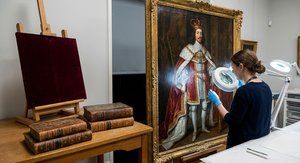 The Majesty of Representation: Exploring Regal Imagery in Art History
 Rhode Island State House
 Recto: A study for the Trivulzio monument. Verso: A study for an equestrian monument


